
Before bidding farewell to James Bond in No Time to Die, Daniel Craig had to tackle another mission with Spectre.
Skyfall was a miracle that exceeded all hopes of its backers. A global sensation, the film earned near-universal praise from audiences and the press, who, after having loathed Quantum of Solace, again sang the praises of the secret agent. People were even whispering here and there that it might be the best installment in the saga, the most beautiful, the most moving. For the producers there was no doubt: you don’t change a winning team. It was essential that the director Sam Mendes return to helm the project.
The stakes were even higher because 007 had to reconnect with love, but also with the greatest villain in the history of his wildly adventurous saga. In more ways than one, the franchise’s durability hung in the balance here. A $300 million investment later and a tidal wave of disappointment washing over fans’ hearts later, what happened?
WHAT IS IT ABOUT?
From an investigation conducted more or less covertly by James to prove the existence of the terrorist organization Spectre. He does so by setting Mexico City ablaze, which makes him re-evaluate his sense of the greater good. His high-octane adventure leads him to discover that this gang of criminals is more powerful than he imagined, but also closer to him than he had suspected. After interrogating a widow with her famous fighting spirit, he makes a terrible discovery.
The head of Spectre is none other than the jealous son of his former ski instructor, which underscores yet again that winter sports are a tricky business. While he loses all faith in humanity and in the ski lifts, 007 meets, saves, then crushes Madeleine, the daughter of Mr. White, with whom he falls in love while sipping an algae juice. But that won’t stop him from arresting the grand villain, all while foiling a plot aimed at trimming Britain’s defenses.

WHY IT WORKS
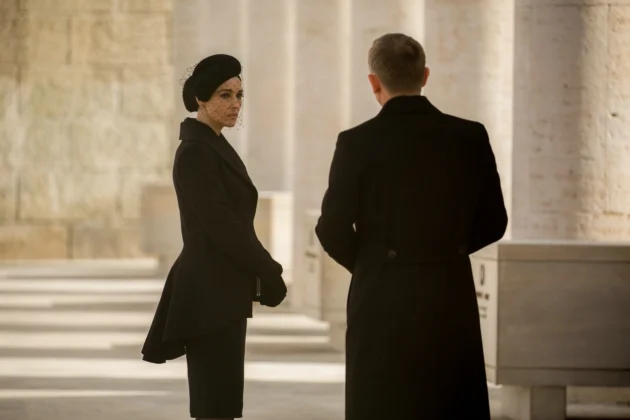
Sam Mendes sometimes tends to lean on a pompous, grandiose staging, but it proves highly effective when it comes to boosting Bond’s “class.” In this way, several seemingly classic scenes—on paper not always obviously dramatic—are elevated. Think, in particular, of the funeral gathering for Spectre, which takes on the air of a decidedly unsettling funeral celebration; or the film’s opening, which would pale in comparison were it not for the director’s flashy, dazzling single take, ideal for plunging you into the narrative.

More broadly, you can sense Mendes’ project to bring the franchise back from the solemn gravity of Skyfall toward a tone of relaxed bravado and flamboyance the series hadn’t seen in nearly three decades. This approach is especially evident in the gadgetry and the way the humor is stitched together. No matter the danger or the stakes of a scene, our favorite secret agent never loses his cool, delivering as many quips as sardonic grimaces.
Add to that the film doesn’t shy away from confronting the grotesque or owning it. The torture scenes with high-tech machines are almost as old as the character, and it takes all the director’s wit and craft to pull them off, despite a couple of implausibilities that are hard to swallow. But it doesn’t really matter that Bond endures having his brain probed by a drill—he does so with the charisma of a Brit who is rediscovering the secrets of his own cuisine.
WHY IT ISN’T SO GREAT
Spectre started off on a very rocky footing. The Sony hack in November 2014, just weeks before filming began, revealed tensions behind the scenes between the producers and the crew, over budget and the script. The script even leaked onto the web during that hacking storm, forcing the production to publicly acknowledge the situation and declare it was an older version.
Officially, this debacle supposedly had no consequences for the film, which went into production as planned right afterward. In reality, it’s quite likely it lit a fire under things, given what Spectre ended up looking like. The episode would be criticized at every turn, starting with the return of Blofeld.
Not that Christoph Waltz does a bad job, but choosing, to portray Bond’s ultimate nemesis, an actor who has been stuck in villain-roles for a decade, is a decision that signals a lack of vision, boldness, and imagination. We’re left with a lazy echo of Blofeld from yesteryear, who never has a shot at establishing himself, dragging along an origin story that’s more misfired than Pierre Brossolette.
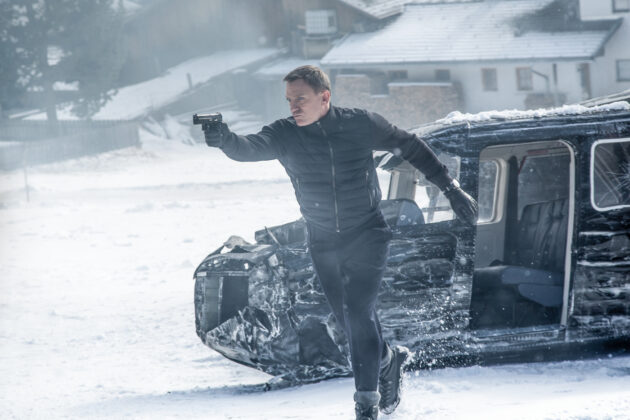
With the exception of a superb duel between Craig and Bautista, the action scenes in the film feel pale in comparison. The director had found just the right distance and involvement in the previous installment, aided by the decision to present most of them against the grain of traditional Bond-era sequences. But here there’s no longer talk of telling the brawls through the direction. And when Mendes has to orchestrate complex passages, his filming comes across as heavy-handed, utterly incompatible with the notion of grand spectacle.
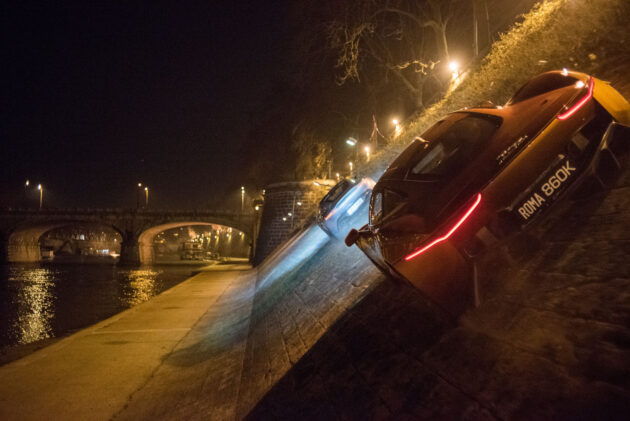
Even when he’s capable of skillfully handling a real plane on the set, breaking cars in the heart of Rome, or filming a massive explosion hyped as a brand-new pyrotechnic feat, the film never loosens its grip, and struggles to give these clashes any real impact.
BOX OFFICE
With roughly $880 million at the box office, Spectre is a success since it ranks as the second-biggest Bond outing at the box office (or fourth if inflation is taken into account). A success that seems logical, given the film benefited from the formidable reputation of Skyfall, which drew in audiences, and the promise of seeing a legendary villain on screen again.
Be warned, though: with a budget of $250 million, the film clearly aimed for the $1 billion mark, a score similar to its predecessor, which was about $50 million cheaper. A success, to be sure, but not a total triumph, and far from the glory hoped for.
In France, audiences didn’t hold back from checking out Bond’s latest adventure, with just under 5 million people filling the theaters. A figure that would make most productions jealous, but far from the 7 million who watched Skyfall. The same story in the US, where the chapter was warmly received, bringing in $200 million there—about $104 million less than its predecessor.
A CULT SCENE
The one standout action sequence of the film, the confrontation between James and Hinx, is rather exhilarating. Not only is the physical commitment of the leads entertaining to watch, but it also follows with a number of self-assured, well-executed nods to the golden era of the franchise. The luxurious set dressing gives the whole thing a charmingly old-fashioned feel, the arena evokes a grand scene from From Russia with Love, the villain has an impossibly silly name, the hits land hard, and people die with melodramatic flair.
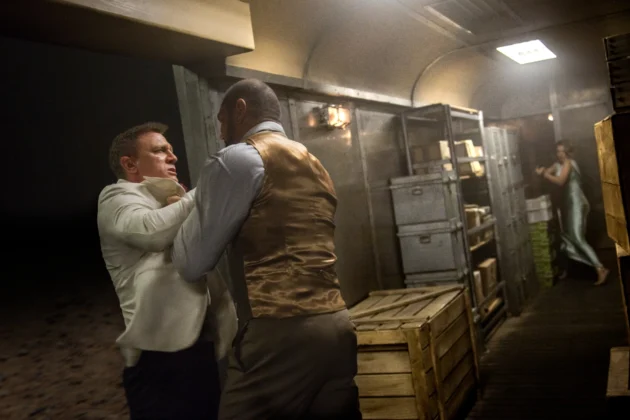
And to top this feast off, just after having pulverized nearly everything two bodies could reduce to pulp—without, of course, turning a human into meat pâté—Bond and Madeleine suddenly discover that spreading death is a little thrilling. All of it is bombastic, entertaining, flamboyant, utterly silly, and—therefore— incredibly enjoyable.
