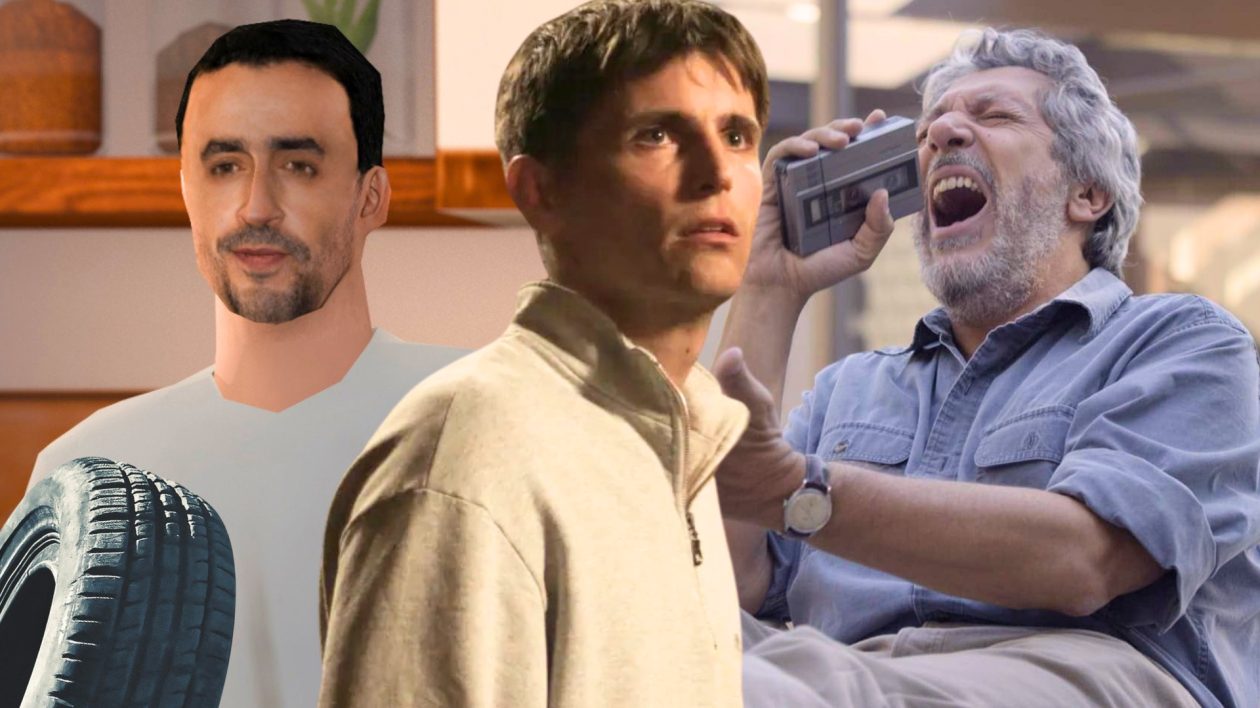
Steak, Reality, Rubber, Yannick, The Vertigo…we’re taking a look back at the best and the worst of Quentin Dupieux’s career.
First known as Mr. Oizo through the mid-2000s for his remixes and electro tracks, Quentin Dupieux ultimately made a name for himself on the big screen. In 2007, with his official first film Steak led by the famous duo Eric & Ramzy, the Frenchman’s career took a sharp artistic turn, and his second film (or third if you count Nonfilm), Rubber, propelled him into the big leagues with a tire that kills.
Since then, Quentin Dupieux has become a fixture of French cinema, ultra-prolific (he has released ten films since 2018) and a leading figure in absurdist and surrealist cinema, a clear heir to the late Bertrand Blier. That said, his filmography is a mix of highs and lows, and it’s simply impossible to place every entry on the same pedestal of originality and madness.
A look back at the entirety of his career as a filmmaker.
NONFILM
- Release: 2001
- Running time: 47 minutes
The pitch without the pitch: The worst nightmare of anyone who hates Dupieux’s least watchable films.
Why it’s a perfect warning for what’s to come: At the time, Dupieux was “just” Mr. Oizo, and loaded with cash. To the point that he didn’t know what to do with his money and decided to pull off a big stunt with his friends Sébastien Tellier and Kavinsky: a film that would be the opposite of a film, largely improvised, and without any editing or sound work.
That yields a moonlit short that starts from an absurd idea (a man wakes up in the middle of nowhere and involuntarily becomes the actor in an ongoing shoot) and constantly pushes the boundaries of absurdity by playing with the borders of mise en abyme. From an actor who shoots half the crew with a gun used on set, to a director who ends up alone in the desert searching for a crew and a film to shoot, Nonfilm quickly becomes a test for anyone who came looking… for a film.
One thing is certain: it’s an essential piece for anyone who loves Quentin Dupieux’s cinema and its codes. Everything was there from the very first (non)film.
Steak
- Release: 2007
- Running time: 1h22
Death suits you just fine, Eric and Ramzy version
The pitch without the pitch : Eric and Ramzy want to make a cool film, the producers hand them 5-6 million euros without reading the script, and disaster ensues.
Why it deserves better than its lousy reputation: Yes, Steak is a disaster. Built like another Eric & Ramzy movie in the vein of La Tour Montparnasse Infernale, Double Zero or Les Dalton, it left almost everyone at a loss and flopped in theaters. No one knew what to do with this biting comedy that imagines a world where cosmetic surgery is merely a fashion accessory, which starts as a friends’ story before turning into a chainsaw carnage.
But that’s the beauty of this tightly orchestrated caper: to turn Eric and Ramzy (and their popularity) against them and place them at the service of a joke that runs to the extreme. Dupieux clearly relishes stretching situations, multiplying grotesque elements and delivering hilariously blunt lines, all with a refreshing sense of deadpan from the actors. You have to see the solvents and solutions lesson, or the Chivers check to realize there’s a bit of genius in this Steak, somewhere between A Clockwork Orange, Bertrand Blier, and American teen cinema.
Rubber
- Release: 2010
- Running time: 1h22
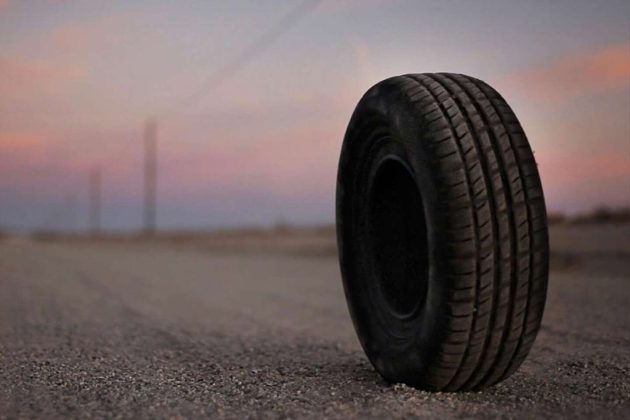
The pitch without the pitch : The life and work of a tire. A serial killer.
Why it rolls off the road: A few years after the unusual failure of Steak, Dupieux holes up in the American desert to shoot Rubber, whose main character — beaming with do-it-yourself spirit — is none other than a tire. This time, he doesn’t risk being misunderstood by the audience. From the start, a character steps out of a car boot and delivers a long monologue that explains the director’s humor. The humor boils down to two words: No reason, apparently the most powerful stylistic element.
The setup of such a direct mise en abyme (spectators literally watch the action below with binoculars) coupled with the ultra-minimalist setting and the tire’s ingenuity of direction serves an ode to absurdity, with the goal of making the spectator identify with a tire. With a tiny budget, Dupieux found a way to experiment… and to develop his style. In the final shot, the tire charges Hollywood at the head of an army of tricycles. Yet another subtle display of his ambitions as his career began to rebound: he intends to build his cinema in reverse.
Wrong
- Release: 2012
- Running time: 1h33
 Wrong turn
The pitch without the pitch : Unemployed but industrious, Dolph has misplaced his dog. So he wanders until he re-centers a dung analyzer. At one point, someone paints his car.
Why it’s quite the trip: Firefighters doing their thing while a van burns. A radio alarm clock that goes from 7:59 to 7:60… Like Rubber, Dupieux carefully introduces us to his world with small details, and he accompanies this plunge into the strange with a sound effect. Only in Wrong, he integrates it more subtly into the narrative. Dolph, played by a highly endearing Jack Plotnick, drowns into fiction as much as the audience.
The director begins to refine the formula: a stripped-down, depressingly ordinary environment, full of soft colors and everyday American archetypes, in which something is seriously off. He also reunites with Eric Judor after Steak, this time escaped from prison with Eric and Ramzy, and finds him a perfect place. “I don’t really feel frustrated anymore,” he told Allocine during the Sundance festival. Thus, Dupieux writes without overthinking, shoots in the wake of it, and looks for meaning in meaninglessness in the editing. The machine is now well oiled, and it will start to run.
Wrong Cops
- Release: 2013
- Running time: 1h22
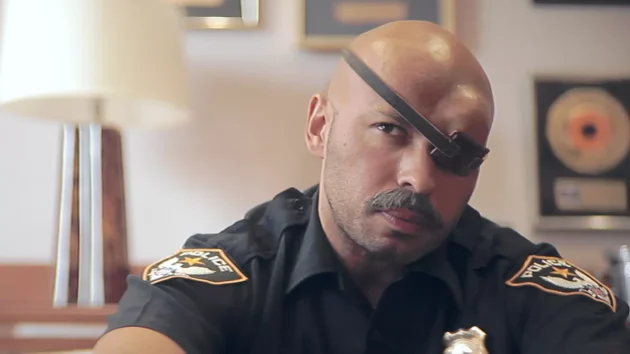 Eric Judor with a sideways glance
The pitch without the pitch : ACAB, by Quentin Dupieux.
Why it’s the wild ride that goes too far: At the end of Wrong Cops, the corrupt cop played by Mark Burnham says to a woman who’s been won over by his drivel about hell: “Glad you liked it, I just improvised.” You’d hope that would apply to us as well, but it’s hard to find Wrong Cops enjoyable, or even interesting, in its self-sabotaging zeal. This film is, indeed, another iconoclastic delirium that fully embraces bad taste and seeks cinematic absurdity; perhaps a bit too much.
Thus, the sociopolitical and social context (an America free of crime) is almost ungraspable, as is the story, which is just a collage of scenes, without goal, stakes or reflection. At the same time, the work grew from a short film with Marilyn Manson and Mark Burnham, to which six other sections were added, like a Frankenstein creature with feet instead of hands.
Before its national release, the film was shown at Sundance as a three-chapter series with micro-credits between segments. The result could have been deliciously burlesque and intelligently disturbing, but what remains is a dull one-hour-plus joke that bores far more than it provokes.
Reality
- Release: 2015
- Running time: 1h35
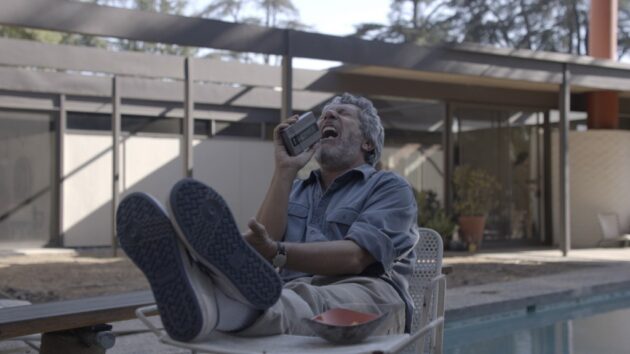 Aaaaaaaaaaaaaaaaaaaaaaaaaaaaaaah
The pitch without the pitch : Alain Chabat searches for the best scream in cinema while a boar gnaws on a VHS tape.
Why it’s Dupieux’s best film: The last film of Dupieux’s American period, Reality is arguably his most impressive work. The director had wanted to bring it to life since 2008 and having to wait nearly seven years to realize it likely paid off. Armed with his craft, Dupieux plunges us into a far bolder and more accomplished experience than his previous features. With its multiple narrative layers where plots and characters overlap, the film could have simply been a homage to Lynchian surrealism.
Instead, Dupieux shatters those influences to dive headlong into his own imagination and never really come out. Never has the filmmaker fused fiction and reality so seamlessly in his career. By bending the markers and acting as a true demiurge, Dupieux invites viewers to lose themselves in the labyrinth of a story that is funny, scary, and poetically impossible. A showcase of cinema that sits between a waking nightmare, a fantasized logic, and magic of the impossible. A grand Dupieux achievement.
Au poste !
- Release: 2018
- Running time: 1h11
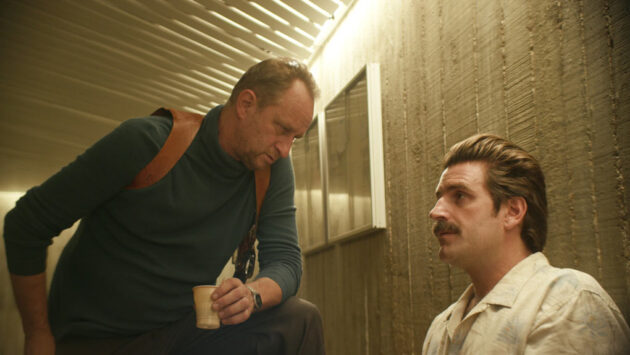 “Come on, admit it, you don’t know how to finish your films.”
The pitch without the pitch : A police procedural chamber drama you’d swear came from a stage play. And yes, it is one.
Why this one concentrates the best and the worst of Dupieux: Back in France, Quentin Dupieux returns to a certain idea of the French thriller. With a poster paying homage to René Château and a claustrophobic room-drama that twists Claude Miller’s Garde à vue, the nostalgic, cinephile trip unfolds and lands on the foundations of the morbid absurdity of Bertrand Blier’s Buffet froid.
Unassumingly, the director finds in this tapestry of references a solid balance, at least in its first half. Supported by sumptuous art direction and the charisma of his cast (Benoît Poelvoorde is perfect as the relentless cop, just as Grégoire Ludig is as the credulous suspect), Au poste ! toys with its situational escalation until the hilariously over-the-top moment with Marc Fraize. And then, as with Dupieux often, the ending has to land, and even if the twist ties a logical knot to the artificiality of the setup, it still feels like a bit of a damp squib.
The Leather Jacket
- Release: 2019
- Running time: 1h20
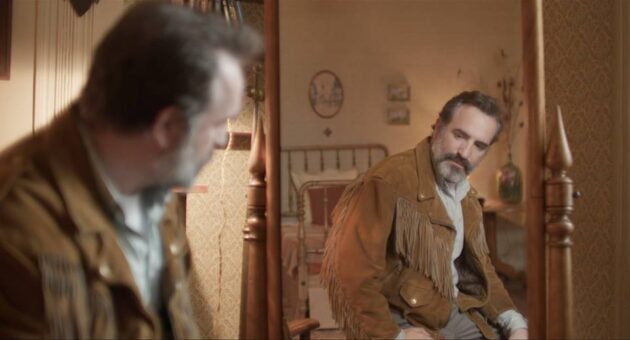 I saw in this store, that little suede jacket
The pitch without the pitch : Georges falls head over heels for his suede jacket. To the point of fleeing with it.
Why it’s one of his most fascinating films: The Leather Jacket is certainly the most divisive Dupieux film among Ecran Large’s staff. It’s also something of a standalone. On paper it resembles the others: an absurd premise, a star-studded cast (Adèle Haenel and a Jean Dujardin who has a ball between two big productions), a desaturated shot, a minimalist set… With one crucial difference: here, it’s not the world that’s strange, but the main character who is mad.
By flipping the dynamic that made him famous, it also shifts the tone. If the humor remains delicious, Georges’s pathological obsession colors the narrative with real darkness, even palpable despair. Many would have leaned into a delirious consumerism, Dupieux instead telling the loneliness of a man with no interlocutor but his jacket. The more the plot unfolds, the more you’ll laugh through your teeth, until the introduction of compulsive cinephilia (via Denise) cultivates a fairly rare, offbeat beauty.
Mandibules
- Release: 2021
- Running time: 1h17
 Dupieux’s fly, far from the Cronenbergian body horror
The pitch without the pitch : The Palmashow leaves TV to rob banks with a giant fly.
Why it doesn’t quite hit the mark (or almost): “With Mandibules, I finally abandon death to focus on life,” Dupieux explained for the film’s promotion. And it’s true that his ninth feature (yes, we count Nonfilm) might be one of his lightest. With his comedic duo, he recycles the buddy-comedy code (Dumb & Dumber comes to mind) and adds a refreshing fantastical touch on paper (the giant fly, for instance). The film tilts further into the absurd when the duo meets another group of totally lost youngsters (including a hilariously over-the-top Adèle Exarchopoulos).
Yet, bizarrely, the inherent madness of Dupieux’s cinema seems to crack a little under Mandibules. The story resists fully embracing the burlesque and ultimately leans on familiar, well-worn clichés of the filmmaker while constraining itself to a very conventional comedy register. The result is a sense of something missed, especially in a grand final shot that could have served as the springboard for all this whimsy.
Incroyable mais vrai
- Release: June 15, 2022
- Running time: 1h14
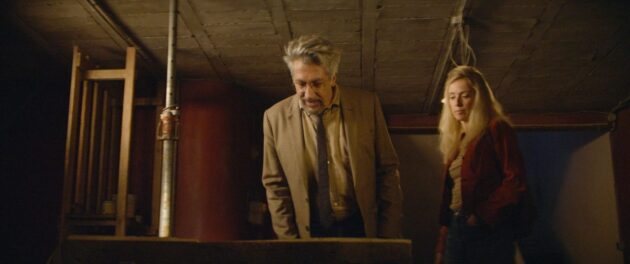 Here’s a pretty decent hole
The pitch without the pitch : Incroyable mais vrai the show, mixed with Recherche appartement ou maison with Alain Chabat
Why this is Dupieux’s sign of a drift: Not a lot of surprise here; Dupieux continues to explore the realm of the absurd with his goofy story where a couple buys a house whose basement contains a mysterious tunnel hatch. But for once, the director goes further—at least at the outset—by shifting into a more melancholic and gentler idea than his previous films. The result is a deeper reflection on existence and even the sketch of a charming, philosophically tinged fairytale with pretty humorous touches.
Unfortunately, Incroyable mais vrai perfectly captures Dupieux’s growing artistic drift: a sense of something unfinished. By resting the narrative on a post-it-sized idea, the film never quite touches all of its internal potential. Instead, it circles back (which is never a good sign for a film under 1h15) until an ultimate act that is completely botched, destroying all potential for a tragicomic punch.
Fumer fait tousser
- Release: November 30, 2022
- Running time: 1h20
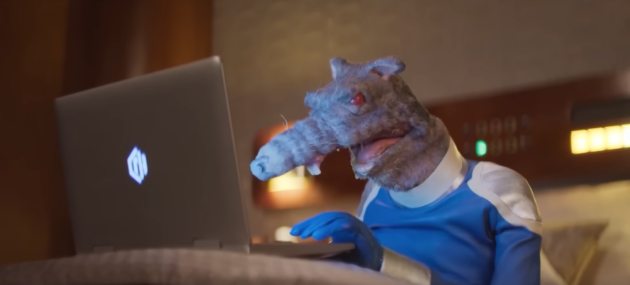 The real star of the film
The pitch without the pitch : The depressed Power Rangers go on a Fear Street-style vacation and play It Follows with the horror of a joke.
Why it’s a no: This is one of those moments where you wonder if anyone has ever asked Quentin Dupieux to write a real second draft of his scripts. Or if the actors sign on with eyes closed because it’s become really cool to work with him.
More than ever, Fumer fait tousser looks like several bits (that could have become good films) pasted together to become one, well, film. The Lycra-clad heroes’ team-building opens up several doors, with an axe-wielding machine, a barracuda, and a villainous helmet. None of it quite clicks, the irony being that these stories don’t really have endings, or end almost abruptly… much like Dupieux’s own films. *insert laugh*
With this gag moving in fits and starts and portraying its own uselessness until the quasi-apocalypse, Dupieux takes his cinema to the extreme. Except that at this stage he has more than enough resources (a handsome budget reportedly around €6 million), which makes the farce less playful and light. Fortunately there’s this brilliant chef Didier, voiced by Alain Chabat, who deserves his own film.
Yannick
- Release: 2023
- Running time: 1h07
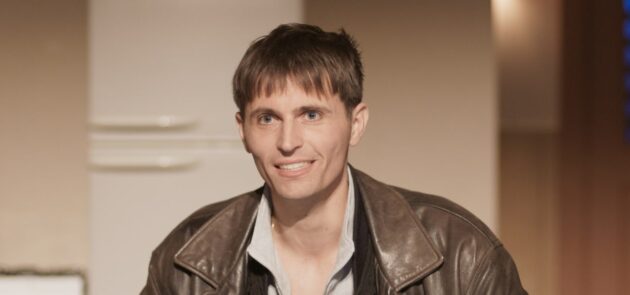 Raphaël Quenard, who continues his meteoric ascent
The pitch without the pitch : Raphaël Quenard took a day off, rode 40 minutes in public transport from Melun, and walked 15 minutes (!!) to see a lousy Paris theater show. Naturally, he’s audacious.
Why it’s one of Dupieux’s best recent films: After films leaning toward fantasy or surrealism, Yannick signaled a shift toward something more grounded and less sprawling (or dissipated) for Dupieux. The film, shot in just six days in Paris, is a claustrophobic chamber piece set in a theater, giving the filmmaker a chance to exorcise some of his demons.
Without renouncing a welcome thread of absurdity and eccentricity, the director examines through this improbable hostage scenario the complex, if not contradictory, relationship between artists and their audience. As the film unfolds, the power dynamics shift, as do the audience’s sympathy and empathy (both real and fictional) that oscillate between Yannick and this trio of failed actors, particularly Pio Marmai’s aggressively pretentious persona. Dupieux, thus, seems never to take sides, conceding that audiences and critics can disdain the artists as much as the artists can look down on them. And this stasis is both painful and touching, between an impossible reconciliation and natural dependency.
Daaaaaali !
- Release: 2024
- Running time: 1h18
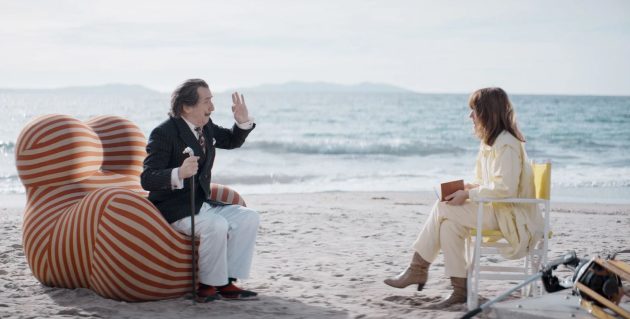 The clash of the titans
The pitch without the pitch : Dupieux tackles the king of surrealism, a little obvious perhaps. As a filmmaker who tests the limits of his concepts, this exploration of the elusive painter is one of his most playful outings. Inspired perhaps by Todd Haynes’ I’m Not There, Daaaaaali! breaks the artist into a multitude of faces (Edouard Baer, Jonathan Cohen, Gilles Lellouche… all having a ball) to better capture the need for permanent division.
Like an exquisite corpse where every cut and splice invites surprise, the feature becomes a sequence of mises en abyme that end up becoming hypnotic. There’s a refreshingly humble quality here, the desire for an anti-biography that never seeks a portrait carved in stone. Instead, Daaaaaali! is in constant motion, leaping between spaces or bending time like a child jumping from one idea to the next. And it works, in addition to being genuinely funny.
The Second Act
- Release: 2024
- Running time: 1h20

The pitch without the pitch : Four characters traipse a lot before settling into a strange restaurant.
Why this is overkill: And if we’re starting to grow tired of Dupieux? Or worse, if he himself is growing tired of cinema? Under its light, anecdotal comedy veneer, The Second Act seems to try to take the pulse of the era, questioning quite bluntly whether the world (and cinema) isn’t moving into a void, toward nothing. On paper, a fascinating object of reflection. Yet, as Dupieux has been doing more and more recently, the whole thing remains just intentions without outcomes or relevance.
On the contrary, The Second Act feels almost like a complete detour by the director, as he never truly goes for broke. Its characters-stars tire of bearing political or societal responsibility, and there’s little doubt that, given Dupieux’s distrust of the press (and critics), this four-person ensemble is also a proxy for him. A testament that his new film is a perfect example of a form of cowardice, which would aspire to be a snapshot of the era, but instead becomes a comfortable, unconscious farce.
L’accident de piano
- Release: 2024
- Running time: 1h20
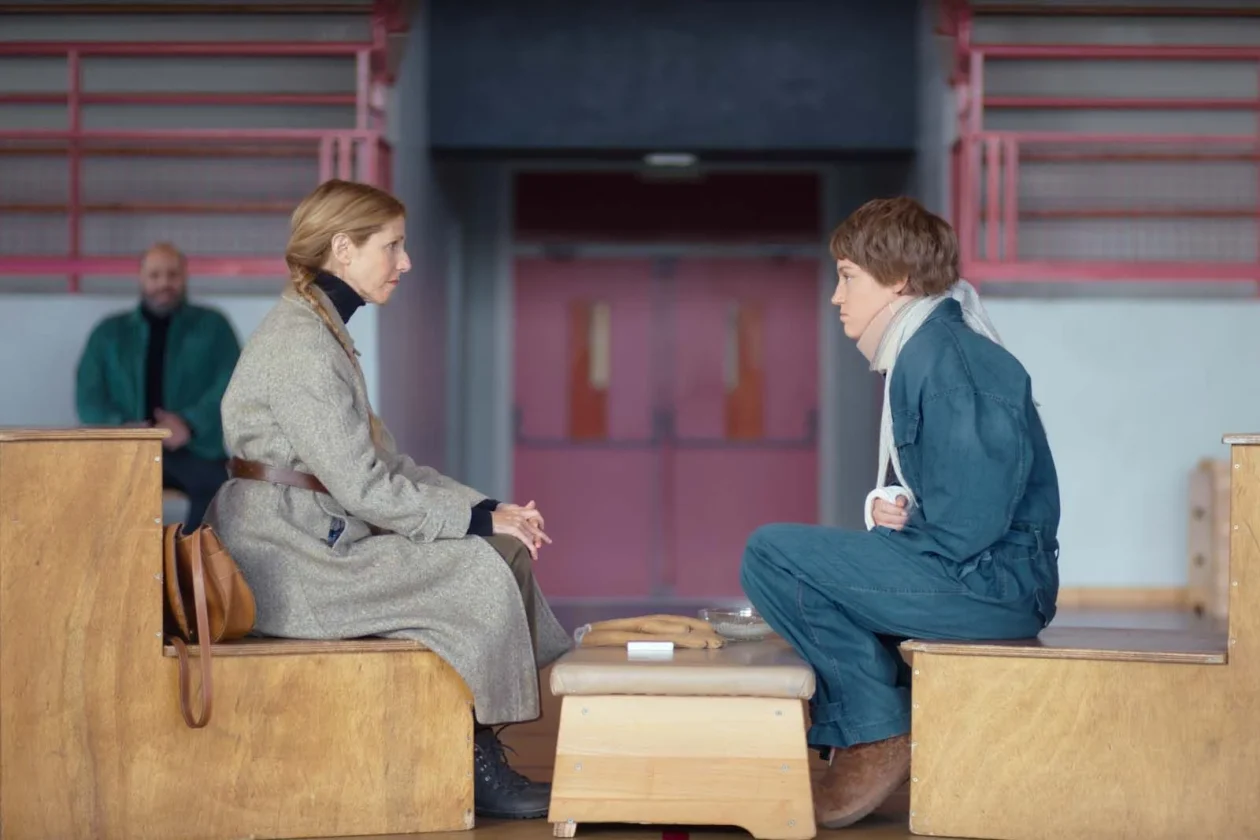
The pitch without the pitch : Quentin Dupieux is sick of everyone and does his psychoanalysis on the big screen, episode 90.
Why it’s the angriest:The Piano Accident follows a YouTube content creator who makes extreme, absurd videos à la Jackass. As is rarely the case in his films, Dupieux almost explicitly cites Johnny Knoxville’s crew, bringing a real-life element into his fantastical universe.
That’s the perfect excuse to give in to the temptation of intellectualizing what probably didn’t need it. But it’s hard not to project Magalie with some traits in Dupieux himself, from his improvisational camcorder days to the obsessive search for meaning in a journalist’s work (who wants to overanalyze her subject). Let us not forget the famous question about why Magalie keeps going when she’s clearly done this shtick for ages.

But this time, Magalie being the opposite of an artist (a notion the film toys with) does Dupieux also use it to question himself and his art? Or perhaps we’re overthinking it and/or doing it wrong. The best way to enjoy The Piano Accident is to consider it as a simple volley of middle fingers from a filmmaker overwhelmed by this dreadful era of vertical content (shorts and reels), indifference, lethal buzz chases, and parasocial relationships.
After all, everyone is skewered, with no hope for redemption or conveniently comforting introspection. This includes the falsely virtuous journalist played by Sandrine Kiberlain, the lazy and complacent manager of Jérôme Commandeur, and the socially awkward fan of Karim Leklou. And it’s this cathartic nastiness, especially Magalie’s, that gives the film its bite, even if it’s a bit bland when trying to become a tirade.
The Vertigo
- Release: 2026
- Running time: 1h07

The pitch without the pitch : Jacques learns from Bruno that they’re living in a simulation, and it’s hilariously funny because it looks like a clunky old video game.
Why it’s the false good idea: You have to admit, the concept of The Vertigo and its derivative machinima aesthetics borrowed from an old PlayStation game promised a dream. In its first third, the return to a DIY amateur animation cinema works its charm. Dupieux manipulates those blocky polygons, stiff bodies, and material clipping, even though we’ve grown accustomed (as the characters have) to the limitations of real-time 3D on our screens.
But what is The Vertigo aiming at behind this easy split between its prestige and its rudimentary technique? Not much, and that’s the problem: you sense a cynical object that will amuse boomer audiences in the back rows who’ve never held a game controller. Yet, for more than twenty years, machinima has already told (better) this vertigo of the title, this search for meaning by characters faced with the emptiness of virtual existence. There is a Beckettian quality to this existential crisis: they wait for Godot, trapped in strict lines of code that only reinforce the absurdity of the situations. A premise Dupieux never pushes beyond a humorous gimmick.
