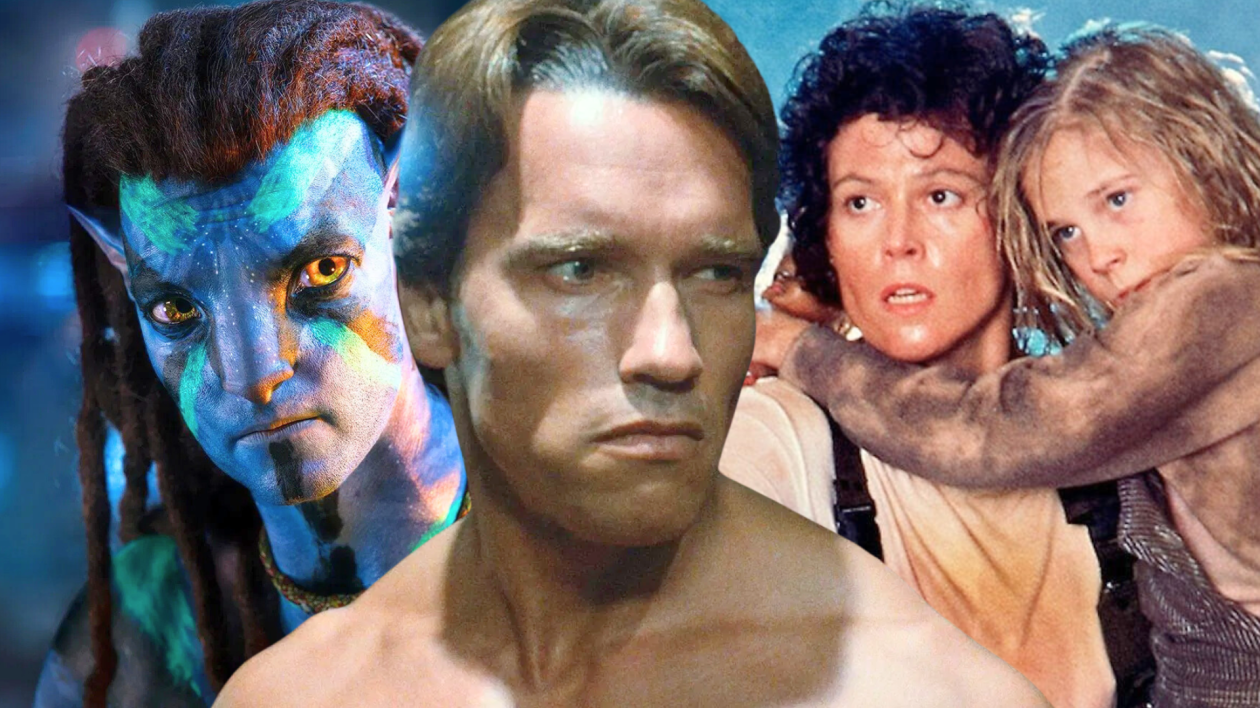
Terminator, Titanic, Aliens, The Return, Avatar, Avatar 2, Abyss, Avatar 3… Which is James Cameron’s best film?
No matter whether you think Titanic didn’t deserve its blockbuster status, that Avatar is merely a remake of a Smurf x Pocahontas mash-up, that Aliens isn’t worthy of the franchise, or that Claude Zidi did better with Thierry Lhermitte. James Cameron belongs to the pantheon of the greatest Hollywood filmmakers. He can’t be reduced to box‑office feats (three films in the top 5 of all time grosses, after all).
From his breakout moment with Terminator to the巨ulent reach of Avatar, via the Alien sequel and his True Lies remake, the director has established himself as a master of spectacle. His career is endlessly fascinating, and since we love to argue about matters of life and art, we’ve decided to rank all his films.
NB: We’ve decided not to include Piranha 2 – The Spawning (from which James Cameron was fired early in production), nor his documentaries The Ghosts of the Titanic and Aliens of the Deep (co‑directed with Steven Quale), and you’ll have to live with that.
9. Avatar 3: Fire and Ashes
- Release: 2025
- Runtime: 3h17

Avatar 3: Fire and Ashes is the first entry in the saga to rattle the most fervent Pandora defenders within our ranks. Not that the film is a failure, far from it. James Cameron remains an absolute maestro of the big spectacle, and the nearly 3 hours and 20 minutes of this mega‑blockbuster—produced for roughly $350–400 million—slip by thanks to a flock of sensational set pieces—notably the assault on the Wind Trader convoy by the Mangkwan clan.
Unless you’re allergic to the Na’vi (in which case you might want to bail on these films), the magic keeps going deeper in technical achievement, with a level of detail that dizzyingly rewards Cameron’s lingering on the eyes and faces of his characters, revealing more of the talents of Zoe Saldaña, Sigourney Weaver, and even Sam Worthington (proof that time has gentled him a touch). Even if you don’t care about the technique, the emotion becomes more striking and breathtaking.
Yet there is everything else—namely all the flaws Cameron has carried since the first Avatar—and they seem to swell with each sequel. It’s hard to imagine the seasoned scribe behind Titanic, Abyss, Aliens, Terminator and its successor could have penned Fire and Ashes.
Between the rough humor (kidnapped kids, Kiri’s powers…), the underwritten and underused characters (the great villain Varang reduced to a luxury cameo in the second half, Ronal’s death that lands with almost zero impact given her place in the story, the benevolent scientist Ian Garvin who hobbles back to assist Sully and then vanishes…), and the somewhat exasperating recycling of Avatar 2’s climax, there’s plenty to wonder if Cameron really gave the screenplay’s “details” as much time as it needed. And it’s not as if he had THREE HOURS to flesh out the narrative.

Even the most emotionally charged moments suffer from a lack of subtlety that blocks the genuine emotion—it’s as if everything must be handled with the blunt force of a bulldozer—the brutal confrontation between Jake and Spider in the forest, written with a trowel, replete with heavy‑handed lines. And since Cameron has no appetite for steering his story through the cadavers of his protagonists, echoing that “dead” turn he loves, the sense of treading in circles becomes more and more persistent.
Avatar: Fire and Ashes either completes or rehashes—depending on who you ask—the stakes of the previous installment, with a combustible energy and an ambition that still casts a spell. But you can already sense it, nonetheless.
8. True Lies
- Release: 1994
- Runtime: 2h24

The 1990s is probably a parallel dimension where a studio like Fox could entrust James fucking Cameron with well over $100 million to remake a Claude Zidi film, with Arnold Schwarzenegger stepping into Thierry Lhermitte’s shoes. That’s how True Lies was born, one of the grand finales of the muscular American blockbuster, where Terminator acts as a liaison for his wife Jamie Lee Curtis, who never questions the fact that he’s built like a refrigerator.
Even though it looks like a Hollywood product on the nose, True Lies is far from a misfire in Cameron’s filmography. Dazzling practical effects, straightforward writing that remains supremely effective, storytelling that remains legible amid sequences packed with explosions, Bill Paxton in full throttle, a pace that never flags in two hours… And above all, the triple‑climax structure, more evident here than ever. The final half hour is a veritable feast, escalating to a showdown on a supersonic plane and that brilliant line, perhaps the best of Schwarzenegger’s career: “You’re fired!”

Yes, with its stereotypes and rough edges it isn’t as thematically rich as the other Cameron films. But when the film’s signature finale—nestled into a kiss with a backdrop of nuclear explosions—arrives, we can say, rightly for once, that films like this don’t get made anymore. Or at least, they only existed in the alternate dimension of the 1990s.
7. Avatar
- Release: 2009
- Runtime: 2h42
Let’s be clear: this ranking isn’t meant to devalue any of Cameron’s films, but it does require difficult choices. To the dismay of some editors, Avatar sits at the bottom of the list. That said, it is worth recalling how the filmmaker transformed his post‑Titanic project into an event equal to the expectations placed upon it, while signaling to audiences that they were about to witness something unprecedented, a film that would reshape an entire industry.
From the opening crane shot, where the misty forests of Pandora seem to spill beyond the screen, the momentum Cameron creates invites a total surrender of senses and reason—permitted by a masterful level of sophistication in the staging. And it isn’t only the astonishing quality of its CGI and performance capture. Critics often call the film simplistic, but the film’s making is incredibly meticulous, designed so we, the viewers, can simply enjoy the flow of immersion.

A genuine monument of organic worldbuilding and a technological revolution that would thrust digital projection and 3D into theaters around the world, Avatar changed an entire paradigm of cinematic wonder, yet perhaps it did so at the expense of emotion. Despite its various extended versions, it’s hard not to notice a narrative imbalance in the sprawling story, especially in the development of certain characters, something perhaps not helped by the film’s deliberately conventional structure.
6. Avatar 2
- Release: 2022
- Runtime: 3h12
Thirteen years after the first Avatar, James Cameron had to prove himself again with a sequel, seeking a balance between the familiar and the new. For some, Avatar 2: The Way of Water suffers from a story that mirrors the original film. Humans return to Pandora to wreak havoc, Jake Sully shuns his warlike duties (this time to protect his family) before realizing that such a withdrawal isn’t really possible anymore.
Yet this rewrite (though not always deft) is essential, first because it marks Cameron’s mythic approach to storytelling (Lo’ak swallowed by a Tulkun, much like Jonah and the big fish in the Bible), and second because it embodies the film’s political despair. The mistakes repeat, the apocalypse looms, and the Na’vi must once again take up arms to defend this flawless digital world. Cameron this time rekindles his love of oceans and depths, and even toys with a fresh riff on Abyss and Titanic, though the climactic moment never reaches the same virtuosity.

Si ce talent de remix peut parfois sonner comme une faiblesse, The Way of Water exploite ce tissu de références pour porter sa narration, centrée sur le thème de la transmission et de la transition, qu’elle soit familiale, identitaire, ou liée aux éléments de la nature. En faisant incarner à Sigourney Weaver l’adolescente Kiri (un personnage merveilleux en quête de sens sur ses origines), Cameron dépasse le cadre strict du postérieur Avatar et s’insinue dans une démarche plus profonde. La performance capture permet de s’affranchir définitivement des limites du tangible, afin de nous rappeler le besoin de protéger la réalité de notre propre monde.
5. Titanic
- Release: 1998
- Runtime: 3h15

It’s tough to sum up the significance and the grandeur of Titanic in a few lines. The author of these pages could wax lyrical about the film’s impact on their cinephilia (and about Leonardo DiCaprio’s role in shaping the idea of the perfect man), but we’ll let the numbers do the talking instead.
Titanic is: 3h15 of pure Hollywood spectacle, 11 Oscars, five years of prep, 12 dives to the wreck, seven months of shooting, a record-setting budget at the time (roughly $200 million), a full-scale 236‑meter replica, an 85,000 m³ pool, and $1.8 billion at the worldwide box office (2.2 billion with re-releases). Not to mention the 18 million copies sold of the single My Heart Will Go On sung by Céline Dion.

Recreating the maritime catastrophe demanded vertigo-inducing technical feats and yielded a number of considerable breakthroughs, making Titanic the last of its kind in a certain sense. Most of the production took place on enormous, tactile sets, but it also incorporated the era’s new digital techniques, signaling a new age in cinema and a new way of telling stories.
And then there are the lavish costumes, the sweeping score by James Horner, the “You jump, I jump, right?” exchanges, the legendary “I’M THE KING OF THE WORLD!” moment, the endless debates about the door, Kate Winslet’s triumph, and even the infamous poisoned‑canteen anecdote. In short, there are a thousand and one things to say about Titanic, and that’s why it remains an enormous film.
4. Terminator
- Release: 1984
- Runtime: 1h47

Written by a James Cameron energized by a PKD-esque imagination, Terminator is a kind of science‑fiction slasher that redefines the form and the look of the humanoid robot in popular imagination. While Blade Runner had already broached similar themes two years earlier, the Terminator taps into the full potential of a brutally powerful metal body and the prospect of a chillingly credible technological apocalypse.
Made with only $6 million, thanks to producer Gale Anne Hurd who believed in the project, Terminator demonstrates how to talk about a planetary catastrophe, ultra‑modern robotics, and time travel—without showing much, by concentrating on three core protagonists. And the evocative power works like wildfire, because the film’s dark atmosphere, the stark brutality of the execution scenes, and the Terminator’s imperturbable calm grant it an unparalleled tension. The film’s voice is defined by Brad Fiedel’s sublime score, which alternates between those infamous military drums and a mournful synth lament.

In the casting, Arnold Schwarzenegger finds perhaps the most interesting role of his career: unmistakably imposing, the way he moves and the way he looks as the chrome‑plated appliance brought to life is unnervingly precise.
In the iconic portrayals of Sarah Connor and Kyle Reese, Linda Hamilton and Michael Biehn are so obvious that they never quite manage to surpass this high point of their careers. They embody Shakespearean lovers from the future who remind us that Terminator, like most of Cameron’s films, remains, at heart, a grand (and frightening) love story.
3. Terminator 2: Judgment Day
- Release: 1991
- Runtime: 2h17

Terminator 2: Judgment Day, or the perfect sequel manual. A manual faithfully followed by countless franchise writers since, without ever quite recapturing that peak. Step 1: take all the ingredients that made the first film a hit. Step 2: flip the script. Step 3: make half the world cry. The original Terminator relied on Schwarzenegger’s terrifying inhumanity. Cameron and his co‑writer William Wisher Jr. set out to gradually humanize him.
The threat had been a cold, inert block of metal. Now it’s a shape‑shifting liquid, more sly than utterly unfeeling. Sarah Connor was a plain, ordinary woman who saw the apocalypse coming. Now she’s a hardened survivalist, one who starkly defies the Hollywood star system, while the melancholy of Kyle Reese gives way to the bold spontaneity of John. Everything is there, differently. But there’s no question of abandoning the film’s core despair, inherited from the 1984 version, quite the opposite.

With a bigger budget, Cameron makes the apocalypse feel like a genuine, dread‑inducing threat. The characters endure a kind of pre‑traumatic stress, echoing a population that begins to distrust not technology itself so much as its uses under neoliberal modernity. Many of Cameron’s films probe this relationship, but rarely to this extent, right up to the film’s emotional climax, which reveals his stance. And the craziest thing is, this isn’t even the best sequel of his career.
2. Aliens
- Release: 1986
- Runtime: 2h17 theatrical (2h34 extended)

Aliens, the Return nearly topped the list, and it would have deserved it for embodying a certain James Cameron ideal of perfection: an action film, a war film, a horror film, a female‑led epic, and above all a masterclass in writing, delivered as a sensational rollercoaster.
Aliens was born out of pain. Cameron first won the attention of the studios with the script for Terminator, but Fox had doubts and fears — about Cameron, about his producer Gale Anne Hurd, about the budget, about Sigourney Weaver’s pay. The development became a tug‑of‑war, and filming followed the tension with the firing of James Remar (replaced by Michael Biehn) and the director of photography Dick Bush (replaced by Adrian Biddle), and heated friction with the English crew (the 1st assistant Derek Cracknell fired, then rehired).

Taking a hard left from the original Alien, Cameron conceived the perfect sequel, one that escapes comparison by writing its own destiny. The “s” in the title isn’t just about more extraterrestrials; here, everything is amplified: the scale of the set, the sonic intensity, the number of characters and conflicts. If Ridley Scott played on imagination and expectation with a silent xenomorph, Cameron trains a spotlight on the xenomorphs, turning them into hellish fodder and launching a spectacular countdown.
With a ruthless sense of tempo, the director and writer alternates between savage confrontations (the nest, the lab assault, the queen) and moments of quiet. It’s there that Aliens finds its true strength: by developing Ellen Ripley’s character, giving her a backstory (the cut scene in which she learns of her daughter Amanda’s death, later the heroine of the video game Alien: Isolation), and by giving her a present tense—fighting the mother alien to protect Newt. It’s simple, pure storytelling, and Sigourney Weaver demonstrates the full range of her talent.
And Aliens also means James Horner’s score, the visual effects and visuals (miniatures, the Steadicam repurposed as a weapon, Stan Winston’s creature effects), the iconic sound design (the motion detector), and a perfect cadre of supporting players (Michael Biehn, Lance Henriksen, Paul Reiser, Jenette Goldstein, Bill Paxton, Carrie Henn)… In short, Aliens, the Return is a masterpiece. Period. A testament from someone who has watched it around 55 times and remains endlessly impressed.
1. Abyss
- Release: 1989
- Runtime: 2h19 (the theatrical cut); 2h41 (Director’s Cut, the version you should actually watch)

Facing the popularity of the Alien and Terminator sagas, or the monumental Titanic, a film beloved by an entire generation, Abyss is often forgotten. Yet it is arguably James Cameron’s greatest film, at least in our ranking, though the margin is razor-thin with Aliens and Terminator 2. It must be said that Abyss has probably suffered (and continues to suffer) from the chaos of its multiple versions.
Visually, Abyss has always been a pure wonder. Though much of the film was shot underwater, enabling a strikingly realistic look, Cameron once again pushed the era’s technical boundaries and built an entire world using new technological breakthroughs. From the creation of a specialized breathing fluid for the film (yes, really) to the revolutionary special effects (the liquid alien tentacle, a precursor to the T1000 in T2), Abyss is a perfect blend of the organic and the digital, of realism and the fantastical… Except that, despite its gorgeous aesthetics, the story in Abyss suffered badly from its 2h19 theatrical length.

Luckily, since 1993 and Cameron’s Director’s Cut, the feature has had a chance to repair its narrative flaws. Whether it’s the Bud (Ed Harris) and Lindsey (Mary Elizabeth Mastrantonio) romance under pressure, the tension at the submarine oil rig’s core, or the film’s greatest ambiguity over the aliens’ origin (which aren’t necessarily aliens in the classic sense), Abyss gains enormous scale, intensifying the impact of most scenes.
Indeed, in the Director’s Cut, the written exchange between Bud and Lindsey gives the aliens a far more logical reason to spare Bud and humanity. The film’s naive love message from the theatrical cut becomes a genuine message of hope tied to a visionary reflection on the environmental crisis.
In short, Abyss is at once a grand underwater spectacle and a deeply moving intimate romance, an epic science‑fiction adventure and a paranoid Cold War confrontation. One could even say that Abyss contains everything James Cameron has done in the rest of his career: his fascination with water and depths, the perils of nuclear war and human folly, and the hope for a better future for all species. A work of grand cinema, indeed.
