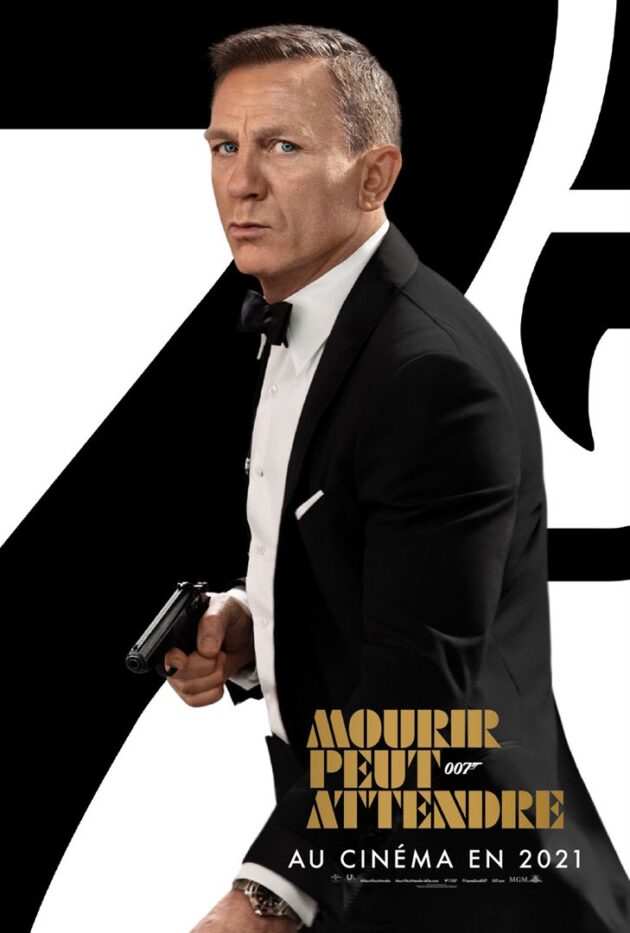
A NAME IS NOT ENOUGH
The Daniel Craig chapter of the James Bond saga has been as thrilling as a roller-coaster ride. The chaotic and uneven Quantum of Solace damaged the legacy of Casino Royale, celebrated as a rebirth as dazzling as GoldenEye in its time, just as Skyfall’s monstrous success made the disappointment of Spectre inevitable. Arriving at last after a storm that seemed endless (from Danny Boyle’s departure to the pandemic that pushed it back 18 months), No Time To Die had thus a mission: to close Craig’s arc with dignity while reigniting the brightest flame.
More than ever, the arc of this modern 007 has been a serialized drama, followed in fits and starts since the Vesper Lynd trauma (Eva Green), whose shadow still lingers. No Time To Die adds another layer with the return of Madeleine Swann (Léa Seydoux) and Blofeld (Christoph Waltz), after Spectre. James Bond is no longer simply here to laugh at his gadgets, his girls, and his foam-core sets: he is here to bleed and to suffer, and for that, time is required. Following the previous installments, this 25th entry takes its time in every sense, as No Time To Die runs for more than 2h40, the longest in the franchise.
In almost 60 years and with six different actors, James Bond has traversed the ages and kept the pulse of his era. No Time To Die is once again a chapter torn between the past and the future, as the screenwriters show: Neal Purvis and Robert Wade (at the helm since The World Is Not Enough) are aided by director Cary Fukunaga (True Detective) and Phoebe Waller-Bridge (Fleabag). But for the first time in its history, James Bond faces his own reality, his own myth. And the saga dares to do something.
LOVERS ARE ETERNAL
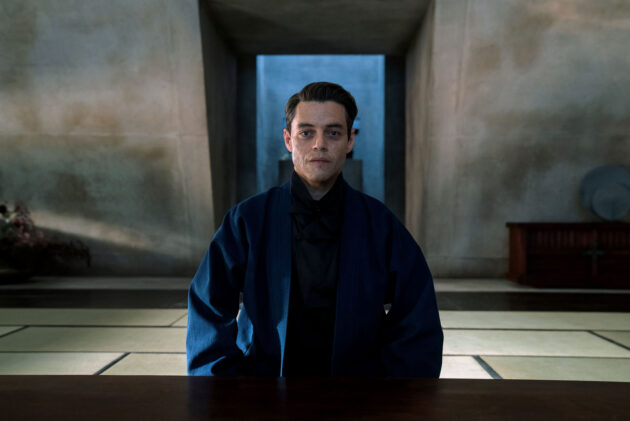
More than any other installment, No Time To Die deserves total secrecy about its plot, which centers on a mysterious man played by Rami Malek. From the opening, where he’s shot as a Courchevel-tinted cousin of Michael Myers, this masked Bond villain asserts himself with featureless eyes. The symbol is stronger than the man, and that’s both the strength and the flaw of this antagonist. Without surprise, the Mr. Robot star brings an unsettling otherworldliness to Lyutsifer Safin, whose power only fully reveals itself in the final stretch.
In the background, there’s the infamous organization SPECTRE, central to the saga and brought back into the foreground in the previous film. But the real enemy is the past of the characters. That same past is the great bogeyman of the Daniel Craig era, as shown by Silva in Skyfall and Blofeld in Spectre, fake brothers and real enemies intimately tied to James Bond. No Time To Die does not break with the rule, and digs even deeper into the lineage, both real and symbolic. A finishing touch that completes the Craig era.

But like Casino Royale, it’s also, above all, a story of love and death.
When the opening titles roll to the Billie Eilish and Finneas O’Connell composition, this James Bond is unmistakably tuned to emotion, and it is that emotion that will carry the film through to its final minutes.
In this game, No Time To Die succeeds where Spectre spectacularly failed with the character of Madeleine Swann. Written as a luxe but clumsy ornament in the previous installment, where she fell hopelessly in love with the hero within a 25-minute frame, Madeleine Swann exists here as a true love for Bond. The ellipsis makes their story a thousand times more interesting and solid, and Léa Seydoux has real scenes to defend. Often shot as an elusive ghost, the actress carries some of the film’s most important moments. And in the shadow of Eva Green’s Vesper Lynd, she embodies another facet of the Bond Girl never before seen.

DIE ANOTHER DAY
But while James Bond loves, James Bond snores. No Time To Die suffers from a pacing problem already seen in Spectre, with a middling stretch where the heroes converge on London for the usual investigative beats. It’s all the more evident as the film kicks off with a pair of spectacular openings, between the icy Norwegian vistas and the sunlit Italian shores.
There, Cary Fukunaga appears fully in command of the blockbuster brief, playing with silence and suspense as deftly as with explosions and the expected set pieces. The director recaptures a bit of that energy in the grand finale, helped by a setting that recalls the saga’s glory days, and some delicious directorial touches – from a long ascent-and-brawl shot to a sly wink at the franchise’s iconic gun-barrel sequence.
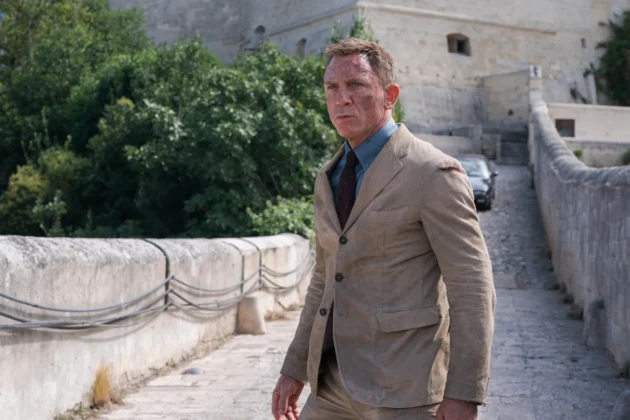
But between those moments, there isn’t much to gnaw on, with firefights and clashes that feel highly mechanical and functional. It isn’t surprising that the other big moment of the film is less an action sequence than a pause where everything hinges on a mood, almost a nightmare atmosphere, of a fog-wreathed forest. Cary Fukunaga seems more interested in these timeless moments, when a masked monster pursues its prey on a frozen lake in a white desert, when an old foe reappears at the end of a hallway like a formidable Hannibal Lecter, or when Bond duck-walks into the woods as distant roar of unseen enemies rumbles in the background.
The cinematography of Linus Sandgren (La La Land, First Man) and the score by Hans Zimmer (the first foray of this giant into the Bond universe) go a long way toward making this a success. But as soon as the spectacle restarts ticking off the familiar markers (the Q appearances, Ana de Armas as a passing Bond girl, Lashana Lynch as a ferocious partner), No Time To Die fine-tunes back into place. Never to the point of slipping into mediocrity, but regularly leaving a lingering aftertaste of ease.

LIVE AND LET DIE
No Time To Die, perhaps, but the Bond business, no. Even without Daniel Craig. With its title mirroring the Pierce Brosnan finale, this 25th installment had to navigate a new turn; a milestone all the more critical now that Amazon owns MGM, and the franchise’s unmistakable voice seems ever wilder in the face of the mega-franchises that dominate today’s market.
No Time To Die faces this situation in a blend of furious frenzy and stark simplicity. The last fifteen minutes are unlike any other Bond film, forsaking pyrotechnics to emphasize pure emotions, whether dark or luminous. It’s Daniel Craig’s opportunity to go all-out with this superhuman take on Bond, a performance he has carried with force and ferocity since Casino Royale. In roughly a decade and a half, the movies have chronicled the passage of time on the body and mind of the character, but also on his actor, who seems to have burned through all his Bond fuel by this fifth and final adventure.
What a final bouquet this is: a wave that sweeps away the film’s flaws, of which there are a few—most notably in some rather blunt writing, and a sense that the movie could have been a touch shorter and more tightly harmonized.
No doubt No Time To Die will spark conversations like never before, with a few spicy questions once the end credits roll (and fade). But after 59 years, 25 films, 6 actors, more than $2 billion at the global box office, and far more in its business footprint, this is arguably the best proof yet that Fleming’s hero still has some bite left in this world.