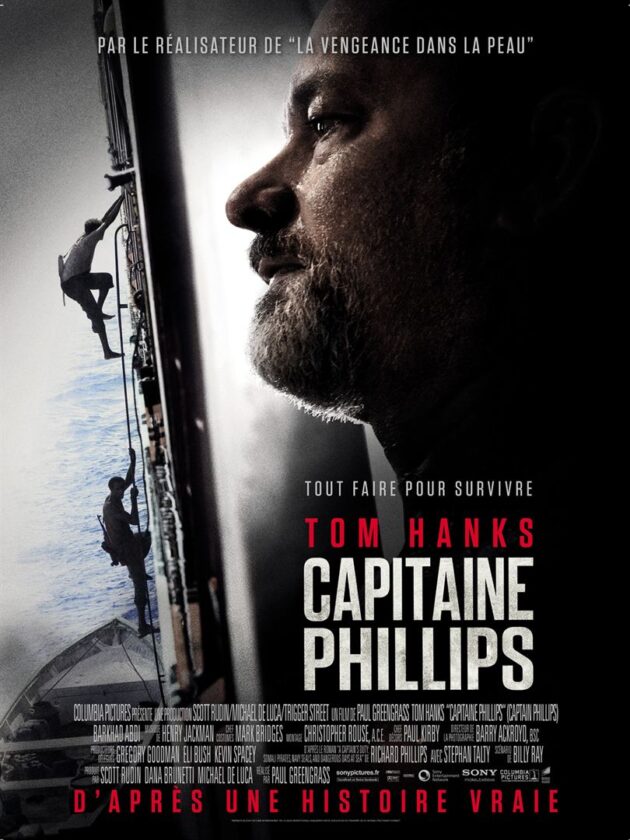
IT’S NOT THE SEA THAT TAKES THE MAN
A director of the moment and of immediacy, Paul Greengrass once again stakes his claim as the undisputed champion of the shaky cam (the shoulder-mounted camera that shakes a lot)—a category in which he excels, if not created, and certainly helped to democratize. Like no other, the filmmaker proves capable of multiplying the shots and angles, of covering the entire action with a setup that in the hands of others would look like pure chaos, in order to achieve a result that is readable, clear, and strikingly intense. If the technique itself remains beyond reproach here due to its mastery, it is the story that traps it in a snare from which it will have a hard time wriggling free.
While Paul Greengrass generally does not shy away from filming action in confined spaces, it’s because his storytelling multiplies them, turning what could be a cluttered scene into a swirling backdrop whose objective limits he blasts apart, sometimes even letting the historical context (Flight 93) metaphorically push the walls outward and lend scale to the setting.
Unfortunately here, the action centers on a handful of corridors, before closing in on a tiny lifeboat. The director never manages to escape this objective constraint, likely a fault of a screenplay that will only truly characterize its two principal antagonists, leaving the others to become anonymous silhouettes as the narrative unfolds. Despite the author’s deft cutting and editing, boredom rapidly overtakes the viewer.

CAPTAIN AMERICA
One must wait until the final third of this tragic venture for the director to be pulled by his screenplay out of a situation he no longer manages to energize. The arrival of the American military on the stage of operations allows the artist to turn his attention to his real subject, far more compelling than everything that came before, sadly introduced far too late. For what fascinates Paul Greengrass here isn’t the clash between a North American certain of his convictions and a violent and disillusioned Somali pirate, nor does he seek to fold this into a work of pure suspense.

What drives him is the obscene ballet that unfolds between a supremely powerful American fleet and the shabby craft where a handful of men are locked in, all fearing for their survival. In the duet between a pirate driven by the naïve, almost childlike wish to flee to the U.S. and the force of an army ready to commit massacres to avoid losing control of a precarious balance, a paradoxical snapshot of the state of the world reveals itself.
It’s in its final minutes that the film becomes gripping. When the excess of means deployed to save a citizen collides with the man’s own turmoil in a spray of blood, Paul Greengrass manages to deliver not a message but a snapshot of the world, a particularly troubling warning, that saves the film from the ennui and the immobilism that weighed down its first two thirds.