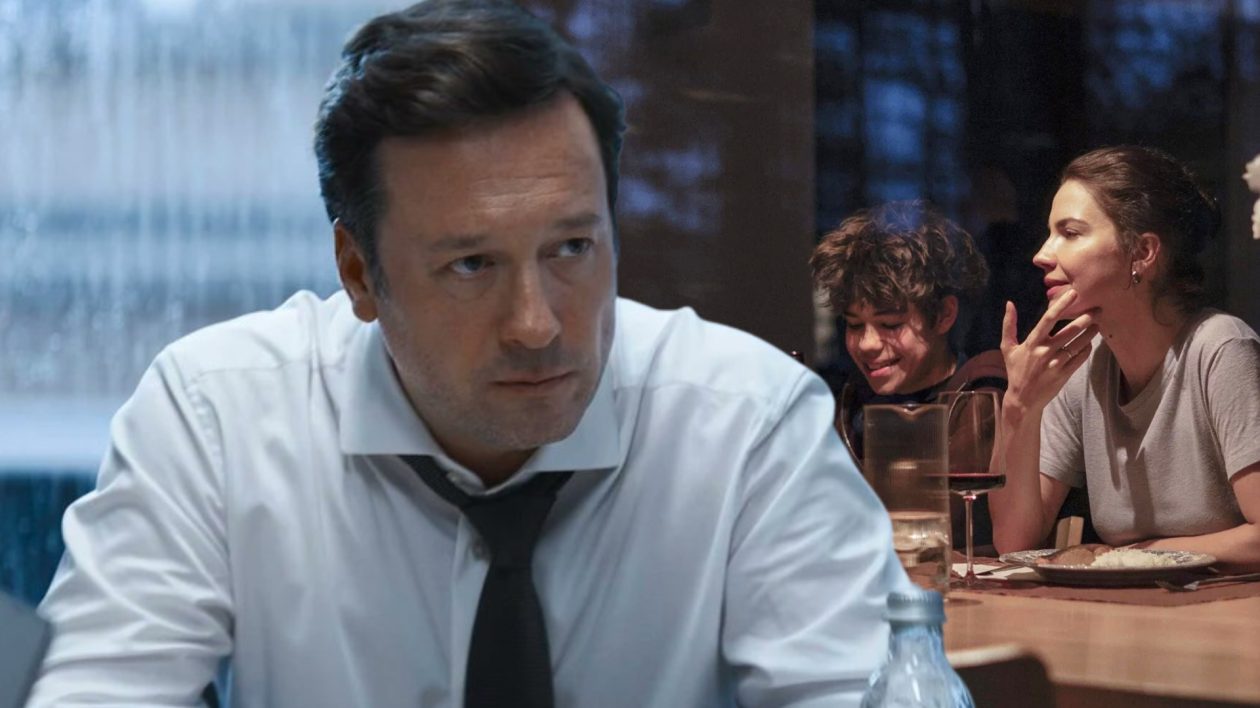
Écran Large is back on the Croisette for the Cannes Film Festival 2026. And it’s time to revisit Minotaure, a conjugal thriller set against the Russo-Ukrainian war.
Since winning the Golden Lion at Venice for The Return in 2003, Andrey Zvyagintsev has premiered all of his films on the Croisette, where each has won a prize: Best Actor for Konstantin Lavronenko in The Banishment in 2007; the Un Certain Regard jury prize in 2011 for Elena, Best Screenplay in 2014 for Leviathan, and the Jury Prize for Loveless in 2017. After nine years away — notably due to a severe form of Covid — the Russian filmmaker returns to Cannes to chase the Palme d’Or with Minotaure. Spoiler alert!
RUSSIA IN THE SPOTLIGHT
What’s it about? In Russia, in 2022, as the war — then openly described as the “special operation” — against Ukraine begins, Gleb, a prosperous businessman, finds his life collide with conscription and growing violence in a world that is turning more unstable by the day.
And how does it stack up? Minotaure is a loose adaptation of Claude Chabrol’s 1969 classic The Infidel Woman (La femme infidèle). The French film traced the tale of a man who, convinced his wife is having an affair, hires a private detective to uncover the lover’s identity and deal with things in his own manner. Andrey Zvyagintsev takes up the same thread and makes it his own — a move that had already been attempted in 2002 by Adrian Lyne with Unfaithful — and uses it to expose, with a thriller’s drive, the disintegration of a relationship, a motif that has threaded through much of his cinema.
The suspense grows as doubt becomes certainty, anger swells, and violence erupts with a virtuoso murder scene about an hour in. The director shows off not only his masterful command of mise en scène but also his capacity as a writer who plays the field with multiple textures. The encounter between the husband and the wife’s lover begins like a vaudeville, slides into unease, and then veers toward pure horror — all while keeping a pitch-black humor that is deliciously audacious (that balcony shot, for instance).

Rehabilitating the Chabrol story would hardly have served a purpose in itself, but Zvyagintsev’s ambitions run far higher. This bloody plot within Minotaure is the perfect vehicle to paint a more nuanced portrait of Russia on the eve of its conflict with Ukraine. The unraveling of the couple, and perhaps of the family at large (the dynamics with the son are thorny, as with the mother-in-law), is steered by a steady stream of character hypocrisy.
A falsity tinged with greed that is in truth the intimate mirror of a wider catastrophe unfolding across the country. The population flees, the government ramps up its “mobilizations,” and the sense of panic is palpable. The militarized hell seems everywhere — posters, pacifist graffiti, a maimed citizen, a convoy of tanks — yet everyone looks away, deceives himself, and clings to a façade of calm (uncertainty becoming a sign of vulnerability, as Gleb teaches his son who is being harassed).

And thus, Minotaure records the moral ruin of a man (a monster) and of a country, both rotted by a thirst for power and an insatiable urge to dominate — to possess, whether it is a wife by her husband, or a country by Russia. This is the great strength of Andrey Zvyagintsev, whose writing is packed with astonishing attention to detail; every dialogue and situation — seemingly cryptic at first glance — eventually finds resonance as the plot unfolds (a river’s water, a discussion about marriage, a summer tan, photographs…).
From there emerges a dark, cold jewel magnified by the precision of Zvyagintsev’s direction, capable of ratcheting the tragic tension to a final shot that feels like a descent toward hell (a reference that critics attribute to Mikhaïl Kritchman). All signs point to it being high time for him to finally receive the Palme d’Or he has deserved for years.
And when is it coming out? It arrives in cinemas on October 14, 2026 in France, courtesy of Les Films du Losange.
