Kahn’s Fury
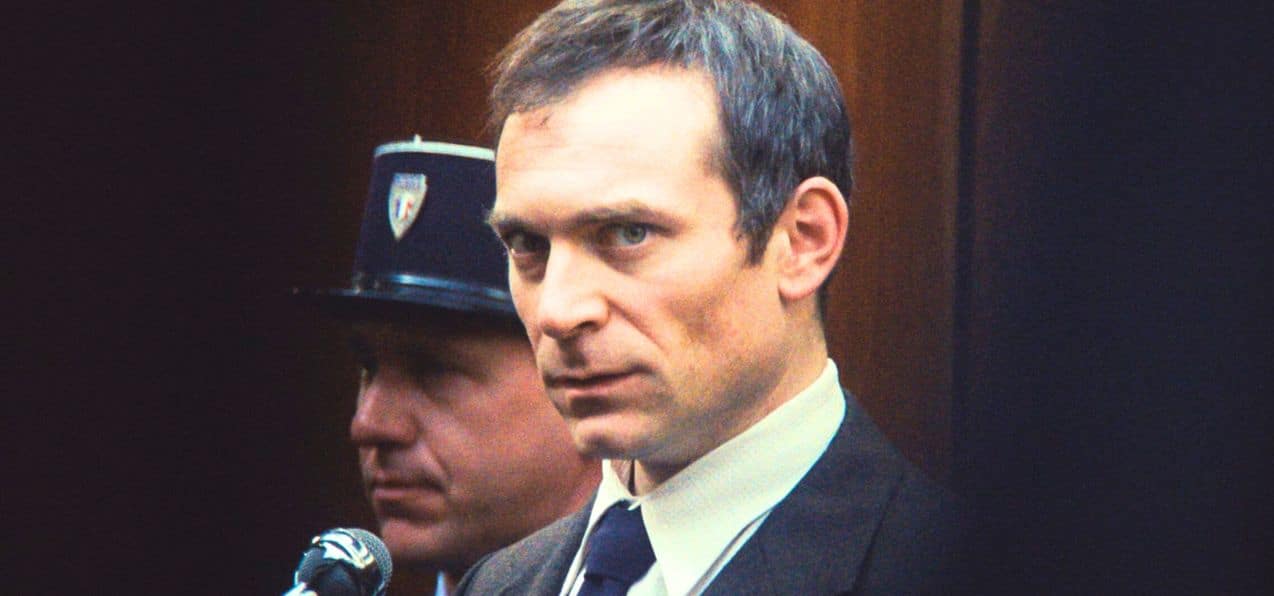
1976. Pierre Goldman, militant and intellectual from the far left, faces his second trial, after a life sentence handed down at first instance. He is accused of four armed robberies, including one that caused the deaths of two pharmacists. While the man admits the first three crimes, he maintains his innocence regarding the killings.
The press of the era pounces on the case, and Goldman becomes a major media figure, especially after the publication of his book, Obscure Memories of a Polish Jew Born in France. This figure and all his ambiguities are at the heart of Cedric Kahn’s approach. It’s easy to understand why, as the character fascinates with his ethical rigidity, his verve and his outbursts, delivered with disarming aplomb.
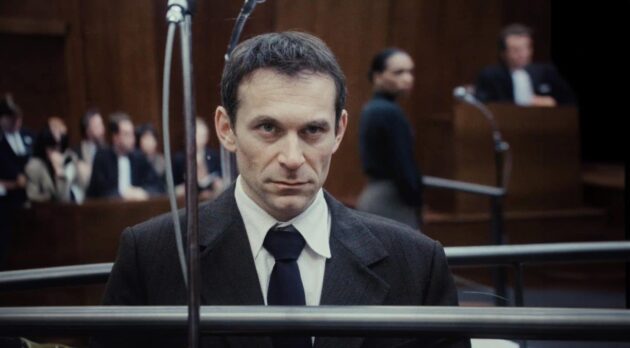
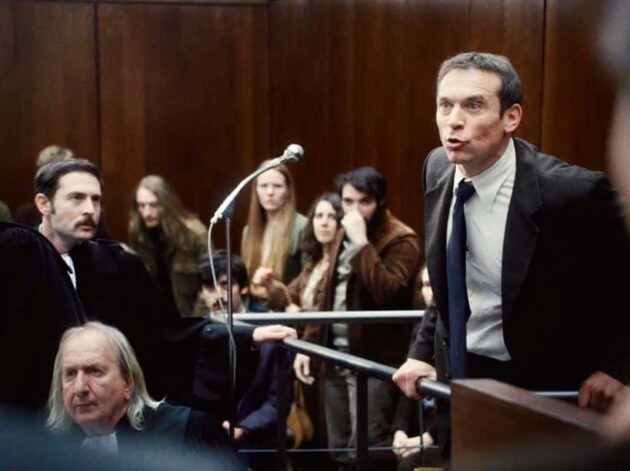
But from these diatribes emerge all the contradictions of the accused, notably when political reality (police violence, racism and antisemitism) morphs into paranoid outbursts. Where to draw the line? That is precisely the question the film makes its main stylistic device. With its sumptuous 1.33 frame, the camera traps bodies and faces in a suffocating square, where only the edges of the courtroom walls show, and above all that witness stand that Goldman refuses to use.
If he is innocent, he could prove it without the artifices of a spectacle in which his loved ones would testify to his behavior. With the same rigor, Cédric Kahn chooses to stage the case’s transcript, focusing as much as possible on the words that were spoken. We might fear that the The Goldman Trial would be a verbose film, stupidly tied to the facts. It is not the case.
On the contrary, the director concentrates on the appeal of this speech within a cinematic context. After all, what could be more millimetered and strategic than a courtroom drama? At the heart of the lawyers’ wanderings and the face-to-face with the judge, Kahn captures, above all, a tempo, with his shot-and-reverse-shot sequences pulsing with meticulous care, until the machine jams. Pierre Goldman’s anger (brilliantly embodied by Arieh Worthalter) keeps disrupting the unfolding of events.
Anatomy of a France
The case is too grave to unfold in flat, quiet terms, because it carries within it the upheaval of its era. This is the film’s achievement. Without ever leaving its enclosed setting, it touches the paradoxes of a France troubled by its recent history, beginning with World War II and its responsibility toward the Shoah.
In the face of such a heavy off-screen presence, the image would seem to stand as truth. Yet Cedric Kahn proves far subtler than that easy assertion. The image, too, is subject to interpretation. It remains dependent on a point of view, just as the words it can illustrate. It is probably no accident that cinema loves to play with this ambivalence, multiplying the “truths” to oppose them (the famous Rashomon effect).
If we can’t trust the image anymore, who or what can we trust? The question seems more pressing than ever in our era of perpetual information overload, which has also led the Rashomon effect to lose some of its finesse in contemporary cinema (The Last Duel and the “true truth” of its final act). We yearn to reassurance about this primacy, even as it deserves to be questioned.
Just like Anatomy of a Fall, The Goldman Trial draws its beauty from the image’s impotence. We will never see reconstructions of the events recounted, because they would merely sway our perception of circumstances we do not know. Cedric Kahn prefers to place us in the juror’s seat, with all the discomfort that entails.
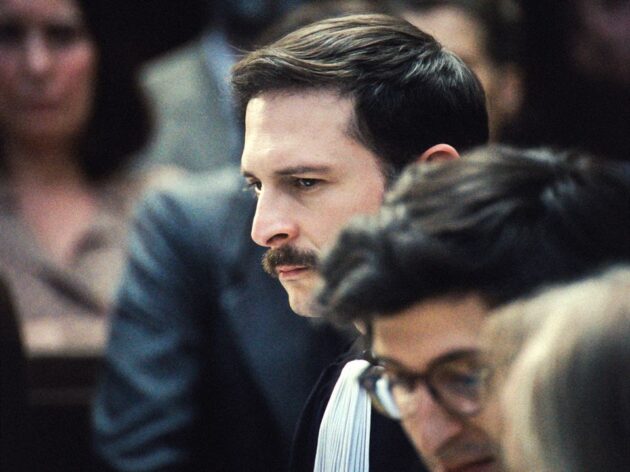
Dès lors, le film nous confronte à nos propres biais, tandis que la virtuosité de son écriture nous enivre autant que la qualité globale de sa direction d’acteur (Arthur Harari, co-scénariste d’Anatomy of a Fall, est fantastique dans la peau de l’avocat Georges Kiejman). Le cinéaste sait que l’éloquence de son protagoniste suffit à rendre son récit passionnant, mais aussi à le rendre sympathique. Cette parole, qu’elle vienne de la défense ou de l’accusation, se donne à voir, se met justement en scène.
Son sens du spectacle pointe du doigt ses propres limites et son insuffisance. Si la vérité et l’histoire ne sont que des suites de points de vue morcelés et rassemblés, que nous reste-t-il dans cette époque de post-vérité ? Pas grand-chose, si ce n’est les visages que Cédric Kahn filme comme autant de portraits fascinants. On peut toujours essayer, en vain, de sonder leur âme.

