
On the occasion of the 2026 FIFA World Cup, here are five football-themed films (plus a bonus) to binge during matches and movie nights.
Ecran Large has unfurled its finest scarves to talk football in its pages. Although this globally popular sport isn’t famed for its presence in cinemas, the art of the beautiful game as showcased by Michel Platini, Diego Maradona, Lionel Messi and Ousmane Dembélé (the Ballon d’Or) has yielded a few masterpieces that reveal the many facets of this magnificent team sport.
That’s why a quick survey of football in cinema is especially fitting during the World Cup period. So here is a list of five films to see absolutely (and a bonus one because we’re feeling generous). Naturally, much like Didier Deschamps (the France manager), we had to make some razor-sharp choices.
Shaolin Soccer
- Release: 2002
- Duration: 1h53
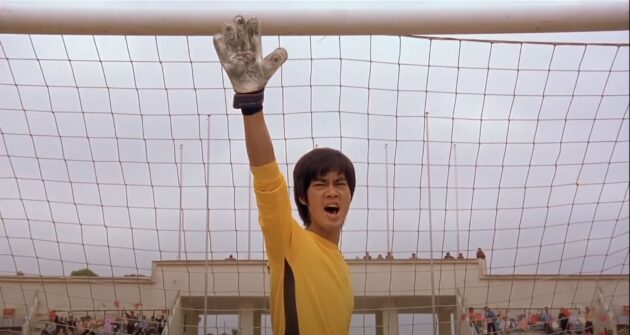
The concept? A fusion of kung fu and football, Shaolin Soccer follows Sing’s team. The aim is to win the league against the Evil Team.
Why is it so bonkers? Watching shaolins perform kung-fu moves on a football pitch makes viewing Shaolin Soccer unforgettable. The feature directed by Stephen Chow is a rare, exquisite pleasure. Indeed, the director of Crazy Kung-Fu is at the top of his game with his brilliant spoof of soccer. Constantly defying gravity, Shaolin Soccer is propelled by the extravagance of match sequences, offering a wild mash-up of the most far-out techniques.
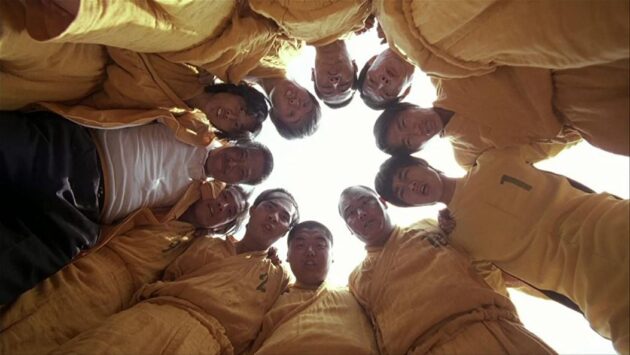
The logic and physics aren’t exactly on the table, but the movie does offer moments of poetry, partly thanks to Wei Zhao’s nuanced performance as the heroine who loves the hero, played by Stephen Chow himself. Additionally, the film delivers a sharp portrait of social inequalities in Hong Kong, where “every man for himself” seems to guide the lives of these characters.
Very playful, the humor mostly aims to not take soccer too seriously and keeps a frenzied pace with goofy gags. Despite the heavy use of special effects that sometimes rob the gestures of their authenticity, Shaolin Soccer remains an excellent, refreshingly silly entertainment that should be enjoyed with a cold beer and a good pizza. If some video-store fans remember its alternate title Shaolin Basket, Shaolin Soccer remains one of a kind.
The Headbutt
- Release: 1979
- Duration: 1h32
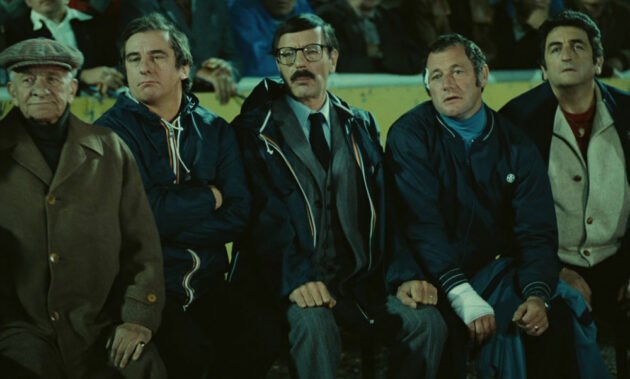
The concept? Patrick Dewaere plays François Perrin, the right winger for Trincamp’s football team. After another outburst, he’s fired from the team and loses his job at the local factory. He is also wrongly accused of rape and ends up imprisoned. Yet the team cannot play without him in the French Cup, and François is parachuted back into the squad.
Why is it so precious? The Headbutt is, above all, one of Jean-Jacques Annaud’s high points. Yet it didn’t meet the box office expectations, partly because Patrick Dewaere refused to promote it. More than a film about a team sport, The Headbutt is first and foremost a satire on the ownership of football clubs by provincial bourgeoisie. Indeed, the deft portrait of the town of Trincamp (the Guingamp stand-in, shot in Auxerre) and its inhabitants underscores the dominant role of football in industrial provincial towns.
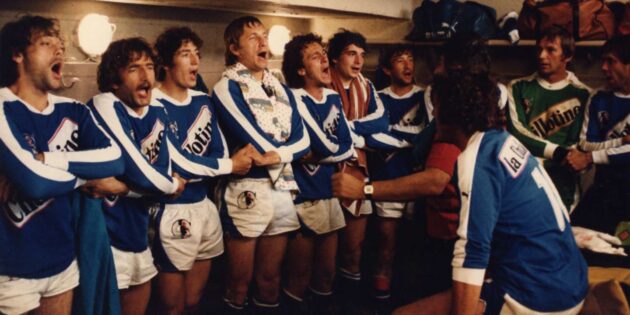
When you watch the film, it feels like you’re seeing an entirely different football. Today, players have become true athletes and the economics of the sport have evolved dramatically. Yet, the film precisely highlights the birth of the football business and the rising star culture around these athletes. This careful portrayal is largely thanks to the director’s massive effort, but also to the insightful guidance of coach Guy Roux. A famous coach of Auxerre, he provided invaluable help in staging certain football actions. Not to mention, the Auxerre team of that era contributed greatly to the film’s realism.
Finally, one cannot overlook Patrick Dewaere’s portrayal. The actor, best known for Les Valseuses and Série noire, delivers one of his greatest performances here. Supported by excellent supporting players, such as Jean Bouise who would win the César for Best Supporting Actor for the film, Dewaere manages to be funny while conveying a deep melancholy.
Death to the Referee
- Release: 1984
- Duration: 1h22
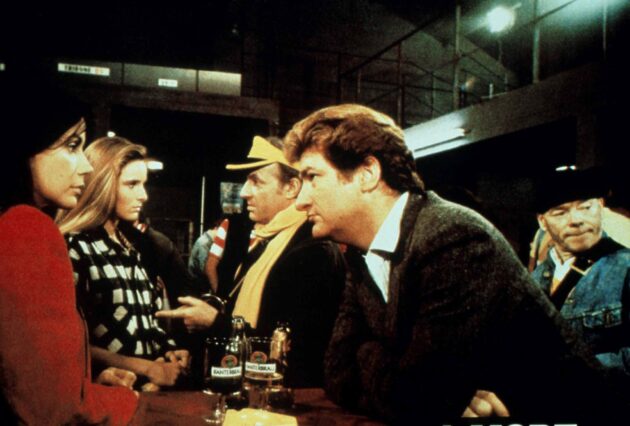
The concept? Referee Maurice Bruno, played by Eddy Mitchell, whistles a penalty that costs the local team. From blackmail to a frantic manhunt, the collective blaze, blind and deadly, sweeps through the town.
Why is it scary? After a start that stays close to the green rectangle, the director Jean-Pierre Mocky quickly veers away to deliver a tight thriller. In a sense, Death to the Referee isn’t easy on football. Indeed, through a narrative drawn from Alfred Draper’s novel of the same name, the director of Un drôle de paroissien and La grande frousse analyzes a France of workers sinking into football fanaticism.
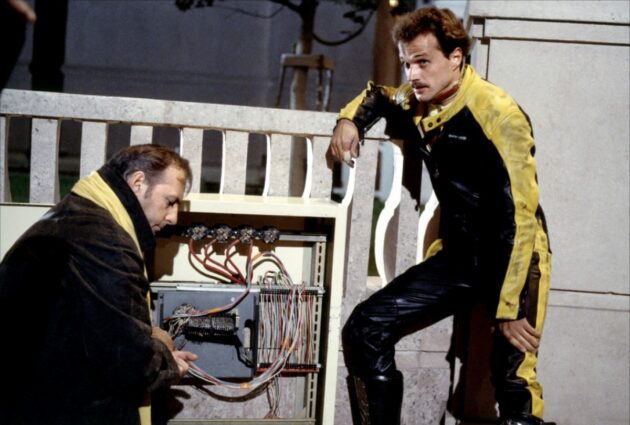
If these fans led by the excellent Michel Serrault seem, at first glance, friendly despite their vulgarity, they gradually become a literal embodiment of human cruelty. In its own way, Jean-Pierre Mocky creates his own zombie-film for which football is everything and whose thoughts cannot influence it. Behind this unflinching portrait of football fan excess (masculinity chief among them), ranging from insults to racism, including homophobia and various resentments, lies the distress of a working-class population abandoned by all.
These fans have only one outlet for joy (and frustration): football, a chance to be on the side of the victors for once. Yet, Death to the Referee is not a contemptuous portrait of this reality, but simply aims to show it as it is. This spotlight on football supporters from a French filmmaker gained some traction when it aired in a 1989 issue of L’Écran, following the Heysel disaster in 1985 and the Sheffield tragedy in 1989.
Victory
- Release: 1981
- Duration: 1h56
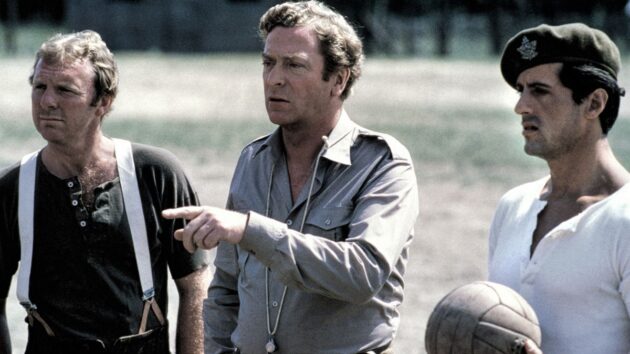
The concept? Rocky meets Pelé and Michael Caine and they team up to face Nazis in a soccer match.
Why is it so improbable? History and football collide more than once. For instance, at the 1974 World Cup, West Germany and East Germany faced off in a dramatic sporting and political clash. In the fictional world of Victory, 11-a-side football confronts World War II. The opening act unfolds at Camp Gensdorf in 1943, where our prisoner-football team begins to form.
Through the involvement of a former West Ham player played by Michael Caine, and thanks to Major Karl Von Steiner portrayed by Swedish actor Max von Sydow, a match between these prisoners and the German team is organized. The Nazis hope to capitalize on this match to bolster their domination in the eyes of the world.
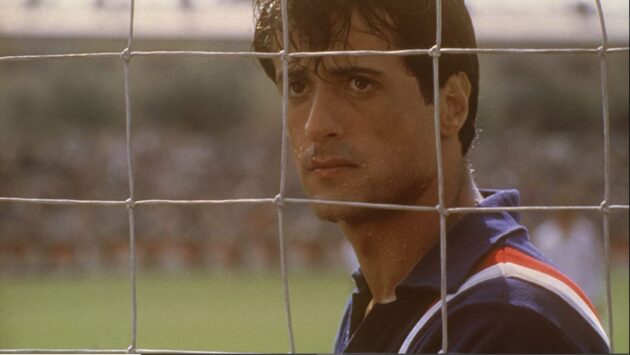
Inspired by a true story, the film’s main appeal is the presence of numerous football stars. At the top of the list, you have the great Pelé, who is surprisingly good here, but also for purists, Bobby Moore (England’s 1966 World Cup captain), Osvaldo Ardiles (Argentine, former Tottenham and Paris Saint-Germain player), Paul Van Himst and Kazimierz Deyna.
And where does Rocky fit in? Well, Sylvester Stallone gives soccer a try here and isn’t exactly a natural. He’d rather break free from the camp, but is forced to take part in this famous match and thus help his teammates gain their freedom. Despite limited footwork, he was assigned the position of goalkeeper, and it was Gordon Banks, the legendary 1960s English goalkeeper, who trained the actor during production.
Finally, to be frank, John Huston (The Maltese Falcon, The Misfits) wasn’t the most inspired choice for this commissioned soccer film and never expressed a true passion for football. With Pelé’s involvement as a special advisor, the on-field staging remains pleasant to watch, even if the offensive sequences feel a bit dated.
Looking for Eric
- Release: 2009
- Duration: 1h59
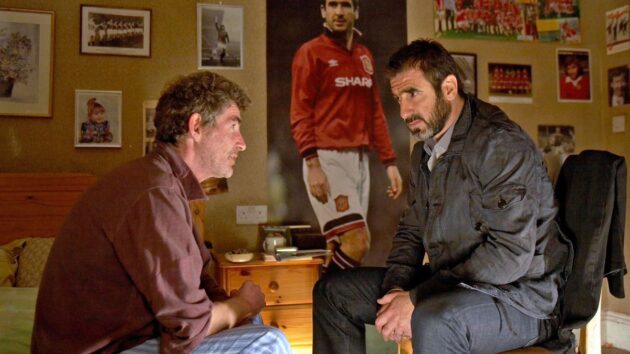
The concept? A Manchester postman is having a rough patch. One evening, he reaches out to his idol who, from a poster on the wall of his room, seems to be watching him with a mischievous eye.
Why is it touching? Everyone has probably hoped to meet their favorite star. In Looking for Eric, Eric Bishop (Steve Evets) lives that dream when Eric Cantona arrives at his door. The Manchester United icon becomes the “coach” of this unhappy Manchester postman. His two sons are into petty scams and his daughter accuses him of not measuring up. All told, a good life, tempered by a virtually non-existent sex life. And it’s thanks to football, friends, and especially Eric Cantona that Eric Bishop straightens out his life.
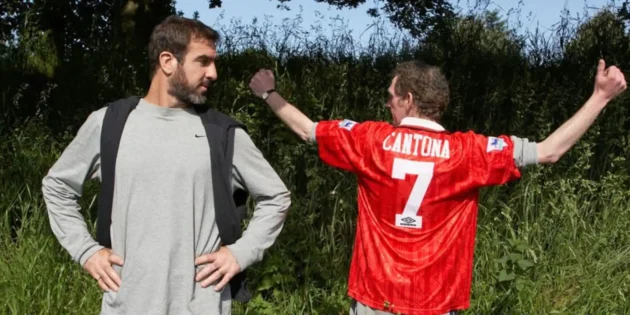
The English director Ken Loach is known for his love of football and has notably crafted a fictional portrait in My Name Is Joe of a second-rate club manager in Glasgow. Here, the director who has won the Palme d’Or for The Wind That Shakes the Barley and Me, Daniel Blake delivers a true ode to the great French player. Each appearance by Cantona captivates, not to mention his singular way with words.
Indeed, the former player with the turned-up collar teaches us that he is not merely a man, but Eric Cantona. These aphorisms are also enjoyable when paired with TV clips of his exploits cleverly woven into the film’s montage by Ken Loach. Behind this homage to the great footballer, Ken Loach once again offers a magnificent portrait of Britain’s working-class milieu, for whom football is a central pursuit. In the end, football supporters have never been so moving.
Bonus: Zidane, A Portrait of the 21st Century
- Release: 2006
- Duration: 1h30
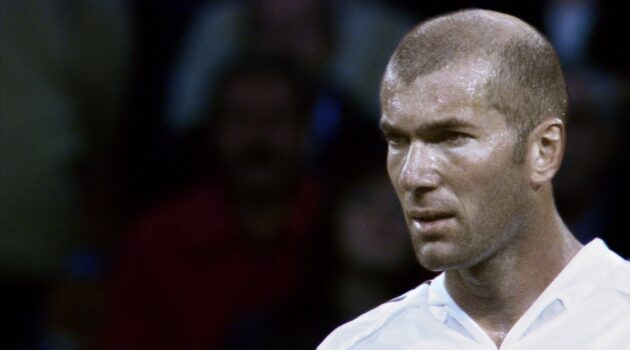
The concept? The impression of being Zinedine Zidane on the pitch with 17 cameras placed all around the stadium during a Real Madrid vs Villarreal match, in April 2005.
Why is it brilliant? Many would have loved to be inside Zidane’s head when he was the world’s best player. But above all, Zinedine Yazid Zidane is more than just a recognizable face. Between his legendary amused smile and his deep gaze, the defining star of a generation was more than just a player.
Comparable to a filmmaker or an actor, Zidane was the ultimate storyteller, capable of changing the course of a match on his own. This pairing of cinema and the player might seem abrupt, yet the two worlds aren’t that far apart. And with Zidane, A Portrait of the 21st Century, the artists Douglas Gordon and Philippe Parreno understood this by focusing 17 high-definition cameras on the star for a full match.
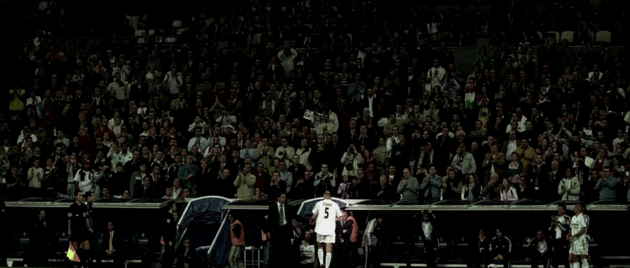
While the Villarreal match wasn’t particularly spectacular, something else was at stake here: time. Because when you’re a footballer, you sometimes have to wait, intervene in the play only in brief moments. Mostly, Zidane stays attuned to what’s happening around him, and the cameras capture only rare moments of what he’s watching.
The point is to go beyond the spectacle, because the small details of Zidane’s presence are what make the difference. Without a voiceover, only the images and ambient sound guide the viewer who admires this legendary player up close. Instead of seeing dozens of roulette-like feints, this Zidane reveals himself as decisive only twice: a decisive assist for Ronaldo, a red card, and then he’s gone. It’s worth noting that Zidane fans will also appreciate the few interview clips from the player that are intercut during the match.
