
The War of the Worlds featuring Tom Cruise, Justin Chatwin, Tim Robbins, and a young Dakota Fanning: why it’s the ultimate horror film of the new millennium, and an instant classic of science fiction.
Far from E.T. l’extra-terrestre and Rencontres du troisième type, Steven Spielberg’s The War of the Worlds is a science‑fiction classic, but it’s more than that. Because it unfolds in a post‑9/11 America where the threat comes from within, and erupts from the ground to reduce the population to dust, the Tom Cruise blockbuster becomes a modern horror film, with a handful of terrifying sequences and, above all, powerful imagery and symbolism. Explanations to deepen your appreciation of this masterpiece.
THE WAR OF THE MONSTERS
To begin with, there is The War of the Worlds, a novel by H.G. Wells published in 1897, which tells the terrifying arrival of aliens on Earth, following the nightmare of a narrator living in England. A story that reshaped the public imagination of science fiction, and gave rise to numerous adaptations. One of the most famous is Orson Welles’s radio adaptation, broadcast in 1938. It doesn’t matter that the myth of listeners wholly convinced by the broadcast to the point of triggering a nationwide panic has been widely exaggerated, particularly by a press that felt threatened by the then‑rising radio medium: this episode cemented The War of the Worlds as a cornerstone of the genre.
Decades later, two Hollywood demigods would seize Wells’s words: Steven Spielberg and Tom Cruise. Delighted by their first collaboration on Minority Report in 2002, an adaptation of a Philip K. Dick novel, the duo found a reason to reunite in an instant. The actor arrived with three projects in hand while the director was shooting Catch Me If You Can. One of them was an adaptation of The War of the Worlds, and the two men chose to move forward in a heartbeat.
For the director, it was obvious: he had purchased at auction a copy of Orson Welles’s radio adaptation and had toyed with turning it into a film, only to shelve the idea in the wake of Roland Emmerich’s Independence Day.
CLOSE ENCOUNTERS OF THE THIRD KIND
For the man who brought us Close Encounters of the Third Kind and E.T. The Extra‑Terrestrial, The War of the Worlds is Spielberg’s way of reinventing the genre. Farewell to peaceful, luminous aliens: enter bellicose extraterrestrials, visiting Earth with no purpose beyond destroying humanity. Kathleen Kennedy, Spielberg’s longtime collaborator, would later recall in promotion that E.T. began life as a darker film that gradually softened into this gentle fable. The War of the Worlds becomes a long‑overdue rendezvous for Spielberg, who would describe the mega‑production as his first “alien movie with no love and no attempt at communication.”
The action of the novel is relocated to the United States in a contemporary setting, both for obvious blockbuster logic and to better reflect the mood of America at the time. “We live under a veil of fear we hadn’t felt before 9/11,” the director told USAToday at the film’s release, with the specter of an urban catastrophe staining the landscape in deadly dust. It’s no accident that the hero’s kids question early on whether the threat is terrorist in nature, that a plane crashes later into the scenery, and that the military presence is so omnipresent.
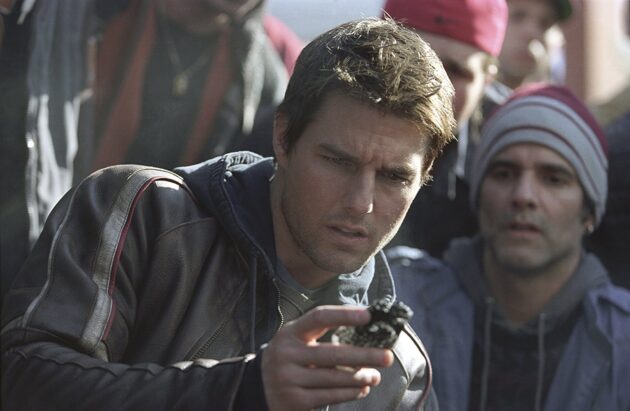
Among other changes from Wells, the disappearance of space‑born ships (massive cylindrical structures) is replaced here by a threat buried underground, beneath the asphalt of the cities. A way for Spielberg to depart from the genre’s well‑trodden paths, but also to emphasize the threat’s all‑too‑familiar nature, no longer coming from distant Mars in the book but rising from beneath civilization’s feet, ready to erupt in the middle of the population. A choice that also raises fascinating, terrifying questions about these aliens, who may have visited Earth in the past to hide, waiting for the right moment to awaken.
Josh Friedman wrote the screenplay, later revised by the renowned David Koepp, the screenwriter of Jurassic Park and its Spielbergian sequel The Lost World, and Mission: Impossible with Tom Cruise.
WE MUST SAVE THE FERRIER FAMILY
Steven Spielberg has offered a cascade of sensational images of wonder—the bike ride toward the moon in E.T., François Truffaut and the alien ship’s music in Close Encounters of the Third Kind, the majestically imagined dinosaurs in Jurassic Park, the imagination that fills the plates in Hook: he has given the world a trove of spectacular sights. He has also left a lasting imprint on the collective psyche with Jaws, or at least with a few shocking moments such as Donovan’s death in Indiana Jones and the Last Crusade.
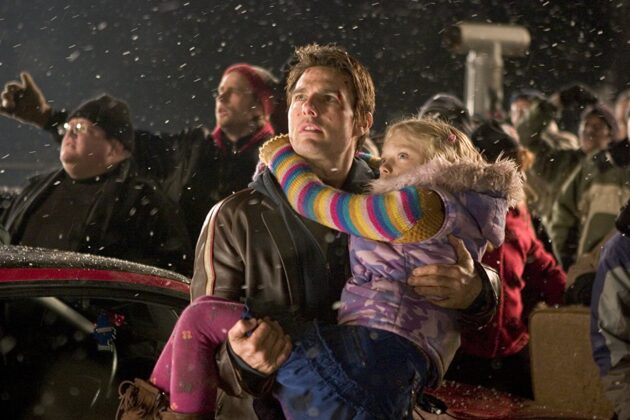
With The War of the Worlds, he pushes into the realm of pure horror. Once the attack begins, the film becomes an astonishingly nightmarish odyssey of violence, where the protagonist has no option but to run, driven by a primal instinct. Reduced to the status of a tiny creature that can only hide while waiting for the largest predator to find him, he embodies a certain Hollywood anti‑hero archetype—a grown kid who toys with danger before his terrified daughter, then hides under a table with her.
Of course, the trajectory remains conventional—the nightmare allows him to regain a bit of humanity and maturity, yet Spielberg withholds the true, conventional happy ending, leaving him in the street in front of the image of the family he has lost, with the almost absurd comfort when he reunites with his son. The fact that Tom Cruise embodies this washed‑out man, overwhelmed by fatherhood and the apocalyptic events, only drives the point home.
Dans ce décor d’apocalypse d’une pureté tétanisante, Steven Spielberg déploie une mise en scène fantastique. La première attaque des tripodes qui vaporisent les habitants paniqués et soufflent les maisons, la fuite dans la voiture en plan‑séquence étourdissant, la découverte de la zone du crash de l’avion : le cinéaste aligne les morceaux d’anthologie, aidé par ses fidèles collaborateurs Janusz Kaminski à la photographie, Michael Kahn au montage et John Williams à la musique.
Qu’un train sorti des enfers file à travers la nuit, qu’une vague de cadavres apparaisse sous les yeux de Rachel, qu’une horde de personnes paniquées s’attaque à la voiture des héros (dont un homme qui déchire le pare‑brise à mains nues et ensanglantées), que des vêtements tombent du ciel sur un paysage dévasté ou que Ray découvre au sommet d’une butte un territoire ravagé et rouge, et The War of the Worlds offre une vision d’horreur pure, celle‑même que l’on peut rattacher à la réalité de notre histoire collective — de la Shoah au 11 septembre.
Quand on se souvient que Wells établissait explicitement un parallèle entre l’invasion des Martiens et le colonialisme britannique dans son récit, le miroir moderne tissé par Spielberg est plus que logique.
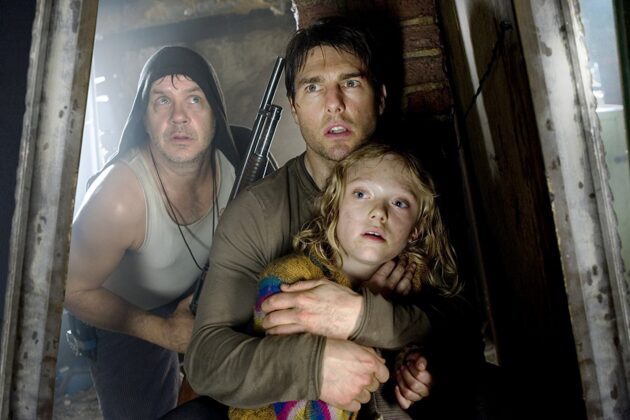
Et si le film souffre de quelques fausses notes (la partie avec Tim Robbins qui ralentit le rythme et pousse un peu trop loin la suspension d’incrédulité quant à l’intelligence des aliens, une fin assez proche du roman qui tranche avec la violence du récit, ou encore quelques effets qui manquent de finesse avec le regard d’aujourd’hui), il conserve une puissance folle, des années après. Une puissance qui va bien au‑delà des mots et du genre du film catastrophe et d’invasion alien, pour s’ancrer profondément dans l’imaginaire primitif du spectateur du XXIe siècle.
The War of the Worlds demeure ainsi l’un des films les plus percutants de Steven Spielberg, et un sommet en termes de spectacle hollywoodien et de réflexion sur son époque.
