Retro Filming
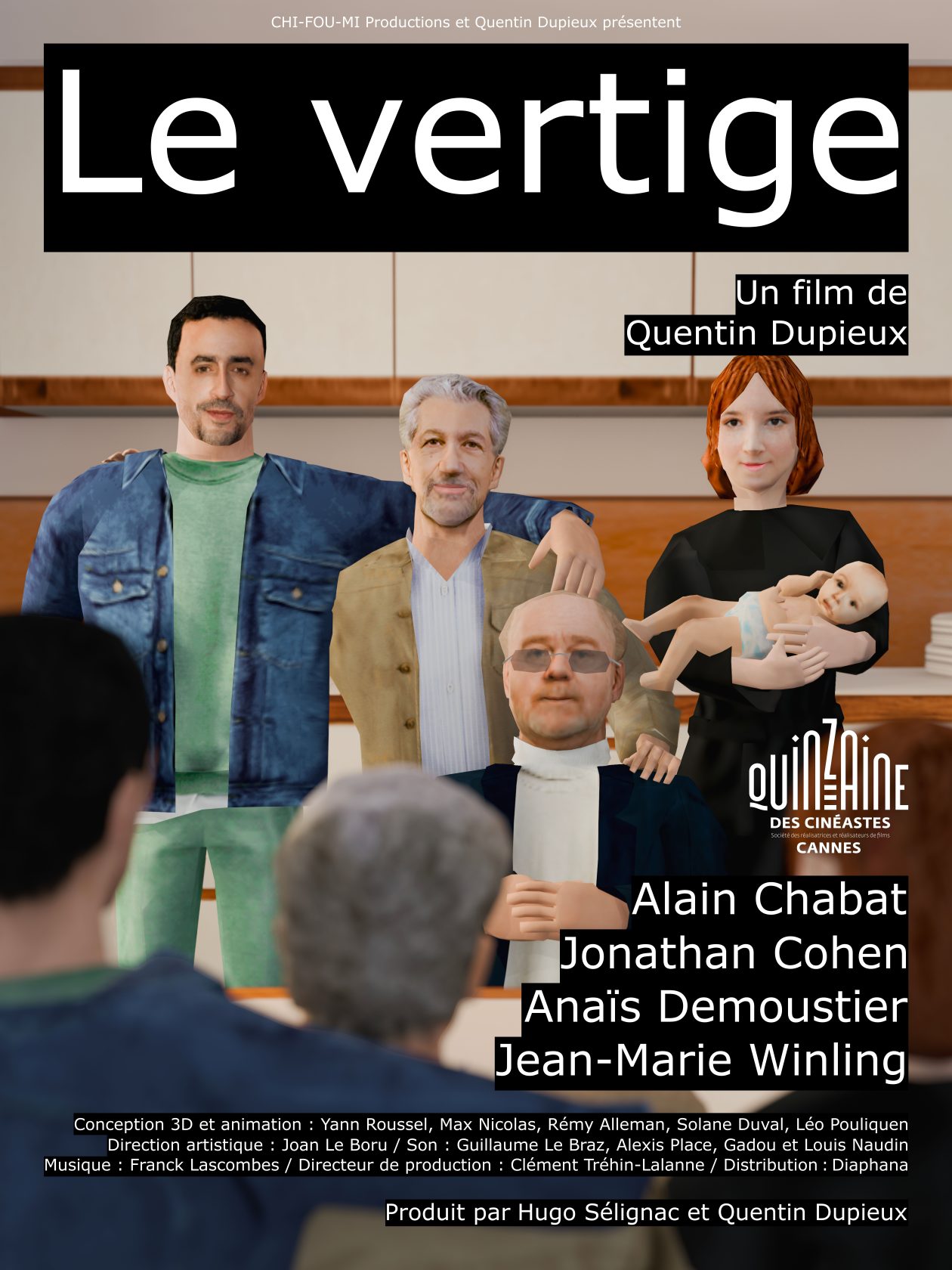
Sometimes we covet Quentin Dupieux’s ideas, or at least the ones we would have loved to have in his shoes. In front of Le Vertige, we would even find ourselves muttering at the effectiveness of his concept, which, in the end, isn’t all that revolutionary. Jacques (Alain Chabat) visits his friend Bruno (Jonathan Cohen) to tell him that they’re living in a simulation.
Although it was created in Blender (the 3D animation software), the film is a derivative of machinima, those captures inside a video game engine. The rough formation of bodies and the flat, low-res textures call up the early PlayStations, and Dupieux wastes no time in his opening in recreating Paris and the wonky interactions of materials, as Jacques’ finger presses the doorbell he’s touching.
From Knit’s Island to Grand Theft Hamlet, machinima has finally found its way into movie theaters, mostly in documentary form. One can witness the democratization of an aesthetic now anchored in our daily lives, on our smartphones or consoles, to the point where the inherent limits of real-time 3D begin to blur. For its part, Dupieux foregrounds this disjunction of bugs as the comedic sap and narrative heart of his program (it centers on a list of anomalies).
And one has to admit that this Matrix without the terrifying facade of a perfect simulation makes its little impact during its first third, even though this “visual nullity” is rarely renewed in its grammar. We therefore end up asking what Le Vertige is aiming for Le Vertige. Does it find its purpose in this split between its cinematic prestige and the poverty of its technique? Let’s say it’s a bit light, and as is often the case with Quentin Dupieux, the concept is quickly caught up by its development and execution.
Machinima
To be honest, the project seems tailored for film festivals, where it will easily stand as a curiosity for the back-row boomers who’ve never touched a gamepad in their lives. But, upon closer inspection, Le Vertige is far from pushing machinima into uncharted territory. The characters’ search for meaning confronts a fear of emptiness and the impossibility of justification. There is a Beckett-like waiting in this existential pause, except that the form had already traveled that road.
Machinima has often staged the player’s place in steering these virtual bodies, like a demigod puppeteer. The series Red vs Blue, set in Halo’s multiplayer, did not merely question the rules of those arbitrary clashes to which its fighters struggled to attach meaning. They wait for Godot, trapped in rigid lines of code that only reinforce the absurdity of the situations.

In comparison, Dupieux doesn’t pull more from his premise than another twist on the gap between fiction and reality, and more precisely on the urge of dramaturgy to force conflicts bigger and more improbable than the real thing, if such a fracture still has any value.
As always, the filmmaker is at his best when he leans into parentheses and digressions (a strength Chabat and Jonathan Cohen pull off with ease), in those moments of nothing where Baudrillard’s vertigo of the simulation reveals itself with less clumsiness.