
When it comes to projectors, the big brands all have compelling reasons to stand out from their competitors today.
The projector market has perhaps never been as diverse as in 2026, with a multitude of manufacturers each carving out their own niche to set themselves apart from rivals. And that inevitably gives buyers plenty of options: whether they’re seeking an ultra-short-throw model that’s ultra-bright for the living room, or a compact device for outdoor cinema sessions, they’re sure to find their happiness among the vast, diverse offering on offer.
For consumers, this diversity makes the choice even more complex because on one side you have the established players (Sony, Optoma, Epson, BenQ…) and on the other, a new wave of aggressive Asian brands focused on price-to-performance (XGIMI, Dangbei, JMGO, Yaber…). This also helps customers find something that fits their budget and their requirements.
Yet, everything hasn’t always been easy in recent years, as projector makers endured a long spell of hardship before a clear rebound in public interest— notably during the Covid period— which revived sales. And since then, the war is truly on between long-standing brands and new arrivals blooming in Asia.

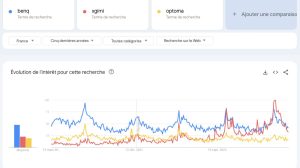
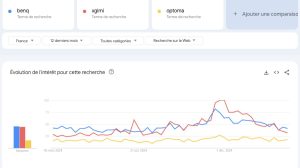
It’s also noteworthy to highlight the exponential growth of XGIMI, which has truly established itself as one of the “phenomenon” brands in recent years, even managing to double the historic Optoma in 2023 and then BenQ by late 2024— to the point of becoming the world’s leading maker of home projectors in 2024. Since then, the two traditional manufacturers have been neck-and-neck and have a lot to do to stand apart.
As for more generalist brands like LG, Hisense, or Samsung, which are also known for other product lines, it’s harder to gauge their real popularity with customers. The same goes for ViewSonic, whose PC monitor sales account for a large portion of its revenue, though it’s still interesting to compare with the other brands.
But then, what exactly are the distinguishing features of the major players you can find on the market today? And more importantly, what’s their strategy to come out on top? We take stock with exclusive data on these brands, listed in alphabetical order, along with their strengths and weaknesses in an increasingly competitive market.
Note: for each brand mentioned in this selection, we’ve done what almost no one does: ask for sales figures, return rates, recent bestsellers and development directions. Some brands played along while others— such as Epson and Sony— chose to remain silent…
BenQ: performance with environmental responsibility
“Bringing Enjoyment ‘N’ Quality (to life)” (“bringing pleasure and quality to life”), that is the message BenQ wants to convey through its initials. This Taiwanese brand, founded in 2001, has been delivering on it with flying colors, especially thanks to projectors that fuse quality, durability, performance and, more recently, a focus on reducing the environmental footprint of its products.

Unlike most other brands, BenQ quickly specialized in display technologies to master both consumer models and those aimed at professionals. This approach has allowed it to diversify its product lineup and even become the sole manufacturer to produce dynamic display screens that are double-certified Pantone and Pantone Skin Tones.
In terms of sales, the Taiwanese label also shows strong figures: it has been in the top 5 manufacturers in France for a decade, with some late-2024 launches like the GP520 projector already selling like hotcakes. The future objective is clear: expand home theater product ranges and push further in environmental sobriety while maintaining image quality balance via more efficient light sources such as LED or laser.
BenQ is also very present in the gaming segment with several models offering low input lag and HDMI 2.1 connectivity (enabling up to 4K at 144 Hz). Nevertheless, this manufacturer remains largely centered on DLP technology, which still has some contrast limitations despite solid color accuracy. We invite you to read our review of the BenQ W2720i conducted in April 2025, a 4K projector with impressive colorimetry.
Data snapshot:
- Global revenue: NC.
- France revenue: NC.
- Return rate: Under 2%.
- Top sellers: W4000i, GV31, TK700.
- Year founded: 2001.
- Headquarters: Taiwan.
Hisense: the winning bet on laser
Among the must-mention projector brands in 2026, it’s hard not to call out Hisense. This manufacturer was among the first to dive into laser projection and became the leader in ultra-short-throw laser projection, opening up numerous possibilities to assert itself in the market by offering luminosity far higher than standard projectors and with lower power draw.

Beyond its flagship models, the PX3-PRO and the C1, Hisense has expanded its range to cover almost every segment. Starting with the L9Q (5,000 lumens, Devialet speakers), the mini C2 Ultra (“Designed for Xbox”) and especially the XR10 unveiled at CES 2026— a long-throw RGB laser projector that can reach 6,000 lumens. An ultra-short-throw PX4-Pro is also expected during 2026.
Alongside this, Hisense can rely on its new partner Devialet to offer an even more immersive cinema and audio experience for its customers. All while maintaining its dominance in the ultra-short-throw laser projector segment, where the brand holds about 40% market share in volume and value (source: GFK – October 2024).
Moreover, it’s worth noting that the Hisense ecosystem remains very living-room oriented with stationary use: if its laser models are less suited to dedicated rooms than some rivals, they generally deliver a solid result in a bright living space. Purists, however, will likely lean toward 3LCD models from competing brands for true cinema-grade contrast and color handling.
Data snapshot:
- Global revenue: NC.
- France revenue: NC.
- Return rate: NC.
- Top sellers: PX3 Pro, C1, L5HQ.
- Year founded: 1969.
- Headquarters: China.
JMGO: a new Chinese brand with serious ambitions
Among the brands that are advancing slowly but surely, JMGO also ranks highly. This projector maker, born in 2011, clearly intends to give its rival XGIMI a run for its money with devices that are portable, stylish and high-performing. The arms race is thus on between these two brands, each trying to outdo the other with innovative technologies.

In this regard, JMGO leverages its in-house MALC triple-laser technology (now at version 3.0) that its Chinese rival would surely envy. But there’s more: the brand offers a revolutionary design with an built-in gyroscopic platform and an immersive audiovisual experience thanks to its two 10W speakers (Dolby Audio and DTS certified).
In 2026, the brand stepped up its presence in France by partnering with retailers like Fnac and Darty, whereas sales in the hexagon represented only about 10% of its global revenue in 2024. It also unveiled the O2S Ultra, notable for housing the world’s smallest laser TV, which we tested in November 2025.
Generally, JMGO clearly targets design-conscious users— as with the N1S Nano tested in June 2025 — who are fans of advanced laser technologies. However, some buyer reviews point to customer service that could be improved.
Data snapshot:
- Global revenue: $50 million in 2024.
- France revenue: About €4.5 million in 2024.
- Return rate: Under 15%.
- Top sellers: N1S Ultimate 4K, N1S Ultra, PicoFlix.
- Year founded: 2011.
- Headquarters: China.
LG: the manufacturer that can do almost everything
It’s a brand that needs no introduction; LG has long proven its prowess in television, and when it comes to projectors, it’s no wallflower either, delivering units that break away from the usual paths, such as the refreshing PF600U design. The South Korean company has also been noted for its ProBeam and CineBeam projector lineups, which have earned numerous awards.

Needless to say, LG doesn’t intend to stop there: the brand plans to continue expanding its projector lineup to deliver even larger, brighter and more color-accurate images with robust contrast. It also expects strong growth in domestic projector sales by 2030, as 4K content becomes increasingly democratized and pushes consumers toward bigger screens or projectors that save space.
Currently, most models rely on LED or laser light sources. Their webOS interface offers a comfortable and user-friendly experience, but the contrast and brightness are slightly behind competitors at the same price points. Yes, the “smart TV” dimension comes at a premium with LG…
Data snapshot:
- Global revenue: NC.
- France revenue: NC (3,000 projectors sold).
- Return rate: NC.
- Top sellers: CineBeam Q (HU710PB).
- Year founded: 1947.
- Headquarters: South Korea.
Nebula: the outsider aiming big in the portable projector market
Riding the wave of portable projectors, the Nebula brand has earned a place thanks to devices that maximize what their compact form factor can deliver. This includes integrating smart technologies that fuel ambitious plans for this year: to rank among the top five brands by sales in France and to establish itself as the leader in the national market by 2030.

And Nebula already has a number of compelling strengths, such as its significant impact on the DLP/portable projector market on Amazon and its strategic partnership with Google TV for official access to Netflix. This has helped it surpass the 500,000 sales milestone for its Capsule series worldwide.
However, note that the Nebula site was inaccessible in France in spring 2025 (it’s since been restored), and after-sales service is handled directly by retailers like Amazon or Fnac. This is not a trivial detail: when something goes wrong, everything may hinge on the retailer’s return policies and responsiveness. It’s wise to trust a brand, especially for portable devices that are meant to be transported and could take a beating…
Data snapshot:
- Global revenue: NC.
- France revenue: NC.
- Return rate: NC.
- Top sellers: Capsule 3, Cosmos 4K SE, Capsule 3 Laser.
- Year founded: 2017.
- Headquarters: China. Anker Group.
NothingProjector: the high-end specialist retailer
Renowned for its selection of high-quality projectors and displays, such as the excellent Black Series that we had the chance to test, NothingProjector (a distributor rather than a true manufacturer) has made ultra-immersive home cinema devices its calling card for years. By mastering ALR (ambient light rejection) technology and ultra-short-throw projectors, it now offers premium products for a striking theater experience in all circumstances.

To stand out from its main competitors, NothingProjector mainly relies on exclusive partnerships with well-known manufacturers, but also on the highly meticulous build quality of its products and its outstanding after-sales service (return rate of just 2–3%). This is reflected in its financial results, with “over €2 million worldwide in 2024” from screen and projector sales like the NothingProjector Black Series ALR/CLR and the Formovie Theater Premium, including around €1 million in France.
NothingProjector’s ambitions are already high, as it now distributes in Europe AWOL Vision projectors, including the impressive Aetherion models. It continues to push for ever more innovative and affordable displays in the future, as well as audio devices.
Data snapshot:
- Global revenue: €2 million in 2024.
- France revenue: €1 million in 2024.
- Return rate: less than 3%.
- Top sellers: Formovie Theater Premium, Formovie Theater, Nothing Projector Black Series ALR/CLR (in-house product).
- Year founded: 2019.
- Headquarters: France.
Optoma: technological innovation in the service of entertainment
Since its inception in 2002, Optoma has embraced three guiding principles for its projectors: innovation, reliability, and ease of use, for both home users and professionals alike.

Thanks to its projection expertise, this Taiwanese brand can integrate a wide range of high-end technologies while keeping prices attractive for customers. It also places emphasis on making its projectors accessible to all users, including beginners. By delivering broad customer satisfaction, Optoma can boast a very low post-sale return rate (0.1–0.3%) and roughly 300,000 projectors sold in France in 2024.
Meanwhile, Optoma has made a splash with the UHZ68LV— its 4K flagship with bi-laser technology, 5,000 lumens, and Dolby Vision— now marketed around €4,500. The brand has also ventured into the lifestyle segment with the Photon Go, a portable model featuring a triple-laser ultra-short-throw and Google TV OS.
However, Optoma remains very DLP-centric with lamp or laser technology, with familiar drawbacks: occasional noise, rainbow effect that can disturb some viewers, and grayer blacks than top-tier references on the market.
Data snapshot:
- Global revenue: NC (300,000 units sold).
- France revenue: NC.
- Return rate: Between 0.1% and 0.3%.
- Top sellers: HD28, UHD38x and HZ40HDR.
- Year founded: 2002 (Coretronic Group).
- Headquarters: Taiwan.
Samsung: the brand that honors design
When you think of LG, it’s hard to separate it from its Seoul rival Samsung. And as with most of its products, the Asian maker has focused primarily on the design of its projectors to ensure they blend seamlessly into the living room. Its The Freestyle and The Premiere models, which were the top sellers in 2024, are perfect examples as they combine discretion with performance. Additionally, Samsung has added innovations like 180° orientation and a 3-hour battery that lets The Freestyle projector be used without constraints.

To stand out, the Korean maker continues innovating with its new laser models in the The Premiere line announced at CES 2025, which can transform into touchscreens. They maintain their elegant, practical design and still offer new apps to watch streaming TV. A trend that’s gaining momentum as traditional decoders fall out of fashion.
Samsung can look to the future with confidence since the manufacturer sits among the leaders in the ultra-short-throw projector market. Its strategy is clear: target the audience looking to replace a television in the living room with a stylish, connected device. For mixed use (TV, movies, sports events…) in a relatively bright room, there’s plenty to be found among its range.
Data snapshot:
- Global revenue: NC.
- France revenue: NC.
- Return rate: NC.
- Top sellers: The Freestyle, The Premiere 7 and The Premiere 9.
- Year founded: 1969.
- Headquarters: South Korea.
ViewSonic: experience oriented toward novelty
In our roll call of must-have brands in the projector market, it would be a pity to overlook ViewSonic. The American maker leverages nearly 40 years of audiovisual know-how to deliver visuals that are truly immersive. Beyond image quality, their products are also easy to use and offer a compelling value-for-money proposition.

Compared with competitors who enjoy greater notoriety (BenQ, Epson…), ViewSonic has evolved in many areas to stand out: notably with the multifunction feet on its portable projectors that have earned several IF Design Awards, plus its Xbox-oriented products that lend it credibility in the gaming sector. The brand has also built a true ecosystem that allows several screens to be connected together to offer a smoother experience for users. A real advantage without inflating the bill too much.
Looking ahead to 2026, ViewSonic has clear goals: to strengthen its presence in the French market, but also to develop its new 3LCD projector range aimed primarily at the education sector. The American brand also commits to lowering the carbon footprint of its products by 2030.
Data snapshot:
- Global revenue: NC.
- France revenue: NC.
- Return rate: Around 2%.
- Top sellers: M1, M2e, X1000-4K.
- Year founded: 1987.
- Headquarters: United States.
XGIMI: the new kid on the block aiming to shake the giants
Here’s a brand we’ve discussed at length, including in our guide to its nine best projectors. It’s clear that XGIMI has left nothing to chance and demonstrates that it’s possible to make a name for itself in this sector and stir the pot among the giants by entering the scene later than many, having been founded in 2013.

Despite this, it has brilliantly kept its bet on offering entertainment solutions that fit all use cases, whether for quick at-home “plug and play” setups or for nomadic use. XGIMI rapidly aligned with major French retailers— Fnac, Darty, Boulanger and Son-Video— to cement its presence in France. To keep acquisition costs down, the Chinese conglomerate has even built its own factories to control the entire supply chain.
Thanks to this approach, XGIMI has managed to sell over 7 million units worldwide and establish itself as a major player in the connected-projector market. On top of the impressive figures, the company can also boast a very low return rate, a French-speaking after-sales service that seems to win most customers over. XGIMI is aiming for 2030 to stay at the forefront, facing rivals JMGO and Dangbei who continue to push hard.
However, the brand’s projectors still have a way to go to truly rival current home-theater references, primarily due to contrast and HDR handling gaps. But that is not their goal: the aim is to make connected projection accessible to as many people as possible.
Data snapshot:
- Global revenue: NC (7 million products sold since 2013).
- France revenue: NC.
- Return rate: NC.
- Top sellers: Halo+, MoGo 2 Pro, Horizon Ultra.
- Year founded: 2013.
- Headquarters: China.

Honorable mentions
To round out our lineup, it would be a pity not to mention a few lesser-known brands that are starting to emerge, such as Dangbei and Yaber, the latter appearing in our roundup of projectors that could shake up the market. They also bring solid advantages, especially with models that deliver an excellent quality-price ratio.
In parallel, Epson and Sony should also be noted; although we didn’t receive enough detail in their responses, they remain firmly established among the brands that sell the most projectors. The question now is whether they can hold their ground against the increasingly strong challenge posed by Chinese brands, which are fast becoming their top threat.
