
Beyond Indiana Jones, Jaws, Jurassic Park and all the classics, what are Steven Spielberg’s best films?
There are a lot, a lot, a lot of possible answers to the question, “what are your favorite Spielbergs?”. And among the most natural options, there will surely be the Indiana Jones saga (at least the first three), E.T. the Extra-Terrestrial, Jaws, Close Encounters of the Third Kind, Saving Private Ryan, Schindler’s List, or even The War of the Worlds – yes, yes, we know your favorites are likely missing, the list is long anyway.
But at 62 years and 36 feature films, Spielberg has of course faced a few hurdles, with films less beloved, less celebrated, and sometimes almost “forgotten” – a word to nuance, since we’re talking about Spielberg after all. So we felt compelled to revisit 10 films (ranked in chronological order) that don’t necessarily strike universal agreement, but deserve another conversation.
Warning: the presence of certain films defended by one or more members of the team elicited a few mocking laughs at editorial time.
Sugarland Express
- Release: 1974
- Running time: 1h48
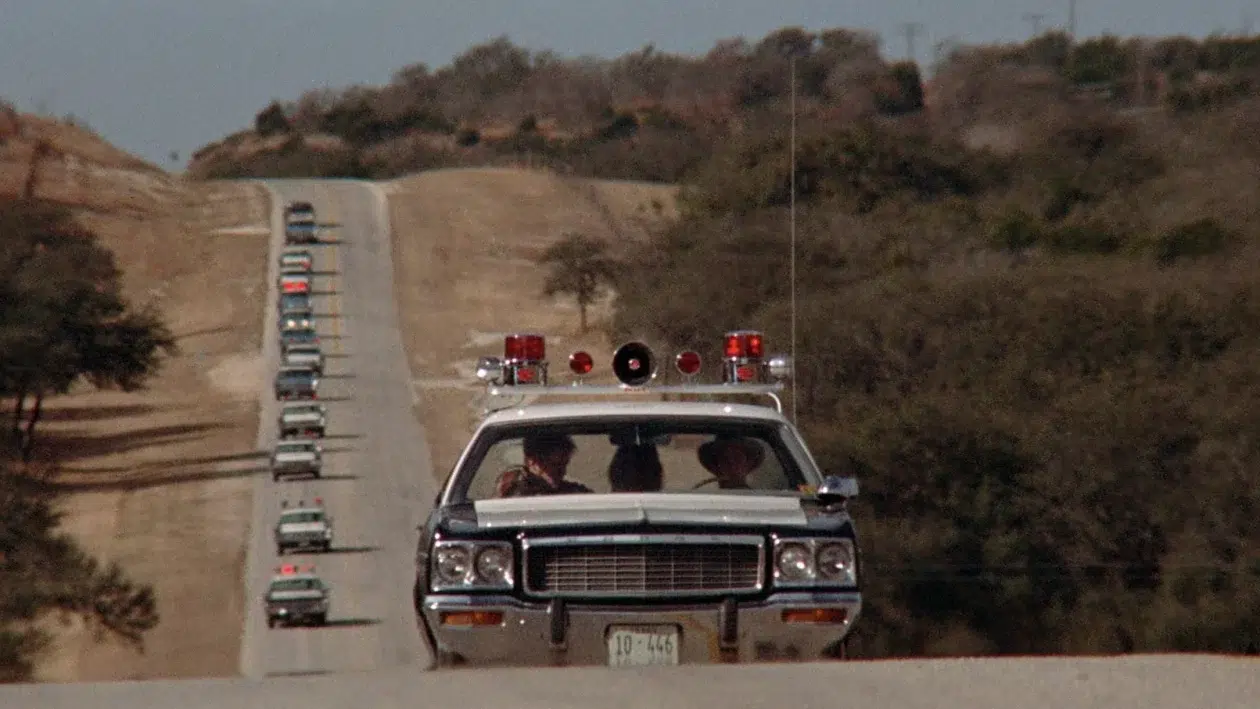
Often considered as the first film in Steven Spielberg’s career to belong to the world of cinema (even though Duel is technically a TV movie), Sugarland Express remains one of his most polished early works, perhaps even more controlled than Duel. Based on a scenario by Hal Barwood and Matthew Robbins (adapted from a true story) and winner of the Best Screenplay award at Cannes in 1974, Sugarland Express follows a marginal couple who kidnap the child they’ve lost custody of and take a police officer hostage. What follows is a road movie in which the couple is pursued by a horde of cops in a manner that’s as absurd as it is lyrical, elevated by Spielberg’s already sophisticated direction (mirror play, playful wink when seen through the camera, intentionally extended takes).
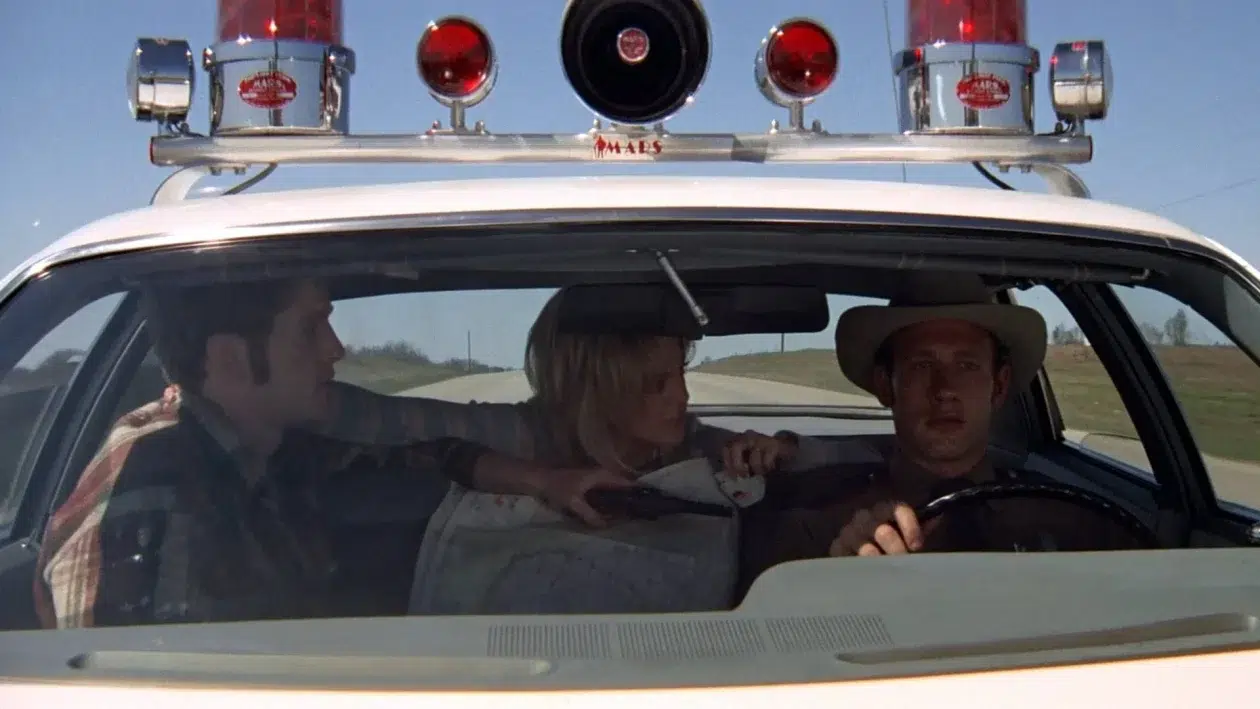
Steven Spielberg would showcase his talent for taut chases for the rest of his career (the Indy films, Minority Report, Ready Player One…), but never has he filmed a car ballet with the same tenderness as in Sugarland Express, where the story unfolds almost in slow motion. It might seem counterproductive, but it yields a touching melancholy rather than a drawback.
Before his highly political Jaws, he was already turning his gaze on an America (late ’60s) full of paradoxes, between a heroic myth-making, a media fervor, and a brutally unjust system toward the most vulnerable. A very beautiful film that already holds much of Spielberg’s heart, and deserves far more consideration.
1941
- Release: 1980
- Running time: 1h58

Pinned squarely between the historic Jaws, Close Encounters, Raiders of the Lost Ark and E.T. (!), 1941 has long been considered the odd duck of Spielberg’s early career, the critical flop, a kind of anomaly since it is a broad comedy—a genre Spielberg would avoid touching for the rest of his career. The director himself has admitted ignoring warning signs, still drunk on the success of his two previous films. He says this experience taught him a lesson in humility.
Messy as can be, it nevertheless bears the stamp of the filmmaker, who revels like a kid with cranes and other equipment sweeping through crowded sets. If not everything lands, he keeps blasting out wildly imaginative sequences with a zeal that foreshadows the Blues Brothers vibe (John Milius, Jim Belushi, and Dan Aykroyd all appear in the credits) and often lands. The garden cannon, the debates between Christopher Lee and Toshirō Mifune (yes, really), the Los Angeles battle, the opening scene that parodies Jaws and prefigures a taste for self-citation that Spielberg and Lucas would bring to Hollywood… So many delirious, sardonic moments. 1941 remains the most irreverent entry in Spielberg’s body of work, to the point that John Wayne reportedly balked at being offered the role of the general back then.
Empire of the Sun
- Release: 1987
- Running time: 2h32

Empire of the Sun is part of Spielberg’s reputation for understated genius that nonetheless wins over everyone who crosses its path. A bold adaptation of J. G. Ballard’s semi-autobiographical novel, in which the British writer recounts his childhood as a prisoner in a Japanese camp during World War II, this narrative taps into many of the director’s obsessions—from a child’s psychology in the face of adversity to the nostalgia of a lost paradise, all threaded through the ambiguous poetry of aircraft (yes, more airplanes again).
Today, Empire of the Sun is most often cited as the true birth pangs of Christian Bale’s career, with Bale playing the lead at barely 12–13 years old, carrying the film’s 2h32 on his young shoulders, and handling the weight of maturity and range that comes with it. And yet, it would be a mistake to reduce the film to just that breakout performance; the directing genius—the sequence in which Jamie’s dream of flying a paper plane crashes into the war’s grim reality, the soaring John Williams score that keeps Jamie’s childlike spirit alive even in the worst circumstances, and the masterful use of symbols and their political dialogue (Norman Rockwell’s Freedom from Fear as a motif)—makes Empire of the Sun a gem that ticks every box of a great Spielberg.
Hook or the Revenge of Captain Hook
- Release: 1992
- Running time: 2h16
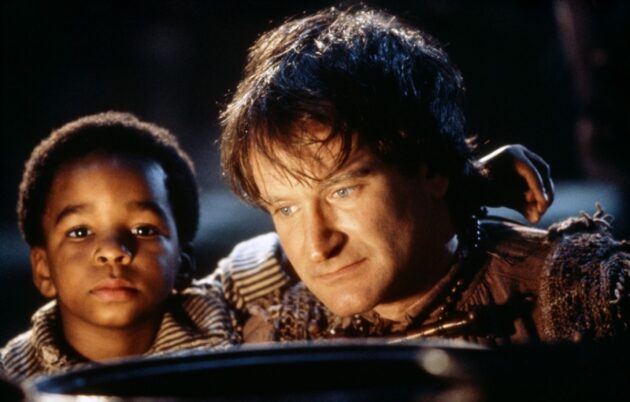
As Crochet would say: “Lying, me? Never! The truth is far too entertaining.” So know that the person writing these lines puts Hook in their top 15 Steven Spielberg favorites, and in their top childhood films. Yes, the pace is uneven, some characters lack real substance and hide behind the easy argument of “memory bait.” But one can acknowledge that this reimagining of Peter Pan possesses a regressive sweetness that lands (wink). Between the garish costumes, the joyful vaudeville, and especially the enormous, overstuffed sets that give the whole thing a theme-park atmosphere, there is plenty to enjoy.
Many criticize the film for a certain naivete, far from the bittersweet clarity of E.T., but behind its clowns and its good vibes, Hook is also a deeply melancholic tale. In addition to echoing Spielberg’s own trajectory, the film partly centers on the unwavering resilience of Wendy and Tinker Bell, who had to grieve the love of their lives so he could fly on his own. A little like Elliott with E.T., in the end. John Williams’ magnificent score more than compensates for any visual or narrative gaps.
And because the editor (yep, that gives away a little) indulges in a touch of sentimentality: Hook is as awkward, unruly, and ardent as the Lost Boys, if not Peter himself. Ah, and there’s also that tasty line, delivered before the release of Jurassic Park: “We always leave feathers in the evolution of a society; would these gentlemen regret the Tyrannosaurus rex?”
The Lost World: Jurassic Park
- Release: 1997
- Running time: 2h09
There are plenty of reasons not to love the sequel to Jurassic Park. For instance: Kelly’s gymnastic sequence as a raptor ponders the plot’s not-so-smart logic (David Koepp’s script). Spielberg is more than happy to gently poke fun at his own film, having often said over the years that he probably shouldn’t have embarked on this project. The Lost World certainly earns its place among the worst the lesser entries in his filmography.
But that’s where you see a great filmmaker at work. Even as a straightforward studio product, where a large share of the passion seems to have flown the coop, there are more pure cinematic moments here than in most comparable blockbusters. The Lost World is full of memorable beats, from the diabolical opening where a little girl discovers that cute dinosaurs aren’t toys (with the stunning editing showing Jeff Goldblum yawning) to Stark’s death at the hands of the same creatures, through the line “DO NOT GO INTO THE TALL GRASS!” and the dream of a T-Rex in the city (much simpler, more satisfying, and honest than anything in Jurassic World 3).
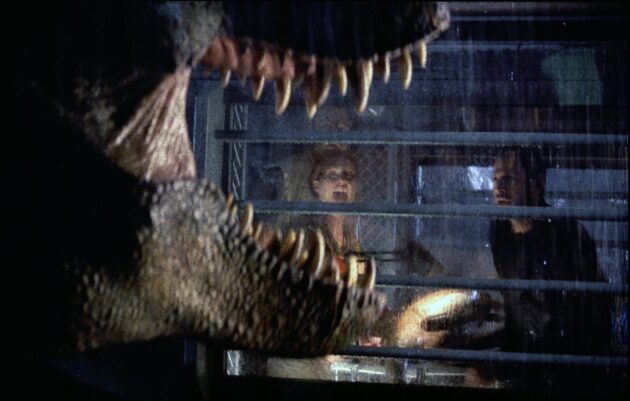
Yet if there is one great cinema moment in The Lost World, it’s the caravan attack by dad and mom T-Rex. The creature’s eye peering from behind the characters, Julianne Moore’s glass shattering in front of the camera, Williams’ score surging, the phone cord slipping, diabolical editing… Seven minutes of sheer exhilaration that demonstrate masterful staging and justify revisiting the film — and including it in this list.
Amistad
- Release: 1998
- Running time: 2h28
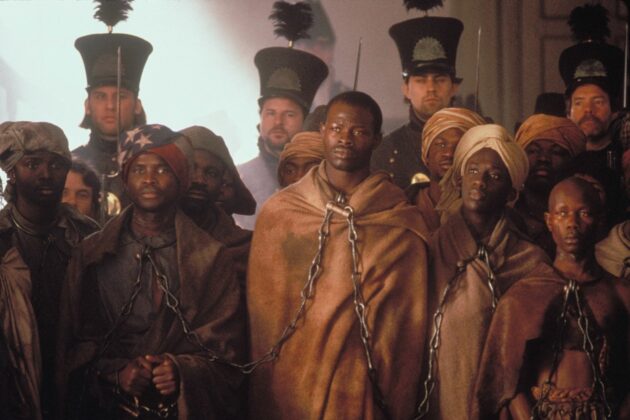
Amistad came out five years after Schindler’s List and the debates that accompanied it. The director did not abandon his stance on the representation of historical barbarity. He again chooses to focus on a specific event, here the trial that followed the slave revolt aboard a slave ship, turning it into the catalyst of a systemic violence on a grand scale. The real Joseph Cinqué is brilliantly played by Djimon Hounsou, surrounded by a stellar cast: Morgan Freeman, Anthony Hopkins, Matthew McConaughey…
The approach can always be debated, especially since Spielberg does not hesitate to stage the absolute horror of slaves being thrown overboard. But the filmmaker allows himself, in this case, to step slightly away from classic Hollywood dramaturgy to really emphasize the morbid absurdity of the situation, reducing men to objects that can be discarded and deprived of their right to rise up against their tormentors.
That it’s seen as a minor film by many is partly because after the nightmare tension of the first half, it settles into a jargon-filled courtroom. But it is precisely the astonishing and despairing gap between these two realities that forms its argument, perhaps clumsy, but one we may be wrong to forget so quickly.
The Terminal
- Release: 2004
- 2h08
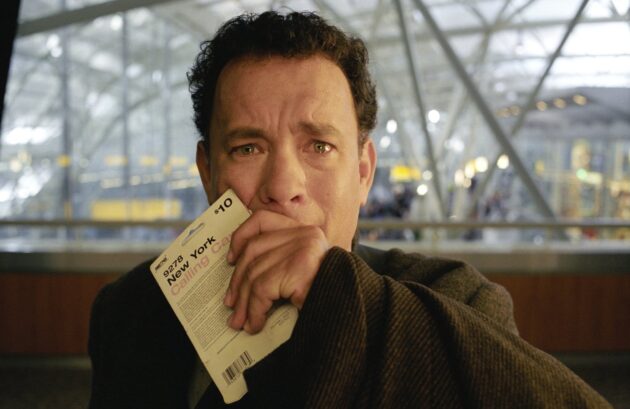
Often regarded as one of Spielberg’s most minor films, The Terminal sits between the epic Catch Me If You Can and The War of the Worlds (not great for it). But our list shows how humanist sensibilities can sound even when he’s working inside a lighter comedic frame, and Tom Hanks’s natural warmth keeps a delicate tonal curve on track.
By telling the story of an apatriotic passenger stranded at John F. Kennedy International after a coup in his fictional Krakozie, Spielberg builds a study in tolerance that relies heavily on a singular stage—an airport, a microcosm of American society where contrasts and absurd moments coexist with genuine humanity.
War Horse
- Release: 2012
- Running time: 2h27
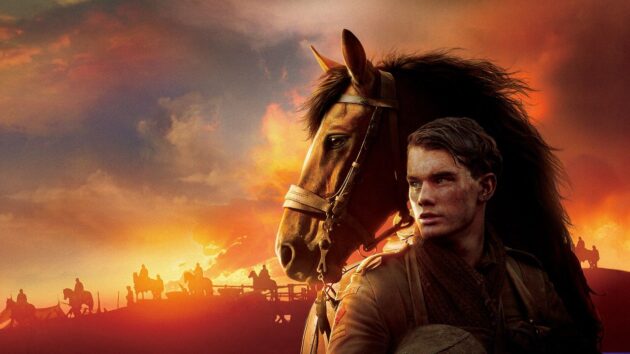
Some critics accused War Horse of classicism and naive sentiment, as Spielberg summons cinematic imaginations (the Western, the war film) only to redirect them from their epic, glorious impulses. Yes, it is about heroism in various forms, embodied by the “masters” of the horse Joey as he’s requisitioned during World War I. In the manner of Bresson’s A Man Escaped, the horse travels from hand to hand, from camp to camp, a neutral being distant from easy anthropomorphism or the moralizing of war.
All that remains is the death that strikes at the end of each chapter, rewriting pride or courage in the wake of disaster (a devastating off-screen disappearance of Tom Hiddleston during a chase). Spielberg has, as always, a devastatingly effective ability to land moral blows that underscore the relentless violence of history. Joey trots along the time line as the film’s only moving hinge, the real backbone of a movie haunted by the bodies it leaves behind. This is why War Horse reaches its dramatic peak in that no-man’s-land chase sequence, a devastating push forward where flesh fights against the cold modernity of mechanized war.
Undoubtedly, the lingering memory of Saving Private Ryan may have disappointed in the face of this more “family” approach to war (perhaps). Yet, once you pass its superficially idyllic opening, War Horse places itself in a similar austere, pessimistic continuum.
Indiana Jones and the Kingdom of the Crystal Skull
- Release: 2008
- Running time: 2h03
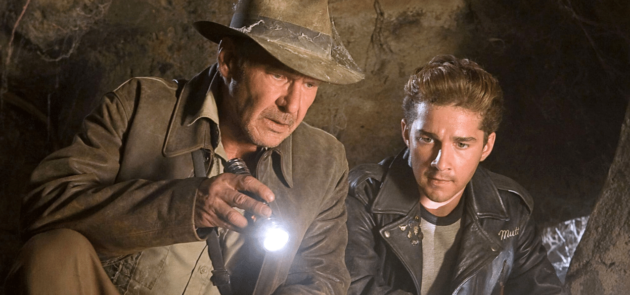
Among all the films on this list, this is perhaps the one that was most anticipated. Over the years, the general disappointment surrounding the fourth installment of the saga has been amplified by the internet, which has surely made it a benchmark for the so‑called Spielberg “bad taste.” Although the film suffers from various narrative problems and a climactic moment that’s a bit weak, the discontent concerns mainly the movie’s theme, deemed ridiculous by the connected fanbase.
Indiana Jones, being pulp-adventure fantasies of nostalgia, was always going to dive into the kitschy Cold War-era science-fiction and paranoia. And right from its amazing first action scene, which rapidly sweeps through genre and period imagery, you understand that Spielberg is going to approach it with generosity. From Cate Blanchett’s gleefully villainous Russian to the conspiratorial gears of the plot, the film is a treat for anyone who enjoys flying saucers and caricatured communists.
Beyond its inspirations, it remains one of the last true old-fashioned adventure films, unafraid to truly hazard its protagonists, even if it massacres its henchmen (the ant scene!), builds gigantic set-pieces (the jungle segment), and dares the impossible (the infamous fridge scene, deliberately comedic). All of these strengths largely outweigh its few flaws. Like Shia LaBeouf’s character. Yes, that’s fair.
The BFG
- Release: 2016
- Running time: 1h57
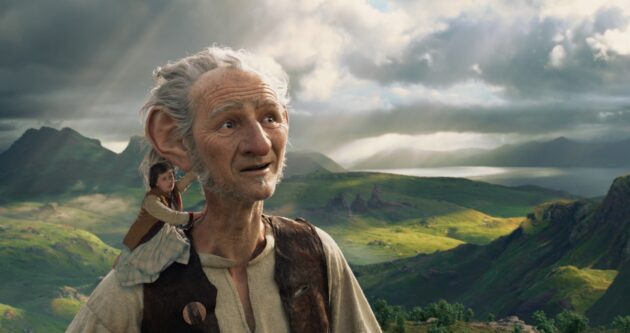
Okay, Queen’s corgis aside, reducing this Roald Dahl adaptation to its most childish, scatalogical elements wouldn’t do justice to Spielberg’s gift for storytelling. In the vein of his Tintin work, The BFG extends the digital-era experiments of cinema, while bringing the tactile world back into the equation. The film’s masterful opening sequence—a game of hide-and-seek where shadows and light shape our perception and the forms we see—proves the point.
This binary thread runs throughout the feature (smallness vs. grandeur, physical vs. digital, human world vs. giant world) with the camera and transition work that’s become his signature. This filmmaking prowess serves as a bridge from one world to another, an osmosis of dimensions that erases borders, just as his narrative-by-image technique can do.
Mark Rylance’s interpretation of the giant serves as an alter-ego to an author in full introspection about the power of his art on reality (the film sits alongside Bridge of Spies and The Pentagon Papers, historical dramas about the importance of a shared truth). Seeing the giant shape others’ dreams like a alchemist is, for Spielberg, a sublime testament: the belief of a tender heart finding meaning in making emotions tangible through imagination.
Bonus: The Twilight Zone
- Release: 1984
- Running time: 1h42
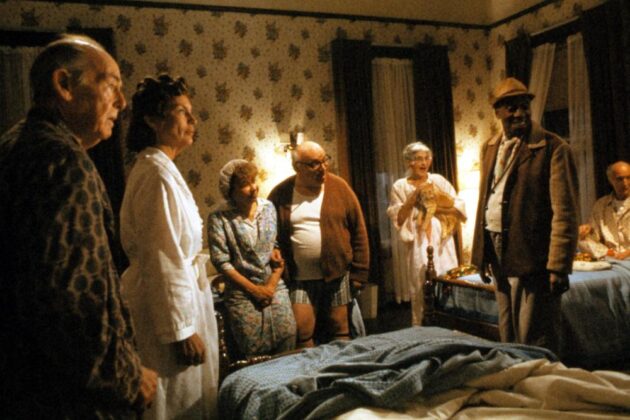
Sadly inseparable from the tragedy that struck during the filming of his first segment, The Twilight Zone, the Movie contains a small Spielbergian candy that accompanies the digestion of the four classic powerhouses the director has just spawned in quick succession. It’s 1984, E.T. has already ruled the box office and he clings to his childlike innocence while esteemed colleagues (John Landis, Joe Dante and George Miller, with a dream cast) tackle a variant of the darker dimension of the original series, for which it’s best known.
Yes, Child’s Play—an adaptation of a season 3 episode—probably isn’t the anthology’s best sketch; that title likely goes to Joe Dante’s with the nightmare bunny—and its plot could seem cloying, even nauseating with its troupe of seniors finding the spark of youth for one night. The director reportedly spent little time on the shoot, affected by the production accident.
But he proves more adept towards the end of the sketch, whose bitterness cuts against the previously wondrous mood. George Clayton Johnson, the writer of the original version, cruelly called out his old grumpiness. Spielberg adds a touch of melancholy that alone makes the sketch worth watching.
