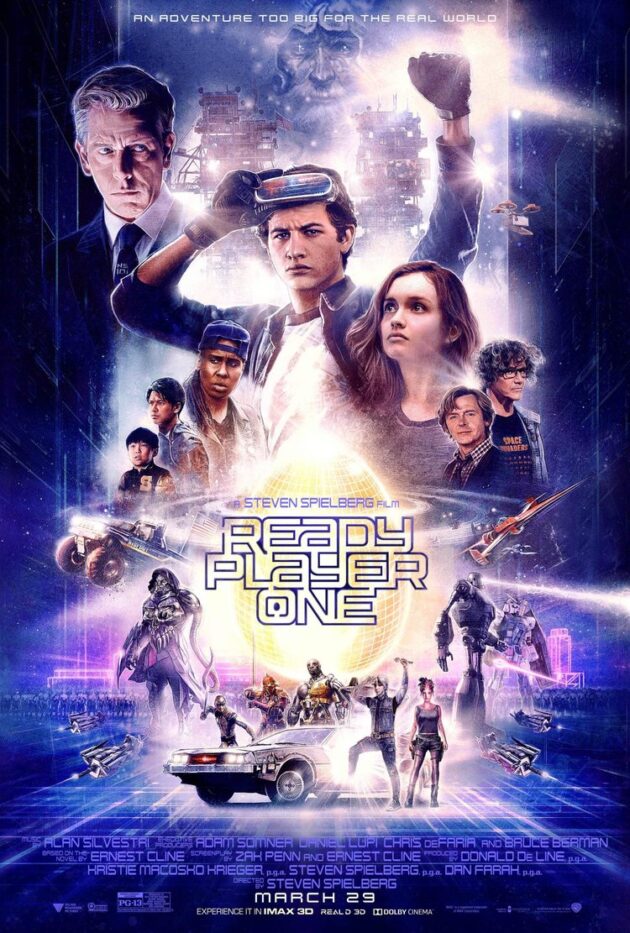
WAR ON EVERYONE
The gaming community and the universes they explore or replay have since the 1990s formed a veritable field of honor where Hollywood has repeatedly bitten off more than it could chew, from opportunistic adaptations of licensed properties to shameless pandering toward culture products the industry knows nothing about. Consequently, to see Steven Spielberg, a lifelong gamer, among the chief architects of contemporary geek culture, examining an entire swath of popular culture through the video game medium was a fantasized promise almost untenable.
The director is acutely aware of this, and never seeks the “revolutionary idea,” or technological disruption. Ready Player One aims more to be a summation work (and what a summation it is!), a condensation of ideas already matured by the filmmaker and the best of his predecessors. The film’s grammar draws from the kinetic energy of The Adventures of Tintin, the Speed Racer of the Wachowskis, and the class-consciousness of Fordian Westerns. The camera thus favors finding the junction between Hollywood’s golden age and the frenzy of a Hardcore Henry, rather than dreaming up some groundbreaking discovery.
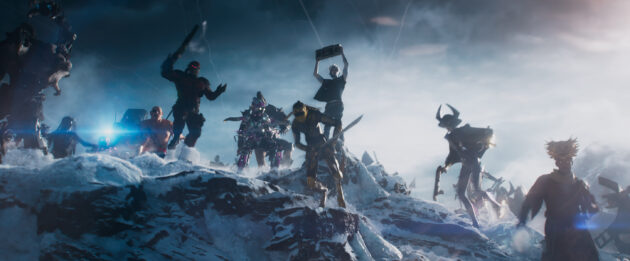
Ce mélange aboutit à des séquences logiquement plus virtuoses que novatrices, où Steven Spielberg s’amuse énormément avec la caméra, n’oubliant pas que le jeu vidéo n’est finalement que l’aboutissement du concept de plan-séquence. Course urbaine rythmée par un T-Rex et King Kong ou charge guerrière emmenée par tous les héros vidéoludiques des trente dernières années, le réalisateur ordonne une armada de références transformées en pluie de saynètes ultra-spectaculaires, mais le cœur de son film est ailleurs.

FAN TOYS
Rather than offering a gulp of nostalgia, or a dreamy trampoline for couch-bound thirty-somethings, Steven Spielberg delivers here a manifesto—both aesthetic and political—of rare virulence. His portrayal of mass entertainment is suffocatingly dark. In 2045, hordes of brain-dead fans relive endlessly fantasized eras and imitate heroes whose origins they do not know, fattening cynical corporations that peddle sanitized dreams to divert them from the real-world misery and the mediocrity of their lives.
Spielberg intends to speak directly to these lumpen-spectators, giving them the dose of references and tributes they crave to better—literally—pulverize them once assembled on screen. It is the fascinating arc of Wade (Tye Sheridan), an everyman gamer obsessed with the creator of the OASIS, who will come to understand the real-world repercussions of his gaming-affects while shifting his view on the creation he adores.
During a hilariously prickly exchange between the protagonist and the industry magnate who wants to recruit him, Spielberg reminds us that his Ready Player One isn’t a love letter to the 1980s, as he skewers the icons of that era and reminds us how Hollywood has misused them to lure the complicit viewer.
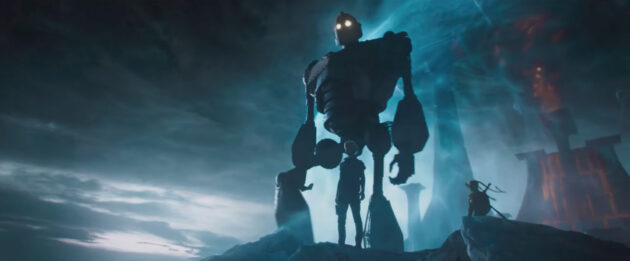
Ce n’est d’ailleurs pas un hasard si lors d’un surréaliste hommage à l’un des cinéastes qui compta le plus dans sa carrière, Steven Spielberg adopte le point de vue du néophyte, quand la plupart de ses héros jonglent aisément avec les clins d’œil qui surabondent. Il n’a que faire de l’enfilage de perles, de l’élitisme culturel paré de collectionnite obsessionnelle, stigmates à ses yeux de la médiocrité de l’époque.
THE SOLO DREAMER’S WALK
If he pushes toward a genuinely “pure” rediscovery of cinema, video games, and their friction zones, it’s because the artist is concerned here with his own legacy. Even more than a mythic techno-odyssey, the film is a deep, anxious meditation on the relationship Steven Spielberg tried to weave with his peers, what will endure, and his inability to be truly understood.
Derrière la figure quasi-autiste du génial Dave Halliday se cache bien sûr un Steven Spielberg démiurge, inquiet que son art ne l’ait condamné à être imprimé sur des t-shirts plutôt que dans des cœurs. Steven Spielberg était déjà le géant troublé du BGG : Le Bon Gros Géant, recyclant les rêves en fiction de son cru, il est ici un spectre bienveillant et incompris.
« Êtes-vous un avatar ? », lui demande Wade, conscient que se joue dans la présence de ce fantôme désolé un enjeu fondamental, « Thanks for playing my game » lui répond l’auteur, sibyllin. Le metteur en scène est-il cet angelot décati, incapable de se lier à ceux qu’il aime, ou son vieil ami, désolé d’avoir perdu le seul être qui le comprenait ?
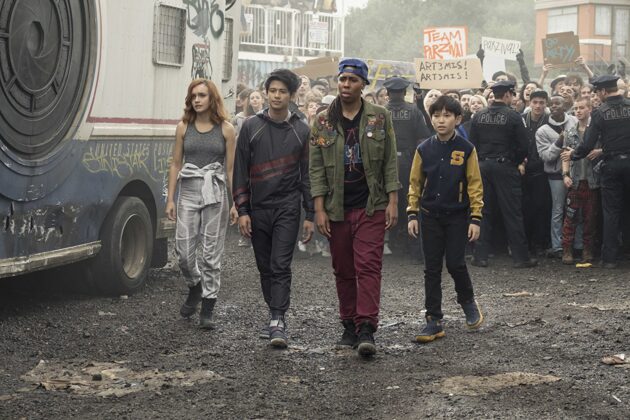
Ce même trouble existentiel anime Art3mis, qui veut combattre l’OASIS mais en use pour masquer une marque de naissance haïe, ou encore Aech, incarnation parfaite des questionnements genrés de son époque. Ces héros vénèrent des époques et des symboles qu’ils n’ont pas connus, c’est pourquoi Ready Player One les vouent à un holocauste salvateur (littéralement et étymologiquement), afin de ressusciter l’appétit indispensable à toute vie culturelle.
À l’heure où majors et studios se tirent la bourre pour raffiner les produits les plus inodores et incolores possibles, Steven Spielberg revient avec non pas son chef-d’œuvre, mais bien le rappel, spectaculaire et salutaire, de ce qui constitue une œuvre et son cœur palpitant.