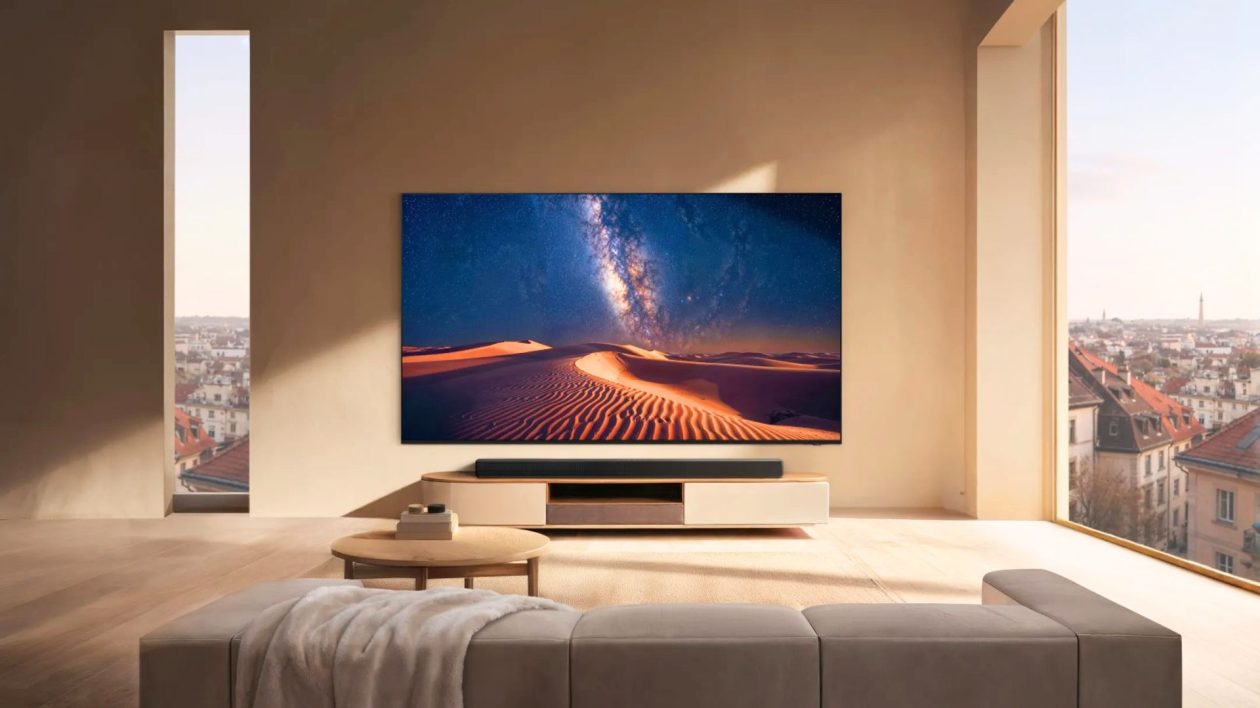
If OLED TVs have until now struggled in brightness comparisons with Mini-LEDs, the 1000 True Black standard is about to change that.
Right now, OLED technology is certainly one of the best you can find, as we noted in our 2026 guide on choosing a TV. On paper, it has plenty of reasons to win buyers over: deep blacks and (nearly) infinite contrast, excellent viewing angles, faithful colors, and its energy efficiency.
However, there’s always a small flaw in its armor: full-screen brightness, which has historically lagged behind what Mini-LED models offer. Fortunately, the DisplayHDR 1000 True Black standard appears poised to close this gap. Here’s the full rundown.
Unlimited brightness for OLED thanks to the 1000 True Black standard?
Until now, most HDR-capable TVs carry a DisplayHDR certification issued by VESA (400, 500, 500 True Black…). This gives buyers a sense of their peak brightness and black levels for content that supports it.
Note that the term “True Black” only applies to OLED panels, and the “1000 True Black” standard has been under development for several years. While it’s just starting to appear on some TV or PC monitor models, there are two major criteria to meet:
- a minimum peak of 1,000 cd/m² on a small portion of the screen,
- a peak of 500 cd/m² across the entire panel.
While manufacturers have struggled to satisfy these two requirements (OLED typically topped out around 350 cd/m²), Frandroid notes that some models like the Samsung TV TQ55S99H reach 498 cd/m² full-screen, coming close to the second criterion. According to Flatpanels, several WOLED or AMOLED PC monitors are even capable of reaching 540 cd/m² full-screen.
A turning point in the OLED vs. Mini-LED duel?
A few months ago, we were already investigating this path to unlock brightness on OLED TVs in 2026. The progress is multiplying in this area, and Mini-LED could find it increasingly hard to keep up with this final advantage it had left.
Additionally, word has it that TCL plans to “reinvent” the OLED pixel to make its models even more affordable. All these technological advances should strengthen OLED’s position in the market, and likely make it the ultimate reference for the coming years.
