Cinema Dream
For Night Flight to Los Angeles, John Travolta draws on his childhood memories, including his discovery of aviation that grew into a lifelong passion (he can pilot Boeing 737s, to be precise). The idea first took shape in the 1990s and finally materialized in 1997 with the publication of a book (never translated into French) titled Propeller One-Way Night Coach, which roughly translates to Night Flight One-Way Economy Class on a Propeller Plane.
Written and illustrated by John Travolta himself, the book is aimed at readers of all ages but especially his son Jett. Indeed, the premise seems to be aimed at him, since the film’s young child at the center is named Jeff (a name a bit too close to Jett to be a coincidence). In the absence of access to medical care perfectly tailored to his autism (a neurodevelopmental disorder not recognized by Scientology, which also rejects psychiatric treatments), Jett would thus have been able to read Dad’s book.
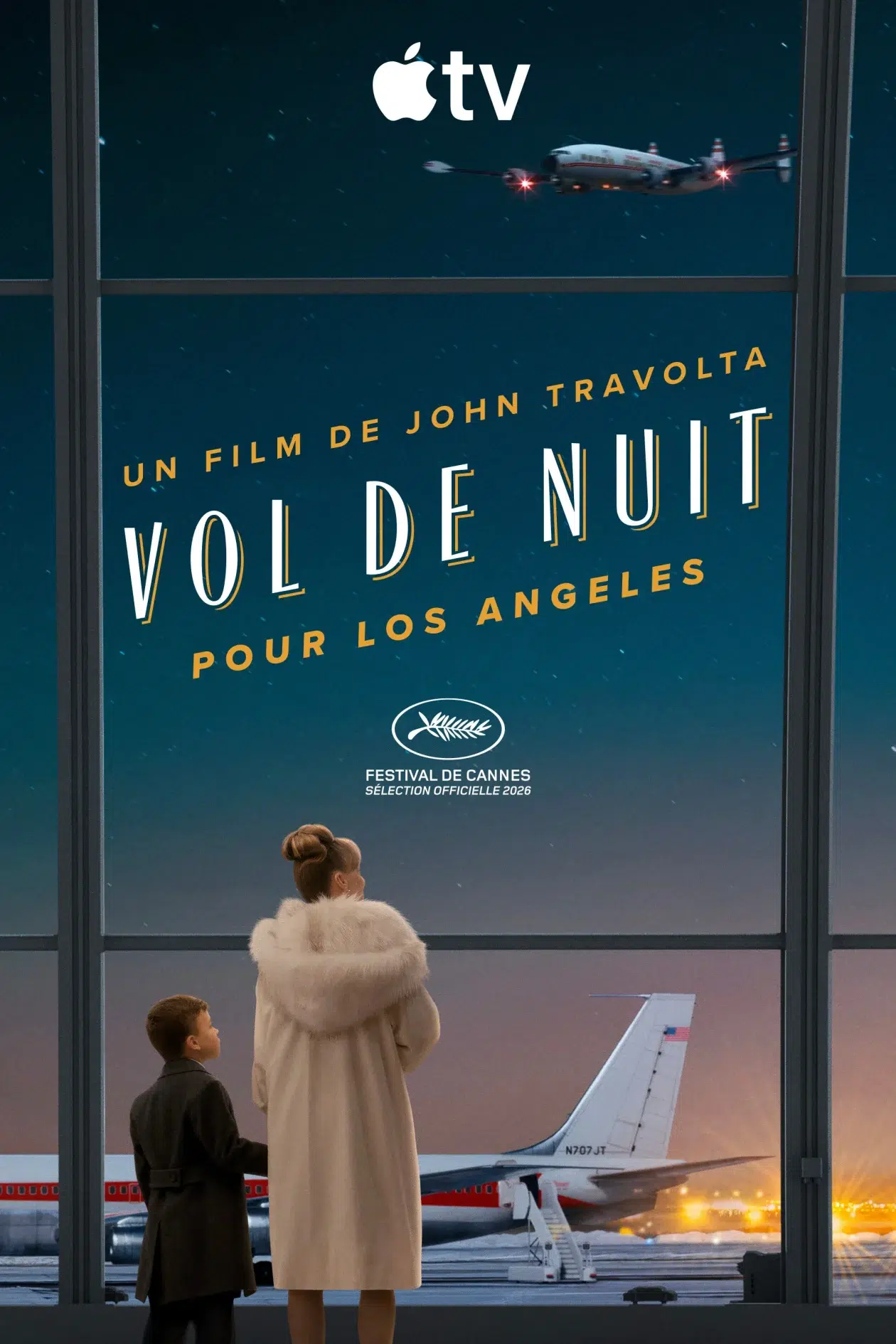
Cutting to the chase, the film follows Jeff (played by the young Clark Shotwell), a boy whose passion for aviation carries him and his mother (Kelly Eviston-Quinnett) on a one-way, no-return trip to Los Angeles, where his mother hopes to launch her acting career in Hollywood. It marks the beginning of a life-changing journey for the boy, whose eyes light up during this long journey as he ascends toward first class and the pilots’ cabin.
In its opening moments, Jeff’s sense of wonder is undeniably endearing. By centering on the boy’s gaze (his own perspective), John Travolta clearly aims to offer a child’s innocent view of the world, with naive admiration and endearing tenderness. This sensitivity is accompanied by the film’s narration, voiced by none other than John Travolta himself (now older). A dual view of this nostalgic memory emerges: the naive child at the heart of the film and the adult, more mature version of the narrator.

Flight of Ennui to Los Angeles
Unfortunately, if Night Flight to Los Angeles seems to want to pursue that aim, John Travolta never quite manages to bring it off. Sure, there are moments where he manages to generate some fairly amusing comic breaks (the chicken cordon bleu, the affection for flight attendants, etc.) and, at heart, the project’s sincerity could move viewers. But the director is far too attached to his own origin story and cannot construct a real gap between the world seen by the young hero and the (theoretical) distance of his narrator.
The film’s biggest failure lies here: it moves forward through the narrator’s words rather than through the child’s gaze. Given the care applied by Travolta and his team (including production designer Chelsea Turner and costume designer Camille Jumelle) to recreate the luxury of vintage air travel (cabin, seats, blankets, outfits, tableware, etc.) while attempting to amplify the bold Art Deco color palette through cinematographer Paul de Lumen’s work, this becomes a missed opportunity.

The wonder of the opening seconds, with a child walking onto a make-believe gangway before boarding his first flight, is quickly crushed by the voice-over that comments on every screen moment… with little value, like an ongoing audio description. Relying primarily on narration (and a very intrusive jazzy background music) to tell this pivotal moment from his childhood, Travolta thereby erases most of the magic.
As a result, everything feels disembodied in Night Flight to Los Angeles, down to Jeff himself, who should be the heart (and engine) of the film. The narration feels superficial, the staging is near empty, secondary characters are caricatures, and the story lacks stakes and twists… cinematically, nothing really works. Even the structural audacity—scenes following one another without a clear sense leading to a very abrupt finale, like the end of a sweet dream—feels off. Was this intentional on John Travolta’s part? Probably, but it isn’t enough to save the film from a legitimate crash.
Night Flight to Los Angeles is available on Apple TV since May 29, 2026 in France