Science-Friction
France’s relatively sparse footprint in science‑fiction cinema is all the more frustrating because the country harbors one of the genre’s most potent legacies worldwide. From Jules Verne to Metal Hurlant, and all the way back to Georges Méliès, these foundations of a futuristic imagination have seeped into other nations (the United States and Japan among them), to the point where those countries are now its few heirs.
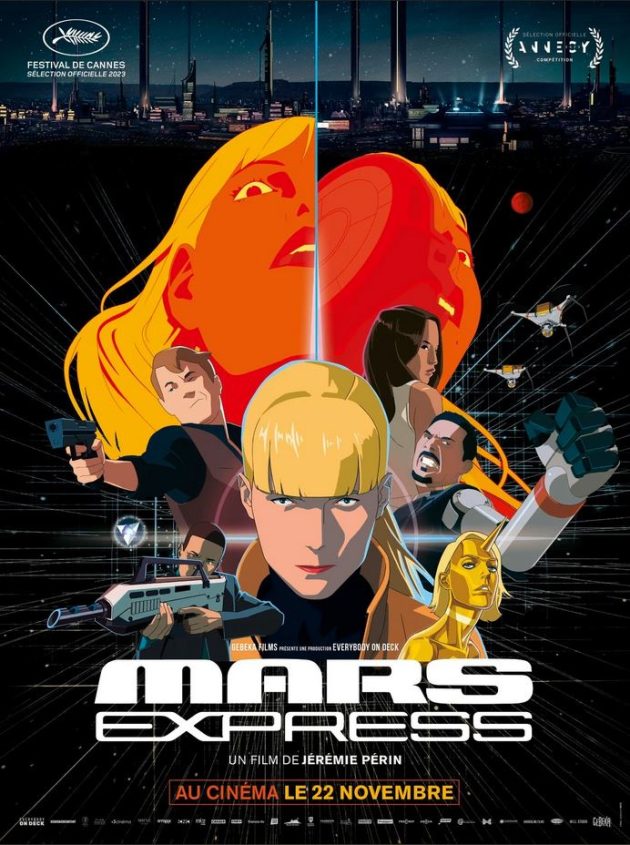
For that reason alone, one might be tempted to greet Mars Express with open arms before seeing a single frame. But that would do a disservice to Jérémie Périn’s first feature film (the Lastman series), which opens with fevered, grip‑lit murder and then an adrenaline chase. In both cases, the clockwork precision of the editing is as impressive as the kinetic energy of the staging, which alternates between jolt‑worthy movement and pure moments suspended in time, like the best of Japanese animation.
This rhythmic yo‑yoing, in turn, seems essential to perceiving the project’s strangeness, or at least its way of weaving its hybrid nature with the unease of its characters. It doesn’t take long for the film to summon Blade Runner, Isaac Asimov, and Mamoru Oshii’s Ghost in the Shell, while it makes you do a double take when you hear the heroine’s name: Aline (brilliant Léa Drucker). The distinctly French identity of the company is thrust right into your face, underscoring its rarity in this melting pot of influences.
From there, a fascinating parallel emerges between this stylistic “recapture” and the protagonists who desperately seek a place in a world torn between a transformed Earth—a “rabbit‑warren for the jobless”—and the artificial comfort of Mars, a sleek, pristine cyberpunk city. In this setting of 2200 Mars colonization, the private detective introduced earlier investigates the disappearance of a cybernetics student with her android partner Carlos (Daniel Njo Lobé, heartbreakingly human) at her side.

Boiling Hot Metal
Mars Express constantly evolves at this crossroads of genres and inspirations, and especially at the noir crossroads. Jérémie Périn and his co‑writer Laurent Sarfati know their classics, and they deftly mine those codes to sketch a gallery of ambiguously defined, disillusioned characters at the heart of this redefining future.
Through its action scenes guided by hard‑edged violence, the feature never forgets the essential: sustaining a corporeality that remains fragile and evanescent in the face of relentless robotics. Paradoxically, Mars Express is a film steeped in a sense of death, even as technology that resurrects the dead (or at least their minds) in metal masks the lingering loss.

Its aesthetic approach shines even brighter because it leans heavily on holograms. Whether reconstructing Carlos’s head above his torso or helping piece together a crime scene, they enable layering and animation in overlaid effects that progressively erase matter and identities within the film’s enveloping sets. As the case stretches toward a gargantuan conspiracy, they primarily trace a neoliberal social order where everything—and everyone—becomes a commodity and, by extension, waste.
Self‑abandonment and the abandonment of others seed this machine‑driven destiny of humanity, and regularly offer visions of astonishing poetry (the shot where Carlos’s holographic head reveals the family that has reassembled itself without him). Mars Express could easily lean into the genre’s core philosophical questions about the porous boundary between humanity and its robotic creations.
Yet its ambition, punctuated by a slyly sharp black humor, remains tethered to a contemporary frame. Planned obsolescence and the failings of technology steadily erode the cyberpunk narrative, as robots become targets of discriminating fake news (“Condemn this violence?”), heard in a sly parody of the 24‑hour news cycle.

A Cocktail We’d Drink Every Day
If you’re initially impressed by a screenplay that never lets up, the organic worldbuilding touches in this progression pair nicely with its plunge into the guts of its universe. Backed by the admirable art direction of Mikael Robert (The Summit of the Gods), the film mutates into a true paranoia thriller of the 1970s, to the point of reproducing some stylistic effects—telephoto‑style shots and the manipulation of sharpness with a half‑soft focus (yes, in animation!).
Through this unveiling of a hidden world behind the pristine veneer, Mars Express seeks a flaw, a motif that reveals itself as doors crack and data streams flow, represented by a thread. As these traces spread across the screen, they hint at a scarred universe, where you must learn to see beyond its references.
We even forget the generosity of this parade, never gratuitous or overwrought, as it summons Cronenberg, Minority Report, RoboCop, and Terminator 2 in turn. That shows how its staging, as elegant as its brisk narration, reshapes recognizable science fiction to make it its own—and, in doing so, reminds us that France has a real role to play in this arena.