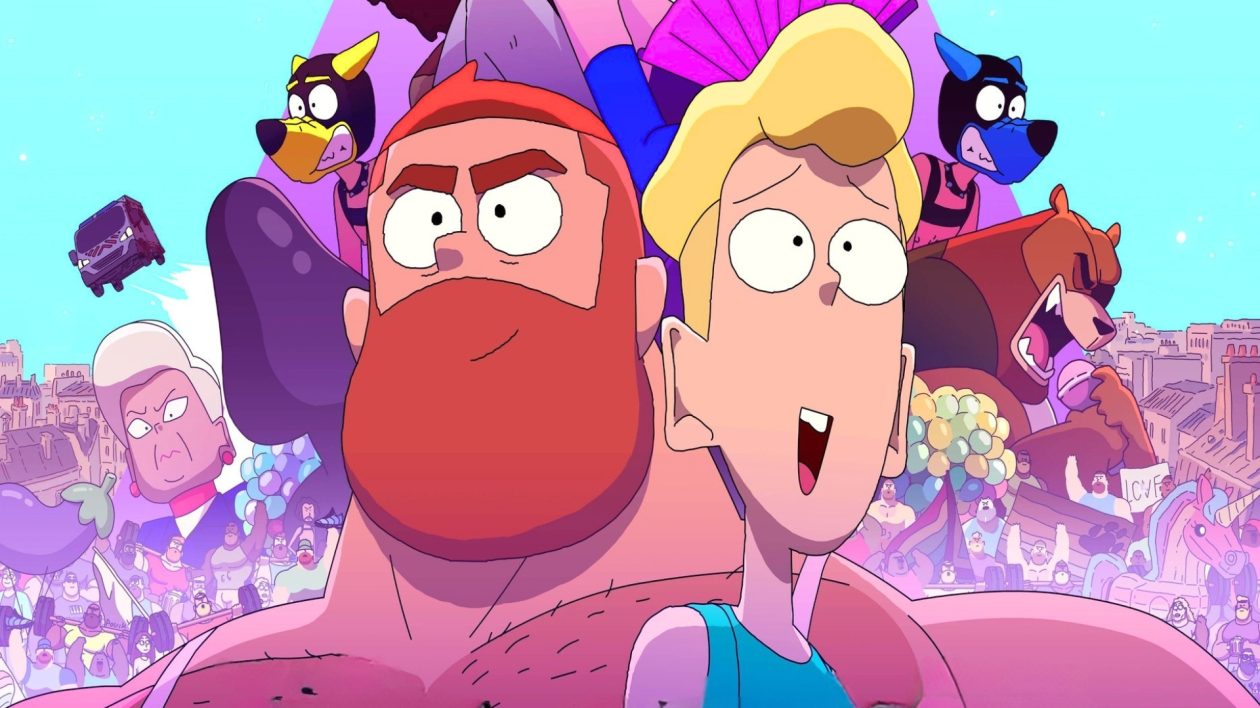
Gay as a Canary
Jim is an icon of the Parisian gay scene and a gym influencer. One day, he contracts Heterose, a disease that makes gay men straight. While the illness spreads quickly through the capital, this egotistical, superficial guy is mostly worried about his abs and his followers who melt away like snow in the sun. With the help of Lucien, an “apprentice” who discovers this world, he sets off in search of Dr. Ragoult, the only one able to forge an antidote: the chloroqueer.
Let’s be honest: we almost want to like Jim Queen just for his joyfully deviant concept and the self-assured parody in his references. Bobbypills’ film aims to be mean and irreverent, but the question is whether it sustains that tone over time, and whether this piling up of gags and wordplay (where there’s talk of a “final solution” and a “Gaystapo”) isn’t the project’s sole end.
Fortunately, that isn’t the case. On the one hand, Bobbypills preserves the simplicity of its rough line work and flat color blocks, a vehicle for animation stuffed with sharp cuts and abrupt shifts in gesture. For a studio that has fully internalized internet codes, the rhythm of its situational humor carries an air of the exquisite corpse.
Pop! Goes My Heart
On the other hand, this stacking mechanic keeps the whole from slipping into the traps of a writing filled with hollow nods. In truth, we eagerly anticipate every step of its programmatic odyssey, a Parisian saga where drag queens, foot fetishists and smelly shoes, and bears cross paths. That taste for surprise and remix becomes even touching, as it carries the filmmakers’ richly borrowed pop-culture heritage.
From Akira to The Last of Us, via Dragon Ball, Jim Queen spares nothing, yet uses this referential framework to reveal its real aim. Jim is introduced from the start as a selfish, arrogant jerk, to the point that the film also shows Lucien, his naive sidekick, is the true protagonist. This little twink in search of validation is launched on an initiatory quest about his place in an LGBTQIA+ community that is increasingly segmented, even as a common trunk is formed by a pop-culture that the creators repurpose and mold into counterculture.

The journey of the young gay man is also the journey of the feature itself, proudly built on an array of nods that you must seize, twist, and redefine. At a moment when many demand the absurd apoliticism of pop culture as a form of escapism, the movie reaffirms the need to arm these shared references, turning them into a tool for rallying and resistance.
Behind the high jinks, Marco Nguyen and Nicolas Athane wake the still-bleeding wound of French government inaction during the AIDS crisis, while tying this homophobic politics to its modern echoes, notably in the resurfacing of conversion therapies. A very elegant proposition, for a deeply beautiful cry for freedom.

