
Everyone remembers Independence Day as a big pile of patriotic clichés, but the film’s details hide a critique of American myths.
What comes to mind when you think of Independence Day? Immense, meticulously staged explosions, Will Smith at the peak of his swagger, Jeff Goldblum stammering more than ever, and a fantasy so “’Murica Fuck Yeah” that it makes you want to both vomit and laugh at once (which sounds absolutely terrible—let’s call it the “vorir”).
An irony: the most American of American blockbusters was directed by Roland Emmerich (recently responsible for Moonfall, a title we won’t forget), an German exile in Hollywood, which is hardly devoid of irony. Or perhaps the complexities go even deeper than they first appear…
A POPULAR AMERICAN FILM… SO WHAT?
Let’s agree on one thing from the start: no one here will claim that Independence Day hides abysses of unexplored depth or that it’s a misunderstood masterpiece to be placed alongside Orson Welles and Ingmar Bergman. Independence Day is, above all, mass entertainment, and its primary purpose is to please crowds by delivering spectacle and positive heroism. And the film doesn’t owe anyone an apology or a justification for being what it is: a popular distraction that speaks to a particular culture—and in this case, America’s.
Like all narratives of this stripe, Independence Day is almost inevitably forced to take shortcuts and lean on hefty symbolism—perhaps even literal symbolism. So be it if that yields a story with loose seams and improbably convenient coincidences—Jeff Goldblum’s ex-wife happens to be a White House aide, Will Smith finds his wife in the desert alongside the President’s wife… the list goes on. In the end, as long as the film remains coherent in its discourse and universe, it can demand less realism if that lets it speak to a broad audience and unite its viewers.
To this goal, Independence Day delivers. You may not personally embrace it, but you can hardly fault it for being what it is (and that is, admittedly, a debatable point): an ideological matrix that blends several myths into an exalted reformulation of the national story—like many nations do every year through their own cinema. So yes, Independence Day makes use of ideology. Like so many before and after, with varying degrees of sincerity and critical distance.
But in this case, Independence Day leans toward the more, with Roland Emmerich offering an outsider’s view of Uncle Sam’s land, and that is where it becomes interesting. In the vein of Predator or Starship Troopers, there’s a sly irony to the montage of images. Unlike Paul Verhoeven or John McTiernan, Emmerich uses it to tease more than to sour, and he makes it secondary and not primary: his aim remains to entertain. Three myths are especially leveraged by Independence Day, and the way they are woven into the film’s discourse suggests Emmerich isn’t merely stacking clichés by accident.

The first and most obvious one is the “city on a hill” trope: America as a democracy that must be exemplary, a beacon in the night toward which all eyes turn, and a fortress of liberty to be defended at all costs against barbaric external threats in order to save humanity. The second myth, that of manifest destiny, follows logically: the American people have a duty to be free, and a quasi-messianic duty to liberate others and to spread its work across the world.
The final myth has fuzzier borders, but it’s the one Emmerich cares about most—eschatology. A religious term that, in a Christian context, refers to the end of the world… and the advent of the next one to come, necessarily better than the one before, since it restarts from zero, with a people reborn and cleansed of sin, thus enjoying recovered innocence. But if you’re going to reclaim that innocence, it means it was lost, and if it was lost, it implies one or more misdeeds were committed.
BORN ON JULY 4
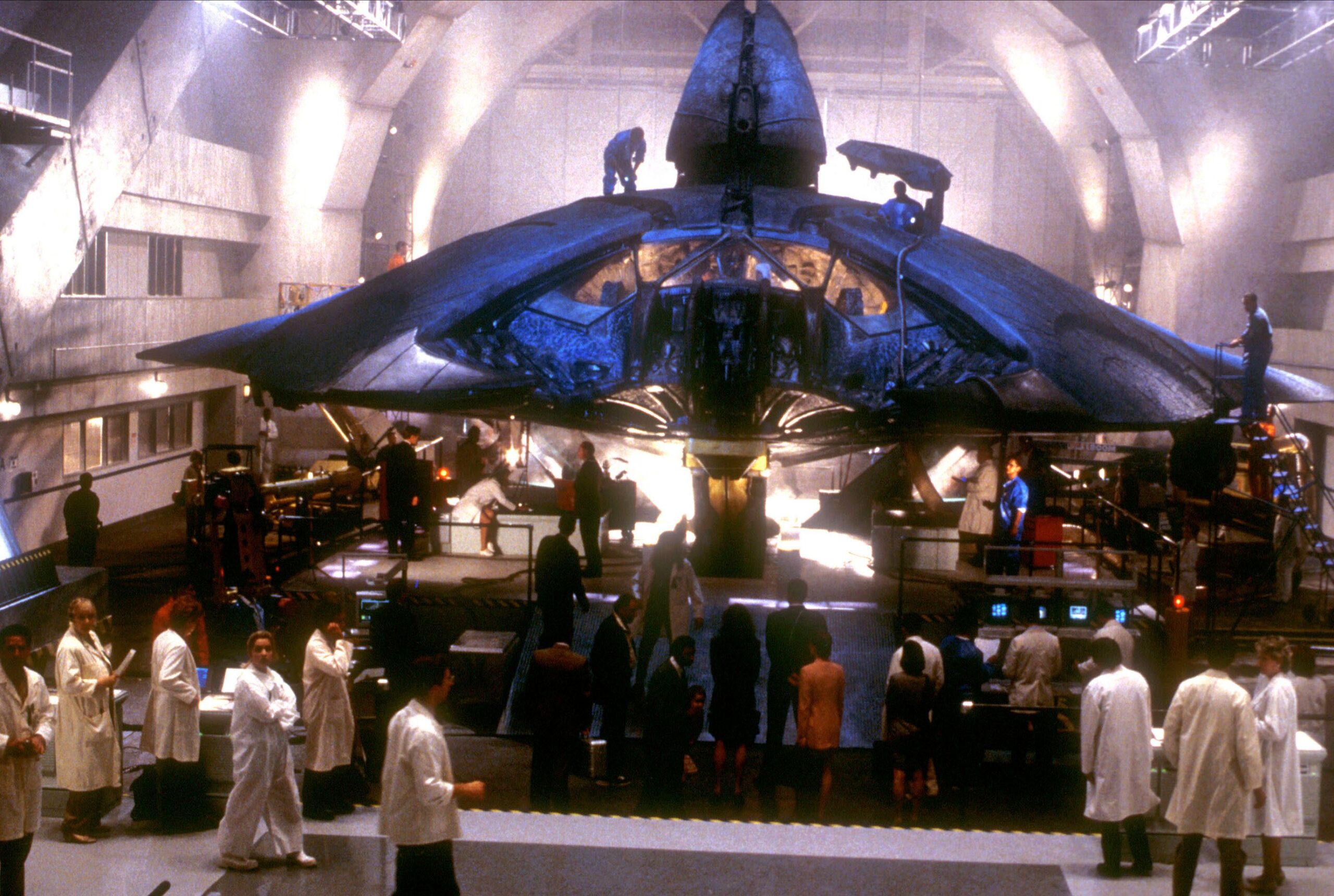
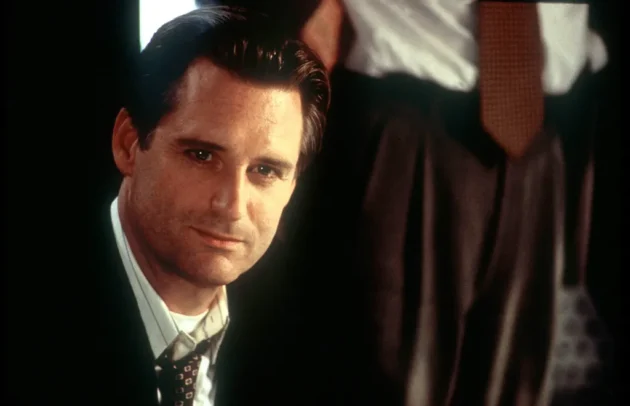
That fault—if you want to call it that—finds its full embodiment in President Whitmore, a genuine extension, even embodiment, of the audience on screen. His arc makes perfect sense for the viewer: he starts the story exhausted and disoriented, and his personal tragedy marks the film’s lowest point before his direct engagement in the conflict rekindles the hopeful momentum in the final act.
Like the United States and the people it represents, he strives to improve things but—importantly—he doesn’t succeed on his own terms. Politically weakened—“you wanted a warrior, you elected a coward,” a TV anchor blurts out—he’s accused of not doing enough, nostalgic for a simpler era: “at least in the Gulf War we knew what we were doing.” What he doesn’t see is that the failures laid at his feet aren’t really his to own.
Like a certain Mr. Smith in the Senate, he is a good man surrounded by cynics and bad advisers who push him toward inaction by withholding crucial facts—such as the existence of Area 51.

It’s a way to absolve and quietly suggest that America’s mistakes are the fault of its administration and political institutions, while the individuals themselves remain innocent. The military is shown in the same light: individuals are admirable, but the institution itself is consistently portrayed as flawed. And it’s not an accident this argument lands in 1996: if the Gulf War boosted Bill Clinton’s aura, the country still carries the burden of its “dirty wars” in Korea and Vietnam (two slaughtered chapters that echo the greatest American taboo—the founding genocide of Indigenous peoples)—and to the world and to its own eyes, that stain remains a stain.
The film repeatedly grapples with accountability, especially through this calm, reflective presidential figure who hesitates to use nuclear weapons and who repeatedly offers peace even as his own generals push for war or as Secretary Nimzicki plots behind the scenes. It is the political structures that push the people toward moral fault, even when the people themselves have nothing to reproach themselves for.
Each member of Whitmore’s team carries a spark of heroism, demonstrated by the choice to dilute that heroism across an ensemble cast: a white president, a Black soldier, a Jewish engineer, a redneck alcoholic, a Black stripper, young and old, a gay scientist, and even Boomer the dog—rather than funnel all of it into a single superhuman protagonist like Rambo.

Yet Emmerich plays a double game: while the apocalypse offers America a chance at redemption and a purge of corrupt elements, that redemption comes through blood again. As at the beginning, the formation of a new, universal human community never happens spontaneously; it is the result of a reaction to a threat. The myth of manifest destiny is inverted: America needs enemies to exist, an external Other to destroy. The obsession with innocence drives an entire country to either deny or deflect its own aggressive impulses.
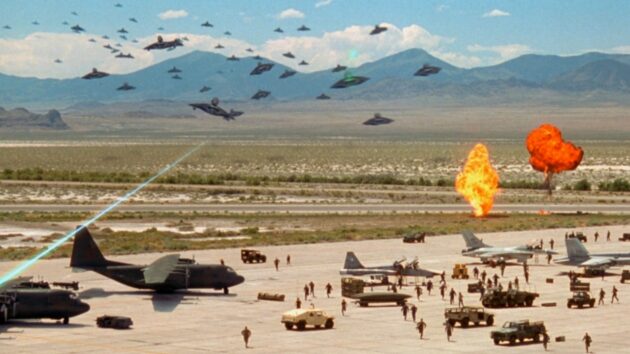
Even when the Other is animated by a primal urge to annihilate, a kind of absolute Evil that instantly places America on the side of Good, America still seems doomed to define itself first by its capacity to kill on a mass scale—though, of course, within a morally sanctioned frame. Emmerich sprinkles over everything a distinctly American self-regard that’s gently ridiculed, as he revels in puncturing every show of brute force by the military, as if to castrate the country he surveys. The suggestion is clear: the United States is very efficient at mowing down entire convoys when it serves no real purpose; when it really matters, there’s nobody left to do the job.
WE ARE (NOT) THE WORLD
Emmerich wades in gently, but in the end he makes the point that America is more of a marketing powerhouse than a genuine ideological force, better at selling its ideals than actually enacting and embodying them. It’s precisely this tension that has provoked discomfort with the film’s imagery, which presents a universalized American Way as if it were self-evident to the rest of the world.
How else to interpret the famous Whitmore speech, which has been parodied and reappropriated—so much so that Ted Cruz cited it on the eve of the Capitol attack after Trump’s defeat—in which July 4 is cast not merely as an American holiday but as a celebration for all humanity, as if it were a new treasure of humankind? It is indeed a message of international unity, a reminder that the rest of the world exists, even if delivered with a hegemonic edge.
Despite this boundary and its overall positive, optimistic messaging, Emmerich invites reflection in his own way (which is, in practice, relentlessly pyrotechnic) and offers an American storytelling angle that’s distinctly different. The victory is earned only if the country rises to meet the challenges it proclaims to stand for, and that is the very standard that is questioned in Independence Day. Yes, in the end the world survives because the United States does, but that ending isn’t guaranteed: there are internal wrongs to address… or to annihilate.
It’s the logic of any good disaster film—a paradoxical genre all its own: we’re asked to confront a looming catastrophe, and yet we’re invited to revel in the spectacle. This is a hallmark of Emmerich’s approach, who makes no secret of his convictions and his ecological anxieties: the end of the world can be a joyful release because it clears away an old order so damaged that it cannot be repaired, and it opens the path to something newer, purer, more peaceful, and humane. “Maybe if we wreck the world enough, they won’t want it anymore.” The eschatology becomes both punishment and a door out.
Despite its status as a blockbuster about toasty dumb fun, Independence Day remains a fascinating object of analysis for the place it occupies in pop culture and for its surprisingly demanding take on the American narrative. Of course, that aspect is only a secondary thread in a movie primarily focused on spectacle, but its treatment is, in fact, less conventional than it appears, because it repeatedly puts the country it purports to celebrate in a position of vulnerability. There’s certainly plenty of patriotic rhapsody, yet that existence is precisely set against a sense of disillusionment tied to past failures.
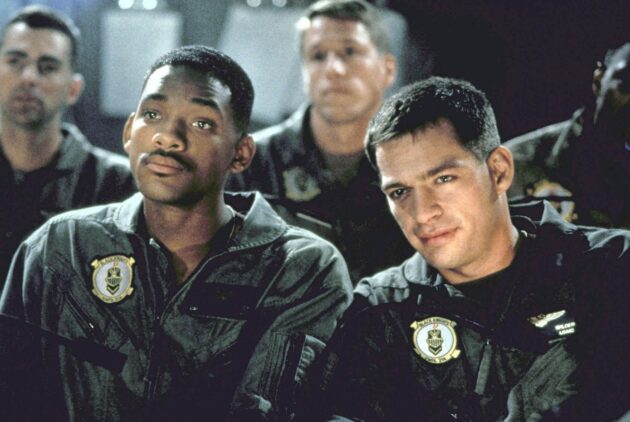
The symbolism of Independence Day doesn’t summon grandeur for grandeur’s sake: it answers another symbol—one that inhabits the film’s soul, the sense of the American spirit’s decline. Roland Emmerich keeps pointing to that decline: it’s no accident that the final key rests in the hands of the crude, outsider, the down-on-his-luck Everyman from rural America, the one person most likely to restore America’s own grandeur.
A worldview and a slogan that once inspired excellence and broad popular pride. It’s a pity that much of that has since been abandoned in a populist junkyard.
