
The Die Hard saga is a cult staple of the action genre, so we’ve ranked the five films from worst to best.
John McClane has faced all kinds of terrorists across his career. Played by the irreplaceable Bruce Willis, the character has become as renowned as the movies in which he fights to survive, and that’s true from the very first one, Die Hard.
Against the backdrop of this franchise that helped define an era of action cinema, Ecran Large has published and detailed its ranking from worst to best in the Die Hard franchise.
Bruce Almighty
5. Die Hard: A Good Day to Die Hard
What happens: Like any aging American who knows how to live, John McClane is busy looking after his kids. He had just made up with his daughter in the previous film (see below), and now he’s got to go play with his son. Problem: the boy is being tried in Russia in a murky case. But that doesn’t stop the father of the year, who hops on a one-way ticket to the homeland of all anti-American terrorists.
Only, McClane’s son is actually a CIA operative, hunting for a file that allegedly links a potential future Defense Secretary to the Chernobyl disaster. He breaks out of the courthouse in a chaotic way, finds his father’s help, and heads toward his objective. But the good guy’s daughter betrays the good guys to the bad, and the good guy betrays the bad guys to become the bad guy himself. The pair doesn’t quite get it right, but in doubt they blow everyone up. What better way to bond a father and son? The family ends up against a sunset backdrop. The audience wobbles. Everyone’s fine.
Why it’s watchable: There’s very little to salvage in this final installment, but there is one requirement the franchise had to meet, and it does. You don’t get bored (not always) in what is, after all, a fairly generous action movie. The Moscow street chase is by far the film’s best sequence, and it comes with its share of spectacular money shots, underscored by a likeable, if generic, Marco Beltrami score.
We also note the finale, whose ugliness is occasionally transcendently improved by a more polished digital shot than average. That’s basically it.
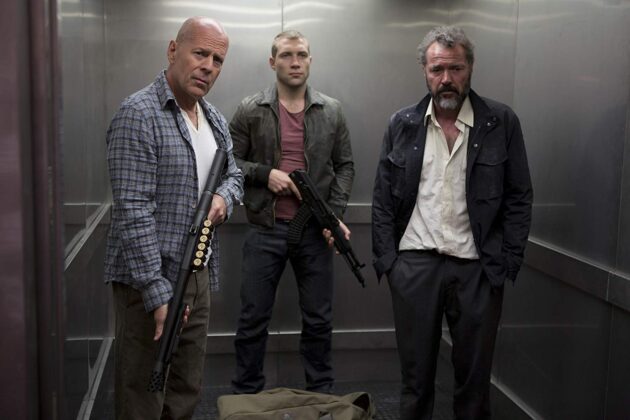 “Are we at the bottom of the ranking yet?”
Why it’s a disaster: The Die Hard mythos had already taken a hit in the previous film, but A Good Day to Die Hard buries the franchise six feet under, sinking into the hell of modern-action DTV fare with a Bruce Willis who’s clearly burned out. If the fourth film, helmed by Len Wiseman, at least stretched to cling to the franchise’s established principles, John Moore’s entry slides fully into conventional, modern action fare—with Russian villains, rough CGI, drab photography, and overcooked, far-fetched plots.
Moore abandons the concept of a single time-and-place setting, already strained in Die Hard 2, to haul the duo around a nondescript post-Soviet wasteland. The rest of the McTiernan-era DNA is mostly filler: McClane’s quips in action are replaced by awkward reaction shots, Willis keeps telling us he’s on vacation every couple of minutes, and Jai Courtney tries to play a bargain-bin Jason Bourne.
The nadir comes when the story desperately tries to sell us on any evolution in the two lead characters’ relationship. Willis’s performance is waning, and the goal is clear: tie Die Hard to the myth of the all‑American family. A defiant wink to McTiernan’s oeuvre, which long argued for those values, becomes the final nail in the coffin.
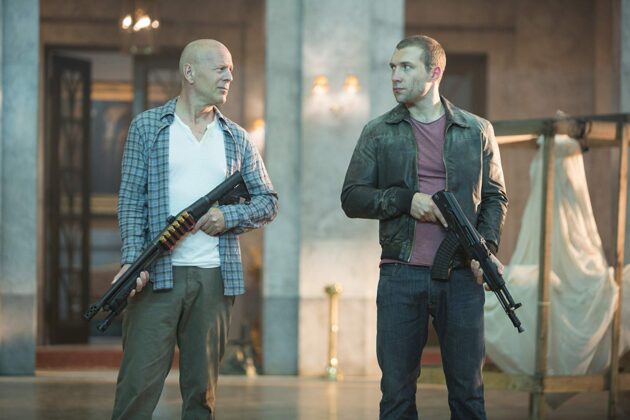 Partners in crime
4. Die Hard 4: Live Free or Die Hard
What happens: As usual, John McClane is in the wrong place at the wrong time. While squabbling with his daughter, he has to escort a quintessential hacker, but—bad luck—cyberterrorists strike. McClane calls out the villains to taunt them, which makes them a bit angry, to the point they blow up the Capitol. Except it wasn’t real; it was a joke.
The young hacker guides McClane to a computer whiz friend for help, but meanwhile the terrorist antagonist kidnaps McClane’s daughter, which makes him furious. So he arrives with a big truck to take out the terrorists. Even as he’s badly injured and taken hostage by the villain, McClane shoots through his own shoulder blade to hit the bad guy behind him, shouting his classic “Yippee-ki-yay!” He’s quite calculated in his move. In the end, McClane rides off with his daughter in an ambulance to rock music.
Why it’s not so bad: This was a long-in-the-works project that had been sitting on the shelf since the late 1990s, and Die Hard 4: Live Free or Die Hard was always envisioned as a Die Hard set in the cyberterror era. The 9/11 attacks paused the project momentarily, only to become its strength in the final product. Die Hard 4 thus carries a certain political resonance for its American setting, confronting the specter of terrorism from within at the dawn of modern tech.
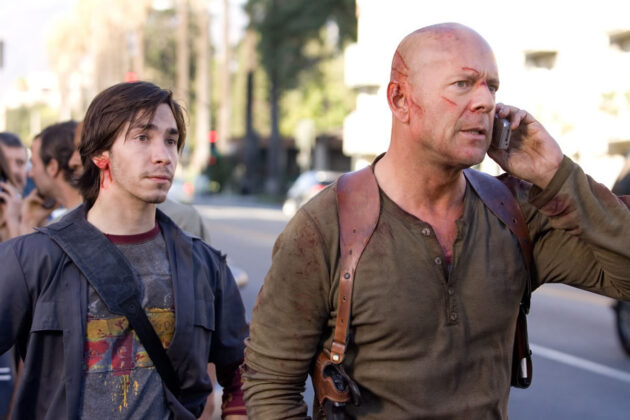 McClane and his service hacker (Justin Long), who explains the scenario…
This is perhaps not incidental that the project was originally titled Die Hard 4.0, a label that clearly announced the aim of turning this fourth installment into a modern Die Hard. Before the fifth film’s flatlining, Bruce Willis still brings his game, staying strong in action and punchlines. He leads the charge with gusto. Add a few well-wrapped action sequences (the helicopter in the tunnel, the elevator cage), and you get a film that doesn’t entirely embarrass the saga.
Why it isn’t great either: Because even if the film delivers on action scenes, they verge on sheer spectacle for its own sake. Len Wiseman leans into escalation, which is entertaining, but a bit ordinary by Hollywood standards.
If the fourth film tries to anchor itself in post-9/11 America through the cyberterror threat, it doesn’t go deeper than the backdrop. And even if Timothy Olyphant nails a charismatic antagonist, in the tradition of Alan Rickman and Jeremy Irons, his motives feel a bit ridiculous and simplistic, especially in a long walkie-talkie monologue. Ditto for the use of McClane’s daughter, which is a touch too facile despite Mary Elizabeth Winstead’s talent.
And then, well, the shoulder-shot gag is a bit much, honestly, John, that’s a reach.
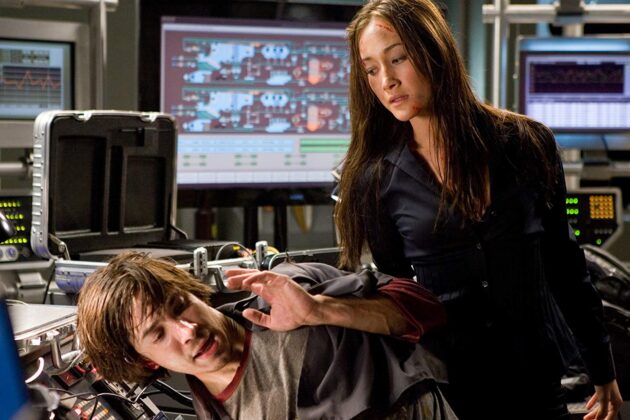 Maggie Q, a badass antagonist
3. Die Hard with a Vengeance
What happens: This dependable old-timer, John McClane, still calls New York home and deserves a vacation. That’s just what happens when his wife joins him for the holidays. The trouble comes when, while he’s waiting for his flight, evil terrorists seize the airport for a kidnapping caper and threaten to blow all incoming planes out of the sky if they don’t let a dictator escape. Things get messier when our tough guy wades in, despite official orders not to.
McClane soon learns that the so-called Simon is actually Peter Gruber, Hans Gruber’s brother from Die Hard, seeking revenge and aiming to topple the world economy, as any good villain would. McClane ultimately blows up his helicopter and saves the day.
Why it’s one of the best: Because it’s pure fun, thanks to the Bruce Willis–Samuel L. Jackson duo, reuniting after Pulp Fiction. A fantastic way to reinvigorate the saga and move beyond the lone hero routine. It’s hard to imagine a more energetic and charismatic pairing for the mid-90s, each riding their own brand of everyman resilience and stubborn grit. And the sly, mischievous Jeremy Irons is the cherry on top.
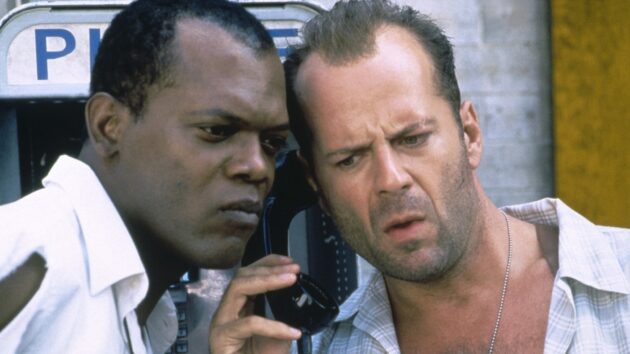 “You’re bluffing.”
Why it’s a great ride: Because Die Hard with a Vengeance is a master class in playfully ruthless spectacle, a brilliantly executed open-air scavenger hunt that still feels fresh. Jonathan Hensleigh’s screenplay (clearly a game of thrones for action enthusiasts—he also wrote Jumanji) followed a long string of near-misses before landing on a blueprint that works. The world of Hollywood is such that a version of this film—an alternate take that would have been a direct continuation of The Buddy Cop Scene or even a sequel to The Lethal Weapon—could have existed; instead, we got a quintessential late-90s McTiernan outing with an exhilarating setup and puzzle-box thrills. The director revels in turning McClane loose in the city, and the chaos is as efficient as it is thrilling—who can forget the runaway subway car, or the riddle in the fountain in Central Park, or the stirring March theme by Michael Kamen? After the claustrophobic original, the director proves he can handle a very different, yet equally flavorful, mode of mayhem.
Why it’s not the best: Because it runs on a tried-and-true buddy-action dynamic that, while beloved, isn’t as surprising or daring as the original’s boldness. It’s solid, entertaining, and crowd-pleasing, but it doesn’t aim higher than necessary. After the glory of Die Hard, Die Hard 3 feels a bit more conventional, and Die Hard 3 lacks the same sense of surprise and audacity the first film carried into the franchise.
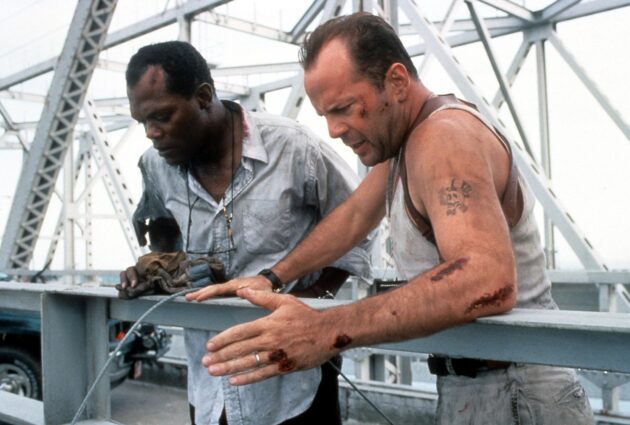 But damn, that duo remains cult
2. Die Hard 2: Die Harder
What happens: John McClane is still a magnet for trouble, and this time he’s set for a day that’s hellish even by his standards. A terrorist named Simon pulls the airport hostage, demanding McClane’s presence for a deadly scavenger hunt. A humiliated hero, a brother-in-crime who is actually the brother of Hans Gruber—the bad guy from Die Hard—is out for revenge and has a plan to sabotage the global economy. McClane ultimately blows up the helicopter and saves the day.
Why it’s one of the best: Because it’s pure fun, especially thanks to the team-up between Bruce Willis and Samuel L. Jackson, reuniting after Pulp Fiction. It’s a fantastic way to re-energize the franchise and move away from a solitary hero toward a dynamic duo that clicks with audiences in the mid-90s. And the wickedly clever Jeremy Irons is the cherry on top.
“You’re bluffing.”
On the filmmaking side, Die Hard 2 is a well-calibrated thrill ride, a masterclass in keeping momentum high within a limited setting. John McTiernan’s handle on the material demonstrates that he can work with a different scale and still deliver that crisp, high-velocity tension audiences crave. The airport-set action, the tense standoffs, the grit of the hero’s perseverance—it’s all here, and it’s a testament to the franchise’s adaptability.
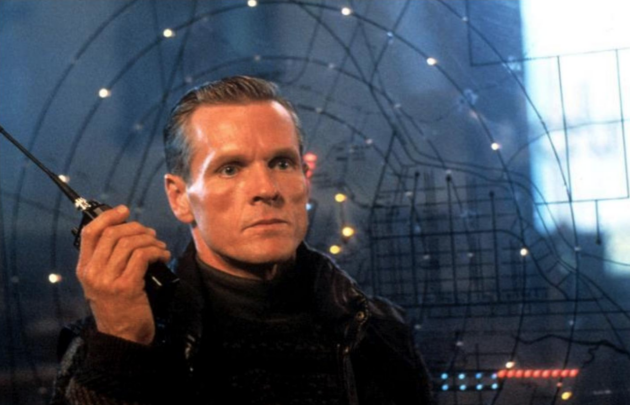 Razor-sharp and dangerous
1. Die Hard
What happens: On Christmas Eve in Los Angeles, John McClane heads to the Nakatomi Plaza to reconcile with his wife. But bad luck strikes: terrorists led by the charismatic Hans Gruber seize the skyscraper and lock down the building to steal the loot hidden in a safe.
McClane, who had quietly settled into his hotel room, ends up climbing floor by floor, fighting Gruber’s crew as the stakes escalate. There’s Beethoven, flying glass, and a cascade of delicious twists, until McClane finally brings Gruber to his demise from the top of the tower. That’s what Christmas spirit is all about.
Why it’s an absolute masterpiece: It’s the Matrix, the jewel in the crown, the film that many argue propelled the action genre into a new era. And they’re probably right. Die Hard is the quintessential piece where everything clicked—if it was originally meant to be a Commando sequel before Schwarzenegger declined, the chaotic production never sullied the talent of John McTiernan and his team.
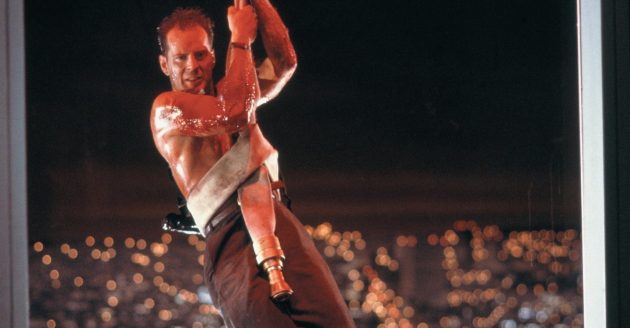 It swings!
One could point to the perfectly balanced humor or to Willis’s breakout performance that cemented his legend. But none of that would matter without the surgical precision of its direction. McTiernan treats his metallic setting like a piece of modern art, playing with lines and the geography of space to craft a staging of unparalleled clarity.
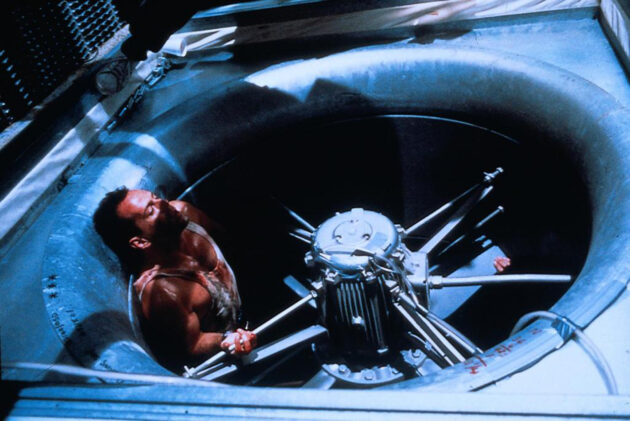 A pristine piece of staging!
Why there’s almost nothing to fault (or nearly):
While no film is flawless, our skepticism compels us to only fault Die Hard for the subgenre it inspired. From Speed to Speed 2: Cruise Control, to Air Force One and White House Down, action cinema has, at times, overeaten the closed-quarters motif—sometimes to great effect, often not.
And indeed, the fact that the main Die Hard film of the 2010s is Skyscraper with Dwayne Johnson is a telling indicator of the era we’re in.
