Police Everywhere, Justice… in Rare Places
There may be in Dossier 137 only a desire to capture a certain mood of the times, and the ferment that was the Yellow Vests movement. Make no mistake, this is already one of the film’s admirable qualities, whose meticulously calibrated editing places the weight of imagery at the center of this struggle, between photos and videos, fake or real archives. The mosaic of frames, testimony, and the looks Dominik Moll focuses on reconstructs with deft precision a generalized outcry from the French public and the fear of a government that has tasked the police with “to save the Republic”.
But above all, the filmmaker depicts the early politicization of youth in this highly specific context, and how these people view democracy’s gains colliding with a wall. “Why does everyone hate the police?” naïvely asks Stéphanie’s son, an IGPN investigator who has a hard time contradicting the opposite. Despite the biases he carries (she and her ex-husband spent twenty years in the narcotics division), she seeks to clean up the ranks where systemic violence and impunity have taken a central place.
This perfectly captured ferment would nonetheless be nothing without the director’s true program, which pits the notion of image against that of reality. The image is first the one the police project, protected by institutions and unions that ultimately seek to defend only this already cracked facade. The image is also Guillaume Girard’s, the teenager struck in the head by an LBD round, who will bear lifelong injuries.
From there, how does one reconstruct the reality of what happened? With images. On this point, Moll’s staging translates as much the characters’ growing obsession as their focus, by layering their eyes or their hands over computer screens typing emails or requesting access to surveillance cameras.

The Peace of the Brave (-M)
In the minutiae of this laborious bureaucracy, the director emphasizes a methodology and a seriousness that, unfortunately, reveal exploitable weaknesses as well. Ironically, images as symbols of neutrality are turned against themselves. Regularly, Moll, like Stéphanie, looks for the sidestep and the off-framing—the angles that will reassemble the puzzle without any ambiguity. In fact, every angle is questioned, decontextualized, tied to a point of view, as ridiculous as the lie or the justification may be.
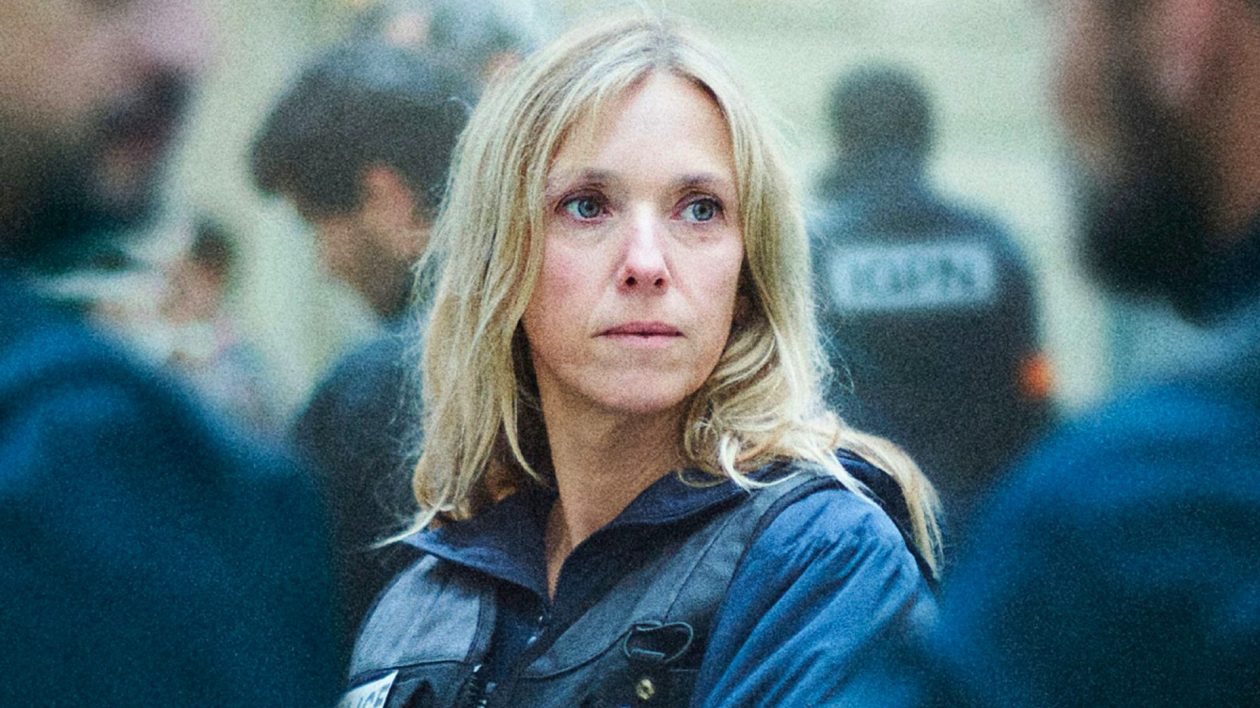
The image, too, is what Stéphanie seeks. Léa Drucker is wonderful in this role, imposing a coldness and a tenacity constantly contrasted by her eyes, whose slight movements betray a humanity, an increasing absence of detachment, and a potential crack. Behind her polished rhetoric about the need to trust the police, how can one make sense of a role of which she is aware there is little impact?

