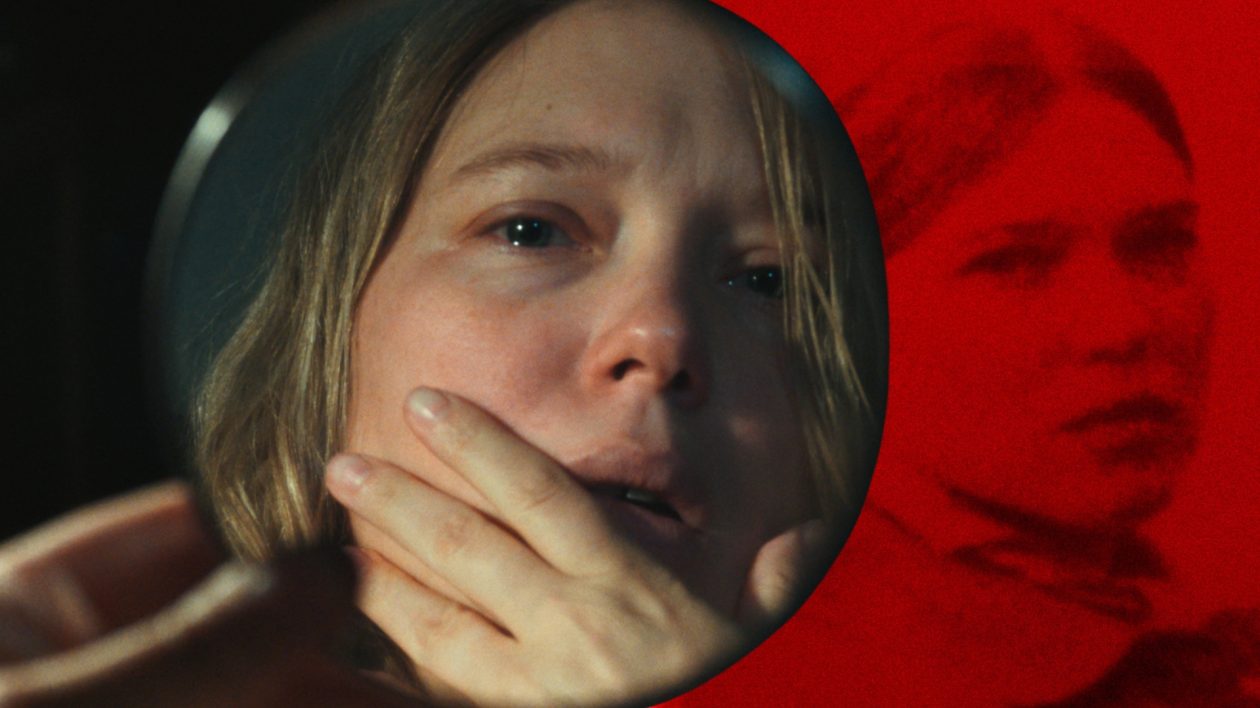
Écran Large is back on the Croisette for the 2026 Cannes Film Festival. And it’s time to revisit L’Inconnue, a strange fantastical thriller starring Léa Seydoux.
The director and screenwriter Arthur Harari has already had the chance to premiere a Cannes film in 2021 with the remarkable Onoda: 10,000 Nights in the Jungle. Five years later, there remains confusion about his opening-slot in the Un Certain Regard section, a placement he could have deserved in competition (even the Palme d’Or that year). He even effectively earned Cannes’ supreme glory as the co-screenwriter of Anatomy of a Fall by Justine Triet (his life partner), the 2023 Palme d’Or winner.
Will the filmmaker bring a second one home? That is certainly his aim, as he is once again in competition with L’Inconnue, an adaptation of the graphic novel The David Zimmerman Case co-written by his brother Lucas Harari.
Troubling Unknown
What’s it about? The photographer David Zimmerman, 40. One day, he photographs a mysterious woman who obsessively haunts him. A few weeks later, he unexpectedly finds her again at a party. The two study each other, connect, and sleep together. Hours later, David Zimmerman wakes up inside the body of that very unknown woman. He tries to understand what happened to him.
How’s it looking? L’Inconnue opens with a subjective shot where the audience, inhabiting the body of a then-unknown character, drives a car in the Paris suburbs. In the very next shot, outside the vehicle and merely an observer, the character’s identity is laid bare — it’s David Zimmerman, a photographer portrayed by a barely recognizable Niels Schneider (a transformation that feels ahead of its time in real life). The cinematic choice was brief, but just one moment is enough to trigger a (con)scious unease in viewers.
The direction by Arthur Harari stands as one of the film’s most striking achievements. It isn’t a surprise given his two previous features, but the filmmaker manages to provoke wild sensations with his simple camera. Whether it’s a long zoom into a negative (foreshadowing a plunge into the abyss), a phantasmagoric pursuit, a visceral sex scene, or an awkward conversation, his direction is highly visceral, often unsettling and uncomfortable, creating a hypnotic vertigo for the 2 hours and 19 minutes.

The tour de force undoubtedly resides in the film’s first hour, almost mute. David Zimmerman (now inhabiting the body of a mysterious unknown) investigates, worries about his discoveries, questions how events might unfold, and simultaneously re-examines his past (and present) with a fresh eye and a new identity. A playful game, with hero and audience moving at the same pace, both tender, anxious, cruel, manipulative, sometimes even perverse, luminous and powerful even in its restraint.
But the fantastical premise, which Harari studies through an ultra-realistic lens (no need for visual effects, just curious bodies), is only a pretext for a more troubling exploration of Identity (with a capital I), all the more so as his camera regularly embraces different viewpoints and sensations.

New Body, Same Identity
What is our identity? Where does it end? Our soul? Our body? Or both, inseparably linked forever? Is it possible to lose it? To change it? The questions abound before L’Inconnue, whose meditation on the topic is both intimate (rape, suicide, memories, trauma, transition…) and universal. Arthur Harari indeed explores as much the mutation of bodies and the evolution of minds as the evolution of spaces through time, which David Zimmerman works to document in a photo series tied to his father and grandfather.
He elaborated on this in an interview available on the festival’s official site :
“Fiction allowed us to question what travel can do. To answer questions that children ask themselves at moments: Why was I born into this family, of this father and this mother, in this body? Why am I here, in this city? And if I were somewhere else? And if I had been a woman? In the end, it all doesn’t make sense; all of this is so strange. Fiction enables this displacement, and it is incredibly productive.”

The end result is consistent with the filmmaker’s words. And on top of that, it features stunning photography (the work of his brother Tom Harari is still amazing), a superb Schneider-Seydoux pairing, and a mesmerizing score (including a standout three-note motif) by Andrea Poggio, Enrico Gabrielli, and Tommaso Colliva. L’Inconnue lingers in the mind long after. Its atmospheric approach will divide opinions, no doubt, but its singularity makes it a fascinating object of cinema, one hopes to see it honored on the festival’s roster.
And when does it come out? On August 26 in French theaters courtesy of Pathé Films
