THE ETERNAL RETURN
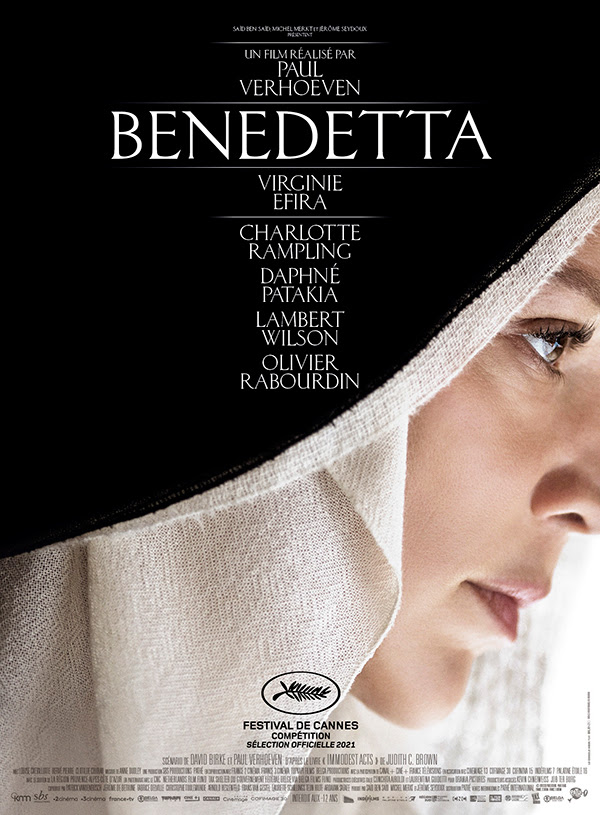
Why wait so long, and weather against wind and tide to give the film the Cannes showcase? Perhaps because, stripped of the polish of official competition, Verhoeven’s latest effort would have had a hard time concealing the director’s own shipwreck. A verdict all the more bitter since this tale of contest, manipulation and sexual emancipation bore the fingerprints of a scorching synthesis of the themes, motifs, and obsessions that have threaded his career.
The Flesh and the Blood subverted medieval representations to narrate a transfer of power that is both carnal and sexual. RoboCop was, in itself, a Christ-like figure rebelling against the catechism of its creators. Total Recall constantly probed the faith of the audience as well as that of its characters, compelled to decide what deserved to be believed. Black Book as well as Showgirls embraced the fates of women colliding with the power of sex and the sex of power.
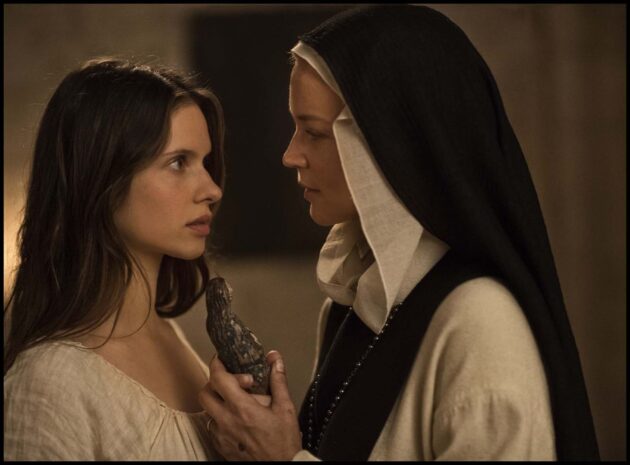
Consequently, the mystico-political mutiny of a lesbian nun determined to seize power over her sisters and the men around her appeared as a near-perfect fusion of Verhoeven’s world, which would obviously inject into this lavish program his Machiavellian approach to vulgarity, an approach he has long used as a tool of power, if not his true nature. In the end, there isn’t much left of those ingredients.
IT’S A PARTY AT MY PRIEST
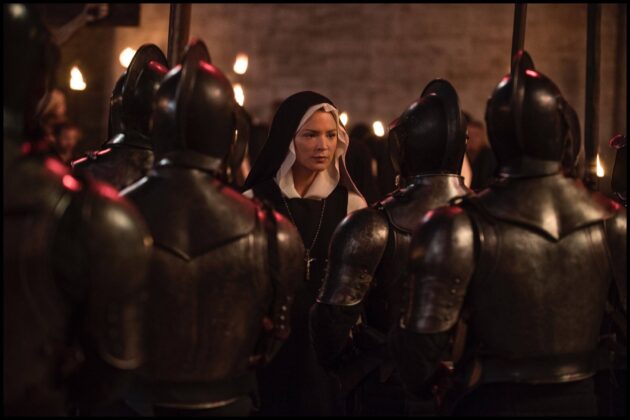
The director’s style hasn’t sharpened so much as dried out. It’s hard to find in his precise cutting the slightest trace of the raw, brisk style that used to define him, with the staging typically opting for vaguely trembly medium shots, utterly unable to bring out the unease the characters claim. And when the colors lighten, it’s to deliver a warmed-over retread of Mario Bava’s heyday, smeared with shockingly brazen color grading.
This soulless staging often drags the film toward the edges of ridicule, when a Christ escaped from a bad porno appears, and here a miserable pastiche of The Devils or Ken Russell’s Altered States. Not only does the artist’s eye seem dulled, but it also fails to mask the budget’s limits, so that the production design leans more toward a theme-park Italianate vibe than Florentine costs.
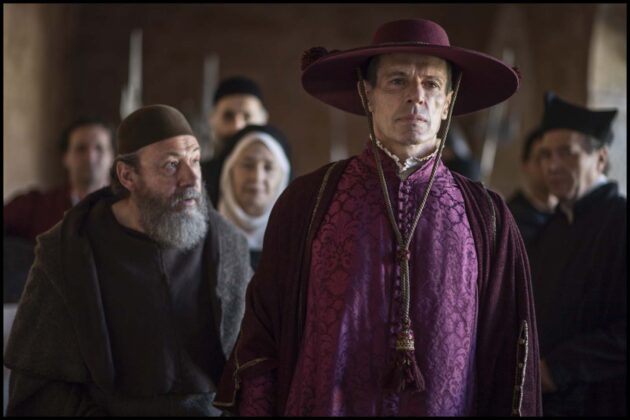
Thus, it’s hard not to notice the stumbles that keep the setup from working. Whether it’s dialogue with a sometimes opaque construction (the mystic gobbledygook around Christ is a perfect example) or genuine acting-direction problems. The cast never quite coheres into a unified whole, some delivering a modern, even anachronistic tempo, others remaining mired in period-piece stereotypes, to the detriment of any coherence, as evidenced by the gasp-worthy opening sequence that lingers like a Robins des Bois pastiche.
CALF LIVER
If there is one domain where we hoped Verhoeven would shine, it was the depiction of sexuality, a persistent battlefield for the filmmaker, the incarnate expression of his characters’ stakes. Unfortunately, there is neither disturbance nor audacity here, not even erotica, but a showcase of a gallery of childish fantasies, shot in a dull, daylight-lit manner. It’s as if an aging, viagra-driven uncle finally decided to document his Cap d’Agde vacation, between two games of bridge.
In this mess, the poor Virginie Efira does all she can, delivering a number reminiscent of The Miel et les Abeilles infused with a solid dose of butt shots and a convincing imitation of The Exorcist. Does that mean the director aimed to de-sacralize even the audience’s expectations and to mock the very genre in which he works?
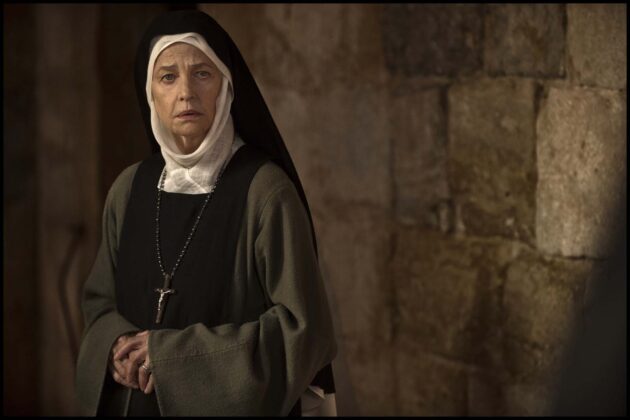
Perhaps, but in doing so, he lacks so much finesse that he completely misses the target. The target grows fuzzier when, on top of a craftsmanship that feels less than Max Pécas, there are a few well-honed humorous lines that intensify the sense of artistic suicide pervading Benedetta. Between the involuntary gags and the punchline duels led by Charlotte Rampling and Lambert Wilson, the ridiculousness falls more often than not.
HOSTILE NUN
The most aggravating thing isn’t so much discovering Verhoeven’s first truly failed film, but realizing how a handful of ideas, sequences, or lines hint at another, stronger and more complex movie. In this light, it’s particularly telling that Benedetta is still discussed in terms of its alleged religious provocation, when that dimension is absent from the film.
Indeed, from the opening minutes it’s taken for granted that no clergy believes and that everyone is there to secure a social position, to assert a power ambition, effectively turning the story from an anti-clerical charge into an allegory of politics and of our relationship to faith, and above all faith in spectacle. The director, obsessed with the figure of Christ (to which he even dedicated a six-hundred-page book), seems intent on probing our grotesque relationship to belief.
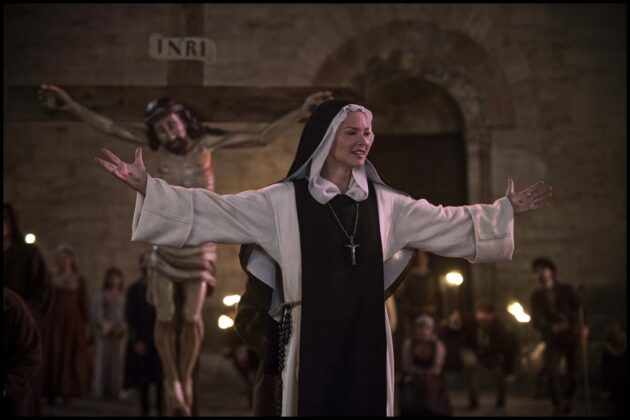
Indeed, with its pin-pointed or contested miracles, the feature frontloads these questions (on paper). Alongside, it would like far too rarely to scratch the European cultural varnish to interrogate its ruins or female symbols, to reclaim their pagan power. But all of this remains too poorly executed, despite the remarkable performances by Wilson and Rampling. They alone prove capable of electrifying the narrative, offering in its final minutes a handful of striking turns. Autant de réussites anecdotiques mais bien réelles, qui témoignent de ce que faillit accomplir Paul Verhoeven.