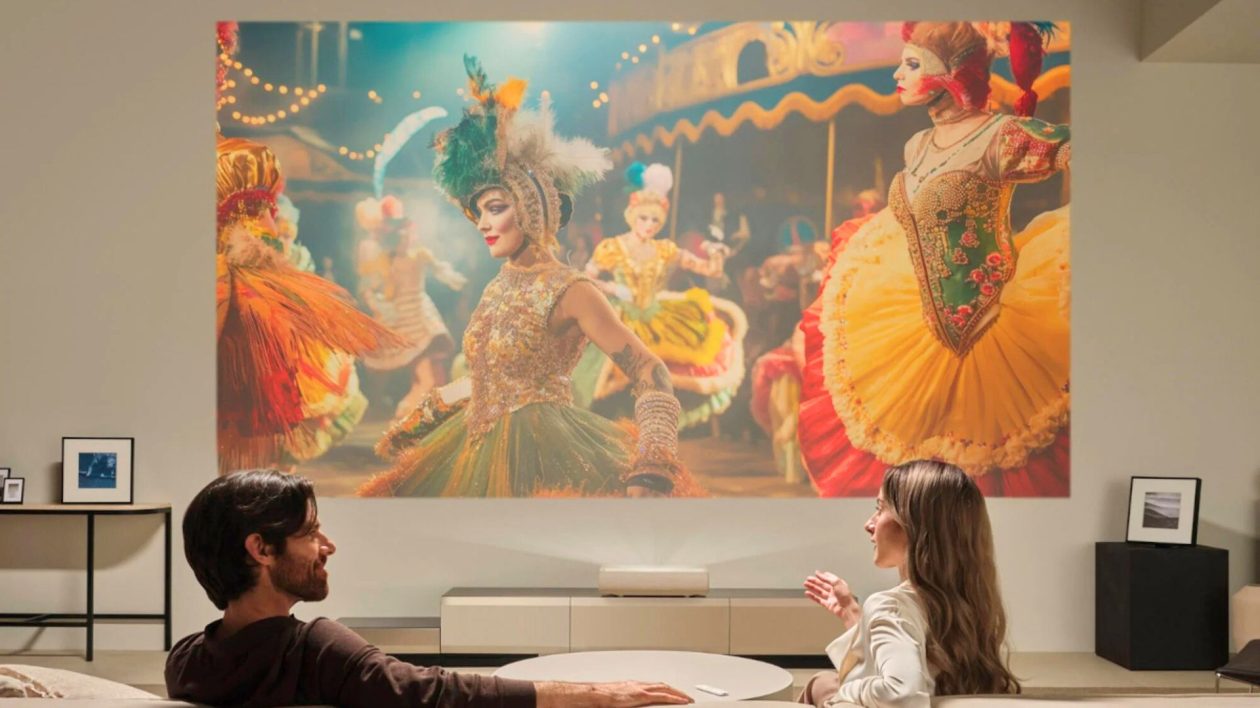
Equipped with exceptional technical features, these ultra-short-throw projectors could well outshine traditional TV screens.
For several years now, ultra-short-throw projectors — often abbreviated as UST for ultra short throw — have established themselves as serious competitors to premium televisions, delivering a larger image without hogging space when powered down. They have honed their craft by offering increasingly advanced technologies, increasingly immersive audio, and a wealth of entertainment-focused features.
Thanks to their placement at the foot of the projection screen, these devices can project an image with breathtaking precision, usually in 4K UHD (though it’s important to distinguish true 4K from “fake” 4K), while providing visual comfort that is far gentler on the eyes than a TV, especially on large diagonals beyond 100 inches. Here are nine ultra-short-throw projectors that could seriously threaten the current TV screens, and perhaps even take the place of yours. This selection will evolve over time.
- The easiest ultra-short-throw projector to carry: Optoma Photon Go.
- The entry-level ultra-short-throw projector for beginners: Samsung The Premiere SP-LPU7D.
- The best value for money ultra-short-throw: Hisense PX3-Pro.
- The most compact ultra-short-throw: JMGO O2S Ultra.
- The most versatile ultra-short-throw: XGIMI Aura 2.
- The purist’s ultra-short-throw: Formovie Theater Premium.
- The gaming-ready ultra-short-throw: AWOL Aetherion Max.
- The comfortable-budget ultra-short-throw: Samsung The Premiere SP-LPU9D.
- The ultra-short-throw with the finest optics: Leica Cine 1.
Optoma Photon Go: the UST that can follow you almost anywhere
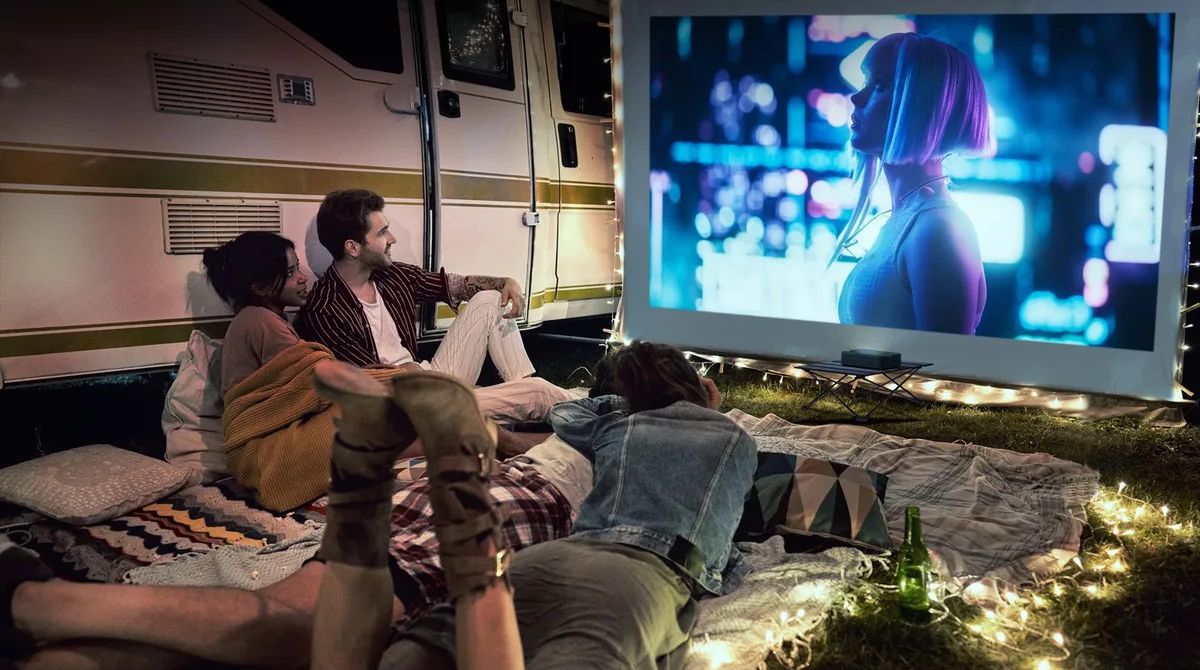
Among the most distinctive models on the UST projector market, the Optoma Photon Go clearly stands out. It offers a unique concept in this segment: combining ultra-short focus, a triple RGB laser, and an internal battery in a compact footprint. If we previously thought UST was limited to the living room, Optoma is here to prove otherwise.
Currently available at a very approachable price (roughly €549 on major retailers), it can rely on a 1.5-hour video playback autonomy, automatic adjustment features (focus, keystone correction), and a featherweight of 1.72 kg to simplify use. No extension cable needed: you just set up and enjoy the show.
On the downside, it does come with several drawbacks compared to more traditional USTs, such as its relatively low brightness (only 650 ISO lumens), Full HD resolution only, and the absence of HDR10+ and Dolby Vision formats. Some trade-offs were inevitable…
Optoma Photon Go technical specifications:
- Projection technology: DLP / triple laser RGB
- Resolution: 1920 x 1080p (Full HD) / compatible with 4K UHD
- Brightness: 650 lumens ISO
- Native contrast: 800:1
- Throw ratio: 0.18:1
- Input lag: 27.1 ms in Full HD / 60 Hz
- Operating system: Google TV
- HDR formats: HDR10 / HLG
- Light source life: 20,000 hours
- Audio system: 2 x 10 W (Dolby Audio compatible)
- Release year: 2025
Samsung The Premiere SP-LPU7D: easy 4K UST for everyday use

If you’re in the market for the more “classic” ultra-short-throw projectors and your wallet is willing, some manufacturers offer comparatively approachable options that are easy for non-enthusiasts to pick up.
The Premiere SP-LPU7D is a prime example, delivering a stunning 4K UHD image and a brightness of 2,400 ANSI lumens from a DLP laser, enough for a moderately lit living room. Among its standout features are a built-in 2.2-channel 30 W soundbar (Dolby Atmos compatible), and an OS Tizen that’s as feature-rich as Samsung’s TVs, while the projector’s modern, understated design helps it blend into most decors.
That said, this model falls short in terms of contrast, HDR handling, and factory calibration. But at this price point, you can’t expect everything…
Samsung The Premiere SP-LPU7D ultra-short-throw specifications:
- Projection technology: DLP / laser
- Resolution: 3840 x 2160p (4K UHD)
- Brightness: 2,400 ANSI lumens
- Native contrast: 1,000:1
- Throw ratio: NC (approx. 0.2:1)
- Input lag: NC
- Operating system: Tizen OS
- HDR formats: HDR10+ / HLG
- Light source life: 20,000 hours
- Speaker system: 30 W
- Release year: 2024
Leica Cine 1: a premium lens for comfortable budgets

Think you’ve seen everything Samsung’s The Premiere lineup has to offer? Think again—Leica Cine 1 raises the bar even higher, and it would be a pity not to mention it.
Indeed, this exceptional model delivers true 4K image quality thanks to its triple RGB laser and a 0.47-inch DMD chip. With a respectable 3,000 ANSI lumens and the iconic Leica Summicron lens, paired with support for major HDR formats, it offers cinema-like immersion — for a price.
The snag: at around €9,000, the Cine 1 is by far the most expensive model in this selection. It also features comparatively modest native contrast (1,000:1), a measured input lag of 35 ms for gaming, and HDMI 2.1 ports that cap 4K at 60 Hz. It’s also quite heavy (nearly 15 kg) and uses an aging platform inherited from the 2022 Hisense L9G. Some drawbacks had to be pointed out…
Leica Cine 1 Ultra-Short-Throw Specifications:
- Projection technology: DLP / triple laser RGB
- Resolution: 3840 x 2160p (4K UHD)
- Brightness: 3,000 ANSI lumens
- Native contrast: 1,000:1
- Throw ratio: 0.25:1
- Input lag: 35.3 ms in game mode
- Operating system: Google TV
- HDR formats: HDR10 / HDR10+ / HLG / Dolby Vision
- Light source life: 25,000 hours
- Audio system: 2 x 25 W (Dolby Atmos compatible)
- Release year: 2023
Short throw or long throw: which type of projector should you choose?
That largely depends on how you’ll use it and your budget: if you plan to use your projector in a small room, a short-throw model is usually best because you can place it at the foot of the screen. It’s also easier to install than a long-throw projector, even though it tends to cost more.
If you have a bit more space but a tighter budget, a long-throw device is worth considering for projecting larger images at a lower price. However, you’ll face somewhat more fiddly adjustments, and shadows can appear if someone passes in front of the beam.
What are the advantages and disadvantages of ultra-short-throw projectors?
Ultra-short-throw models are designed for sedentary use, delivering excellent brightness and considerably better sound than typical projectors. This Son-Vidéo review of the Epson EH-LS800 even suggests some manufacturers market these as “Laser TVs” with integrated soundbars. Nevertheless, they are also significantly more expensive than long-throw projectors, and their fans can be louder due to the heat generated by their higher power.
You’ll also want to invest in a dedicated projection screen (ALR or CLR, preferably—see our guide on this) since even a wall surface can introduce image distortions. Also, screens designed for UST projectors can noticeably improve image quality, as demonstrated by the excellent NothingProjector Black Series we tested.
How much does an ultra-short-throw projector cost in 2026?
Prices for ultra-short-throw projectors vary widely depending on features such as display technology and included capabilities. Still, you can categorize them into three broad price ranges:
- Entry-level under €1,500 (for example the Samsung The Premiere SP-LPU7D), which lets buyers dip their toes into the ultra-short-throw world without completely breaking the bank. It’s a steep price for sure, but it’s the minimum for a decent model in this sophisticated category.
- Mid-range under €3,000 (for example the XGIMI Aura 2), which stands out for its design and the higher performance found here compared with the previous tier. You’ll typically get a triple laser with brighter output and deeper contrasts than a basic LED-based DLP.
- High-end over €3,000 (for example the Samsung The Premiere SP-LPU9D), delivering exceptional performance and versatility that should satisfy all audiences.
Why are UST projectors more expensive?
They are generally as powerful (or more) than long-throw projectors — with higher brightness, true 4K on most 2026 models — and they also pack better built-in speakers, as well as specialized lenses. The ultra-short-throw designs require a very precise, bespoke engineering that contributes to their higher price. However, the exact price varies widely from brand to brand depending on technical specifications and included features.
What is the typical lifespan of an ultra-short-throw projector?
The lifespan depends on several factors, especially the light source:
- Laser: typically the longest-lasting, with a lifespan of around 20,000 to 30,000 hours. Moreover, brightness hardly diminishes over time, and there’s no lamp replacement.
- LED: can also last around 20,000 to 30,000 hours, while consuming very little energy but offering lower brightness.
- Traditional lamp (the so-called “UHP”): the least economical choice in terms of maintenance because it must be replaced after roughly 3,000 to 6,000 hours of use. A loss of brightness can also occur over time, which is why most manufacturers have gradually shifted toward LED or laser.
Also, you’ll want to ensure the projector doesn’t overheat by cleaning it regularly to prevent dust from clogging fans, avoid using damaged power cables, and update firmware as needed. Following these tips will help prevent breakdowns or premature wear.
Which technical features really matter?
To make sure you choose wisely, it helps to know the main technical features that distinguish different ultra-short-throw projectors. Among them are:
- Native resolution, typically 4K UHD (3840 x 2160) or 8K (7680 x 4320) — though 8K remains quite rare for the latest generation of projectors.
- Image size (minimum and maximum), taking into account your projection screen’s dimensions.
- Brightness, usually defined in ANSI or ISO lumens, and important to know relative to how you plan to use the projector.
- Projection technology — options include DLP, LCD, and laser (the latter being most common in ultra-short-throw projectors).
- Projection distance, to know how far from the screen (or wall) you should place the projector.
- Contrast ratio, which determines the difference in brightness between dark and bright parts of the image. The higher, the more immersive the image.
